Showing Posts From
Technical
-
 Editorial Team
 - 14 Jul, 2026
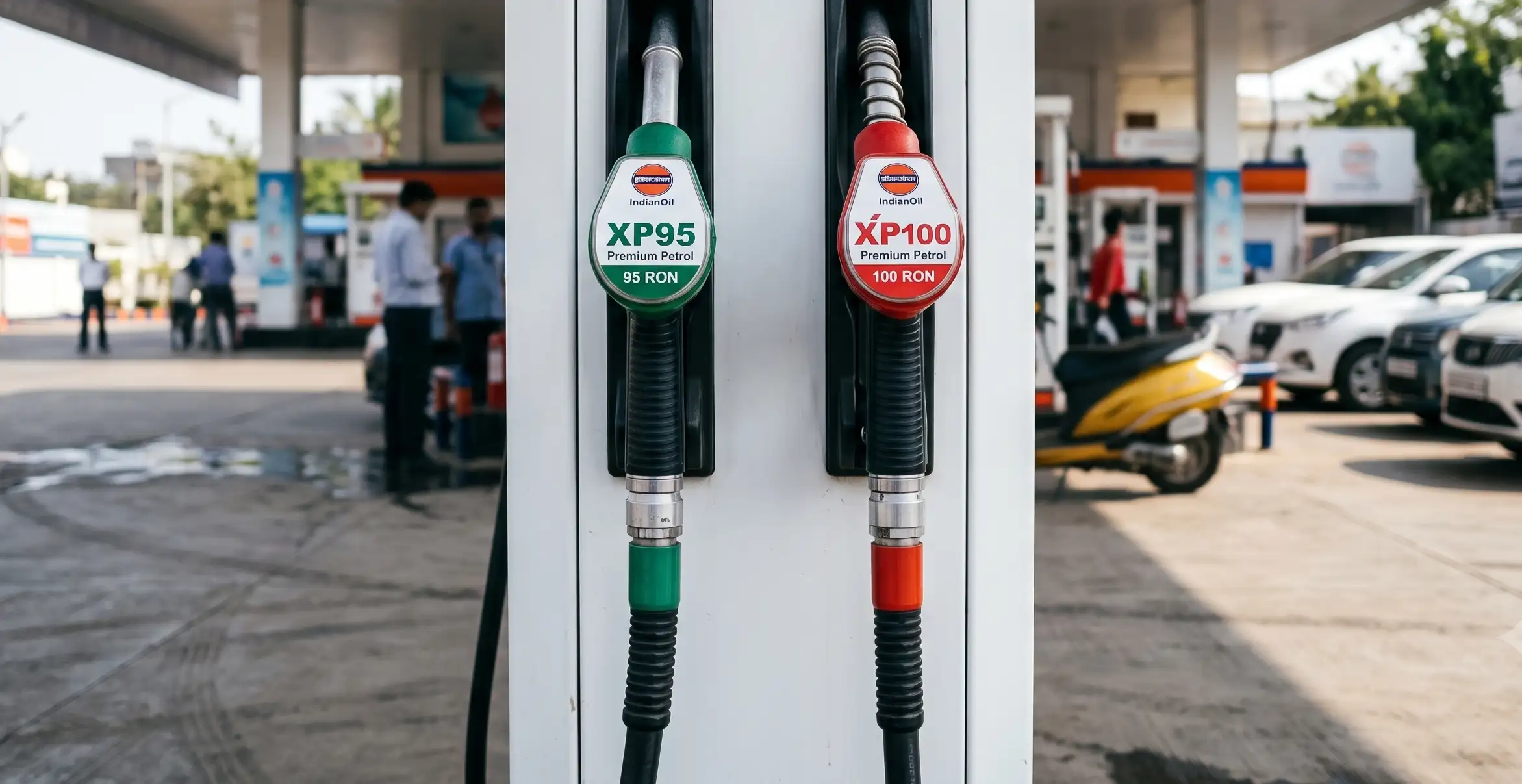
XP95 vs XP100, Which Petrol Is Right for Your Vehicle?
The most common question we see from Indian vehicle owners right now is a variation of this: "I heard XP95 is better than regular petrol. And is XP100 the one without ethanol? Should I be using that instead?" Both questions are understandable. Both usually get incomplete answers. XP95 and XP100 are sold side by side at IndianOil pumps, both carry the word "premium," both cost more than regular petrol, and both have been mentioned in the same breath as E20 confusion. But they are chemically different products built on different refining technologies, priced for different markets, and designed for engines that have almost nothing in common. This article separates the facts from the marketing. By the end, you will know exactly what is in each fuel, which engine types benefit from each, what you are actually paying for, and the one scenario where XP100 matters to riders and drivers who have never considered it before. Table of ContentsWhat XP95 Actually Is, and What It Is Not What XP100 Actually Is, the Ethanol-Free Fuel How RON Works and Why It Matters for Your Engine Which Vehicles Benefit from XP95 Which Vehicles Benefit from XP100 The Price Reality, What You Are Actually Paying For Where to Find XP100, and Why It Is Hard to Find SourcesWhat XP95 Actually Is, and What It Is Not XP95 is IndianOil's standard premium petrol grade. It carries a minimum Research Octane Number of 95 RON and is blended with approximately 20% anhydrous ethanol by volume. It is, in precise chemical terms, an E20 fuel, identical in ethanol concentration to regular petrol at the pump. This is not a speculation or an inference. An IndianOil RTI response confirmed it. Independent gas chromatography testing of IOCL's XP95, conducted per the ASTM D4815 standard and reported by Autocar India, found an ethanol content of 19.88% by volume. The regular petrol tested in the same batch showed 20.86%. The ethanol concentration in both fuels is effectively identical. What XP95 has that regular petrol does not is a proprietary additive package. The additives include advanced friction modifiers, corrosion inhibitors, and detergent compounds that IOCL claims deliver a 3.95% improvement in fuel economy, a 4% increase in power output, and a 20.15% improvement in acceleration compared to unadditised 91 RON fuel. These are IOCL's own figures from their official XP95 product page. The higher RON is achieved through the ethanol content itself, ethanol has a naturally high octane rating of approximately 108.5 RON, and at a 20% blend concentration it raises the overall anti-knock index of the fuel. What XP95 is not: it is not ethanol-reduced, it is not a protection fuel for BS4 or older vehicles, and it is not safer than regular petrol for fuel systems that are incompatible with ethanol. XP95 and regular E20 petrol carry the same ethanol load. The difference is in additives and octane, not in ethanol content. What XP100 Actually Is, the Ethanol-Free Fuel XP100 is a fundamentally different product. It is India's only commercially available 100 RON petrol and the only ethanol-free (E0) fuel available at standard retail pumps. Independent testing of IOCL's XP100 found an ethanol content of less than 0.2% by volume, effectively zero. Instead of ethanol, XP100 uses Methyl Tertiary-Butyl Ether (MTBE) as its primary oxygenate, at approximately 12.38% by volume. MTBE is a synthetic ether manufactured from methanol and isobutylene. Its pure RON ranges between 115 and 135, which is why even at a 12.38% blend concentration it can elevate the finished fuel to 100 RON. Unlike ethanol, MTBE does not absorb atmospheric moisture. It has low water solubility (approximately 4.2% by weight at saturation), does not form the ethanol-water azeotrope that triggers phase separation, and does not cause the elastomer degradation that makes ethanol problematic in older fuel systems. The production of XP100 depends on IOCL's proprietary Octamax technology, a refining process developed entirely by IndianOil's R&D Centre and commissioned at the Mathura Refinery in January 2018. The Octamax process converts C4 hydrocarbon streams (butanes and butylenes, byproducts of Fluid Catalytic Cracking units) into an ultra-high-octane gasoline blending component with a blending RON above 120. The first samples from the Mathura unit yielded a blending octane of 118, above the guaranteed 108 baseline. IOCL's R&D team won the National Technology Award in 2022 for this process under the category "Successful Commercialization of Indigenous Technology." The practical consequence of MTBE over ethanol for the vehicle owner: XP100 does not degrade in underground storage tanks at low-turnover stations the way ethanol-blended fuel does. It does not corrode nitrile rubber seals. It does not trigger phase separation during monsoon humidity spikes. And it carries more energy per litre than E20 blends, because it does not dilute the hydrocarbon base with the lower-caloric-value ethanol. How RON Works and Why It Matters for Your Engine RON, Research Octane Number, measures a fuel's resistance to auto-ignition under compression. In an internal combustion engine, the air-fuel mixture is compressed before the spark plug fires. A fuel that ignites prematurely from heat and pressure alone, before the spark, creates opposing pressure waves inside the cylinder. This is engine knock, or detonation. Prolonged detonation damages pistons, connecting rods, and valves. Modern engines, particularly turbocharged ones, are managed by ECUs that listen for knock via acoustic sensors. The moment knock is detected, the ECU retards ignition timing, firing the spark plug later in the compression stroke to prevent the fuel from auto-igniting. Retarded timing protects the engine but sacrifices efficiency: the combustion gases push on the piston at a less optimal angle, delivering less energy to the crankshaft. The engine produces less power and consumes more fuel to compensate. This is why RON matters. A higher-RON fuel gives the ECU more headroom before knock occurs. The ECU can maintain, or even advance, ignition timing, extracting more work from each combustion cycle. For engines specifically calibrated to use this headroom (high-compression, turbocharged engines with aggressive ECU maps), the difference between 91 RON, 95 RON, and 100 RON is a tangible performance and efficiency variable. For engines that are not calibrated to use the headroom, naturally aspirated, low-compression engines in commuter bikes and entry-level cars, using a higher RON fuel provides no measurable benefit. The ECU simply does not advance timing further than its calibrated limit, regardless of how much knock resistance the fuel offers. Standard petrol in India moved from 91 RON to a minimum of 95 RON with the E20 mandate from April 2026. Every fuel at the pump, including regular petrol, is now at least 95 RON. XP95 is 95 RON. XP100 is 100 RON. Which Vehicles Benefit from XP95 XP95 is the right fuel for the majority of modern Indian vehicles, with one important clarification. It delivers measurable value specifically to turbocharged petrol engines manufactured after April 2020 (BS6 Phase 1 and Phase 2). These engines have ECUs calibrated to use 95 RON fuel and will advance ignition timing optimally. The additives in XP95 provide genuine injector cleaning benefit for GDI engines, which accumulate carbon deposits faster than port-injection engines because fuel does not wash the intake valves. Team-BHP long-term testing of XP95 in a Skoda Slavia 1.5L DSG showed average urban fuel returns of 7.5 to 8.5 km/l, a measurable improvement over equivalent figures on standard 91 RON fuel in pre-E20 testing. Users of the Hyundai Creta 1.4 T-GDI, Tata Nexon 1.2 Turbo, and VW Taigun 1.0 TSI report similar patterns: smoother idle, reduced vibration under hard acceleration, and slightly better highway mileage compared to standard petrol. For motorcycles, XP95 is appropriate for BS6 Phase 2 bikes and high-compression single-cylinder performance bikes (KTM Duke 390, Bajaj Dominar 400, Royal Enfield 650 Twins, Suzuki Gixxer SF 250). These engines have ECUs that can use 95 RON effectively. XP95's detergent package also helps slow injector fouling on performance bikes that see high-RPM use. What XP95 does not do: it does not protect older fuel system components from ethanol degradation. A BS4 bike or a pre-2023 car running on XP95 is running on 20% ethanol, the same as regular petrol. The additive package does not neutralise ethanol's solvent effect on nitrile rubber, nor does it prevent phase separation. If your motivation for switching to XP95 is to reduce ethanol exposure, XP95 does not solve that problem. Which Vehicles Benefit from XP100 XP100's legitimate use cases are narrower and more specific than its pricing suggests. The first and most commercially significant case is high-compression performance vehicles. Cars like the Porsche 718 Cayman, BMW M-series, Audi RS models, and Volkswagen's EA888 Evo4-equipped models (Skoda Kodiaq, Octavia RS) frequently specify a minimum of 98 RON in the owner manual. Running these on E20 95 RON fuel forces the ECU into a double penalty: timing retardation from insufficient knock resistance, plus lower energy density from the ethanol content. XP100's 100 RON removes the first penalty and its E0 composition removes the second. Team-BHP testing in a Skoda Kodiaq reported efficiency figures jumping from 8.5 km/l on XP95 to over 10.2 km/l, and up to 13.9 km/l in light traffic, on XP100. These gains reflect the ECU recovering thermal energy that was previously being wasted through retarded timing. The second case is vintage and classic motorcycles and cars. Vehicles manufactured before approximately 2000, Royal Enfield Bullets of the iron-barrel era, Yezdi, Rajdoot, classic Ambassadors, imported classics, have fuel system components that predate any ethanol compatibility requirement. Nitrile rubber seals, untreated steel fuel tanks with original coatings, carburettor float bowls with zinc or magnesium alloys, and brass jets are all vulnerable to continuous E20 exposure. XP100 is the only commercially available pump fuel that provides E0 operation. For owners of these vehicles who cannot access E0 petrol through any other legitimate retail channel, XP100 is not a luxury, it is a preservation tool. The third case is long-term vehicle storage. Phase separation is the specific risk when a vehicle sits with an E20 tank for weeks or months. Ethanol absorbs moisture from the headspace, the concentration crosses the phase separation threshold, and a water-ethanol layer accumulates at the tank bottom. On recommissioning, this layer enters the fuel system with predictable damage. Filling a tank with XP100 before extended storage eliminates this risk because MTBE does not absorb atmospheric moisture the way ethanol does. One pattern documented in automotive forums is the "3:1 method": three refuels on regular E20 or XP95, one on XP100. This seeks to periodically flush accumulated ethanol residue from injectors and dilute the overall ethanol concentration across the fuel system without bearing the full cost of XP100 for every tank. It is not an OEM recommendation, but the chemistry of periodic flushing has a rational basis. What XP100 does not do: it provides no measurable benefit to naturally aspirated low-compression engines in commuter bikes (Hero Splendor, Honda Activa, Bajaj Pulsar 150) or standard sedans (Maruti Swift K12N, Hyundai Grand i10 1.2). These engines cannot advance timing further than their ECU's calibration ceiling, regardless of RON. Filling a Splendor with XP100 at Rs 160 per litre accomplishes nothing that regular petrol at Rs 105 does not, except drain your wallet. The Price Reality, What You Are Actually Paying For Fuel pricing in Pune in mid-2026 illustrates the economic gap clearly. Standard 91 RON petrol trades between Rs 103.82 and Rs 112.04 per litre. XP95 carries a Rs 3 to Rs 5 premium over standard petrol, placing it at approximately Rs 111.85 to Rs 115.66 per litre. XP100, unprotected by government price controls and burdened by Octamax process costs and imported MTBE, rose to Rs 160 to Rs 167.35 per litre following an Rs 11 single-day price hike triggered by global crude market volatility in early 2026. Check petrolprice.in for your city's current prices, these figures change with global crude and state VAT. For XP95, the cost-benefit is straightforward for turbocharged engines. The Rs 3 to Rs 5 premium per litre is partially or fully offset by the documented 3% to 4% mileage improvement in calibrated engines, and the long-term injector cleaning benefit reduces service costs. For naturally aspirated commuter engines, the premium buys nothing performance-related, though the additive package still provides some cleaning value. For XP100, the premium is 50% to 60% above standard petrol. For a high-performance car requiring 98+ RON, the calculation includes not just pump price but the mileage penalty of running the wrong fuel, an engine retarding timing and burning more E20 fuel may cost more per kilometre than XP100 at optimised timing. For a commuter bike or standard sedan, there is no legitimate cost justification. For a vintage vehicle owner using XP100 as a preservation measure, the cost is weighed against the cost of replacing corroded fuel system components, and corrosion typically costs more. One alternative that some enthusiasts attempt is aftermarket octane boosters, chemicals like Ferrocene, NMA (N-Methyl Aniline), or MMT added to XP95 to reach 100 RON equivalent. These do elevate the octane number but introduce metallic ash deposits on spark plugs, oxygen sensors, and catalytic converters. These deposits eventually trigger check-engine lights and require expensive sensor or catalyst replacement. Refinery-blended XP100 using ashless MTBE remains the only genuinely safe route to ultra-high octane at the pump. Where to Find XP100, and Why It Is Hard to Find XP100 is distributed exclusively through Company-Owned and Company-Operated (COCO) retail outlets, stations operated directly by IOCL rather than franchise dealers. This vertical integration allows IOCL to maintain quality control over a niche, high-value product and prevent adulteration. The trade-off is availability. In a country with over 100,000 fuel stations, XP100 is stocked at only a few hundred vetted locations. The practical implication is that finding XP100 requires planning. The most reliable official source is the Indian Oil One mobile application, which has a filter for XP100-stocked stations. In Pune, locations that the automotive community has mapped as consistent XP100 suppliers include Sure Petroleum in Erandwane and Sukhwani Petroleum in Wakad. Similar community-verified station lists exist on Reddit's r/pune and r/CarsIndia threads for other cities. Because XP100 is a low-turnover product at most stations, freshness is a genuine concern, not because MTBE degrades like ethanol does, but because any fuel sitting in a storage tank for months in adverse conditions can pick up trace contamination from the tank itself. Sticking to COCO pumps, which IOCL manages directly and which see higher accountability than franchise locations, is the practical mitigation. The Ethanol Fuel Finder on this site maps verified XP100 and HPCL Power 100 stations across India. HPCL's Power 100 is the direct equivalent of XP100 from a different OMC, 100 RON, E0, MTBE-based. BPCL's Speed 100 occupies the same category. If XP100 is unavailable near you, Power 100 or Speed 100 at an HPCL or BPCL COCO outlet is chemically equivalent. SourcesIOCL XP95, Official Product Page, IndianOil IOCL XP100 and Motorists Page, IndianOil How Much Ethanol Is in Your Petrol? Gas Chromatography Testing, Autocar India Even Premium XP95 Petrol Has 20% Ethanol, IOCL RTI Response, Cartoq Octamax Technology, IOCL R&D Leaflet, Mathura Refinery Commissioning IndianOil Commissions Octamax Unit at Mathura, Europétrole Experiencing 100 RON Fuel in My Skoda Kodiaq, Team-BHP Tried XP100 Petrol on My Slavia 1.5L DSG, Team-BHP High-Octane Petrol Prices Hiked, JM Financial Services, March 2026 E20 Petrol Row, What Is XP100, Is It Really Ethanol-Free?, LiveMint
- Editorial Team
- 13 Jul, 2026
Is XP100 Worth Using in a Standard Commuter Bike or Car?
When E20 confusion peaked after April 2026, XP100 went from being a niche product for supercar owners to a fuel that every BS4 bike owner started asking about. The reasoning was understandable: if regular petrol now has 20% ethanol and XP100 has none, should I be using XP100 to protect my older bike? The short answer is: it depends entirely on what engine you have, and for the majority of Indian riders and drivers, XP100 at Rs 160 per litre provides no measurable advantage over regular E20 at Rs 105. This article explains the engineering reason why, and the specific, narrow set of cases where XP100 does actually make sense. Table of ContentsWhy RON Only Helps If Your Engine Can Use It What Happens When You Put XP100 in a Splendor or Activa What About the Ethanol-Free Benefit for Commuter Bikes? Which Vehicles Are in the No-Benefit Zone The Cases Where XP100 Actually Makes Sense The Honest Cost Calculation SourcesWhy RON Only Helps If Your Engine Can Use It Every petrol engine has an ECU timing map, a set of instructions that tells the spark plug when to fire relative to the piston's position. This timing map is calibrated at the factory for a specific fuel grade. For most Indian commuter engines, that calibration is set conservatively, at or around 91 RON, because that was the standard fuel grade for decades. The ECU's job includes monitoring for engine knock via acoustic sensors. When knock occurs, the ECU retards timing as a protective measure. When the fuel's RON is high enough that knock does not occur at the engine's calibrated timing, the ECU simply holds at that calibrated timing, it does not advance further just because the fuel offers more knock resistance. This is the critical point. ECU timing advance is bounded at the top by the engine's mechanical design, not just by the fuel. A low-compression, naturally aspirated engine has a mechanical ceiling on useful ignition advance that the factory calibration already sits near. Providing 95 RON or 100 RON fuel to this engine does not push the ECU past that ceiling. The ECU sees that knock is not occurring, holds its calibrated timing, and nothing changes. The same power, the same mileage, the same combustion cycle, just a different fuel cost. What Happens When You Put XP100 in a Splendor or Activa Nothing measurable happens, in terms of performance or efficiency. A Hero Splendor 100cc engine has a compression ratio of approximately 9.5:1 and uses a simple carburettor. It was designed for 91 RON fuel and its carburettor jet sizing, needle position, and float level are calibrated for that fuel composition. There is no knock sensor, no ECU timing map, and no adaptive feedback mechanism. The engine will run on XP100. It will not knock on XP100. But it also will not produce more power, deliver better mileage, or clean its carburettor jets any better than it does on regular E20 petrol. The 100 RON anti-knock capability of XP100 is simply unused, the engine never approaches the conditions where additional knock resistance would matter. The Rs 55 per litre premium you pay for XP100 over regular petrol returns nothing. A Honda Activa 125 is a step up, fuel injected, BS6 Phase 2, slightly higher compression. But the ECU calibration for a 125cc scooter engine is still conservative. The factory timing map does not have aggressive advance that needs protecting. XP100 in an Activa returns the same result as in a Splendor: the engine runs fine, nothing improves. A Maruti Swift with the 1.2-litre K12N naturally aspirated engine is the four-wheeler equivalent. Compression ratio of 12.0:1, port fuel injection, no turbocharger. The K12N benefits from quality fuel and benefits from E20's 95 RON minimum, but it does not have the ECU headroom or the mechanical design to extract any additional value from 100 RON over 95 RON. IOCL's own framing of XP100 as a product for high-compression performance engines is implicitly an acknowledgement of this: the product page does not claim commuter car or bike benefits. What About the Ethanol-Free Benefit for Commuter Bikes? This is where the question becomes more nuanced. The RON argument is clear, no benefit for commuter engines. But XP100 is also E0, and E0 does protect fuel system components from ethanol degradation. Does that change the calculation for a BS4 Splendor owner who is worried about their nitrile rubber fuel hoses? The protection benefit is real in principle but the cost equation does not work for daily commuter use. A BS4 Splendor covering 40 km per day will use roughly 1.5 to 2 litres of petrol. At the Rs 55 per litre premium of XP100 over regular petrol, that is an additional Rs 82 to Rs 110 per day, or approximately Rs 2,500 to Rs 3,300 per month, purely to avoid ethanol exposure. For that same Rs 2,500 to Rs 3,300, you can replace all the nitrile rubber fuel hoses on a Splendor with Viton FKM equivalents, which are chemically resistant to E20 at any ethanol concentration, and have the job done for the next 20,000 km or more. The one-time material fix costs the same as one month of XP100 commuting and provides permanent protection. XP100 as a daily fuel for a commuter bike is the most expensive possible way to manage ethanol exposure, and not the most effective one. Viton hose replacement, fuel additives with corrosion inhibitors, and keeping the tank above 75% during monsoon months achieves more durable protection at a fraction of the ongoing cost. Which Vehicles Are in the No-Benefit Zone The no-benefit zone covers any vehicle where the engine's compression ratio and ECU calibration do not require more than 95 RON to maintain optimal timing. In practice this means: All carburetted engines, BS3, BS4, and any older vehicle. No knock sensor, no adaptive ECU, no timing advance to exploit. Naturally aspirated, low-compression petrol engines, the Maruti K10C and K12N, Hyundai 1.2 Kappa VTVT, Honda 1.2 i-VTEC in non-VTEC operation, Tata 1.2 Revotron naturally aspirated. These engines are calibrated for 91 RON and operate comfortably within 95 RON. Entry-level and mid-range motorcycles below 200cc, Hero Splendor, Honda Activa, TVS Jupiter, Bajaj Pulsar 150, TVS Apache RTR 160. Compression ratios and ECU calibrations do not require 100 RON. Standard commuter cars in the Rs 6 to Rs 12 lakh segment, Maruti Swift, Hyundai Grand i10 Nios, Tata Tiago, Honda Amaze. These are designed for cost-efficiency, not thermodynamic optimisation, and their engines reflect that priority. The Cases Where XP100 Actually Makes Sense There are four legitimate use cases for XP100, and they are all specific. High-compression performance vehicles that specify 98 RON or above in the owner manual. Porsche 718, BMW M-series, Audi RS models, Mercedes-AMG variants, Lamborghini, Ferrari. For these engines, running E20 95 RON causes measurable ECU timing retardation and a compound efficiency penalty, lower timing plus lower energy density from ethanol. XP100 removes both penalties. The cost premium is a fraction of the operating cost of these vehicles. Volkswagen Group EA888 Evo4 engines in India, the Skoda Kodiaq 2.0 TSI, Octavia RS, and similar. These engines use the Budack cycle and have aggressive ECU maps that can genuinely exploit 100 RON headroom. Team-BHP testing documented fuel economy jumping from 8.5 km/l on XP95 to over 10.2 km/l on XP100 in real-world driving, a gain that partially offsets the price premium. Vintage and classic vehicles with fuel systems that predate any ethanol compatibility standard. Carburetted Royal Enfields of the iron-barrel era, Yezdi, Rajdoot, Ambassador, imported classics. For these vehicles, XP100 is not a performance fuel, it is a preservation fuel. The E0 composition prevents ethanol-induced corrosion of period-correct rubber seals, brass carburettor components, and untreated steel tanks where the original coating has degraded. Long-term storage preparation. Any vehicle being stored for more than three to four weeks should have a full tank of XP100 before storage if ethanol exposure risk is a concern. MTBE in XP100 does not absorb atmospheric moisture the way ethanol does, eliminating the phase separation risk that E20 creates in a partially filled tank during extended parking. The Honest Cost Calculation At Rs 160 per litre for XP100 versus Rs 105 for regular E20 petrol, the premium is approximately 52%. That premium is only recovered through demonstrable gains, either performance gains from timing advance in a capable engine, or avoided repair costs from ethanol damage in a vulnerable fuel system. For a naturally aspirated commuter engine producing no timing advance gains, the premium is a pure loss. For a high-compression turbocharged engine recovering meaningful efficiency through optimal ECU timing, the gap in cost-per-kilometre narrows significantly and may justify the pump price difference. For a vintage vehicle where a single fuel system corrosion event could cost Rs 5,000 to Rs 15,000 in parts and labour, the premium buys genuine protection. The question to ask before filling with XP100 is not "is premium fuel always better?" It is "does my engine have a mechanism to use the additional RON, or does my fuel system have a specific vulnerability that E0 addresses?" If the answer to both is no, regular E20 petrol, or XP95 for its detergent additive benefit in GDI engines, is the right choice. SourcesIOCL XP100, Official Product Page IOCL XP95, Official Product Page and Performance Claims How Much Ethanol Is in Your Petrol?, Autocar India Should You Switch to XP100 Petrol Over Ethanol-Blended Fuel?, CRECKK Experiencing 100 RON Fuel in My Skoda Kodiaq, Team-BHP Used Full Tank of XP100 in My XUV700 Petrol, Team-BHP E20 Petrol Row, What Is XP100, Is It Really Ethanol-Free?, LiveMint High-Octane Petrol Prices Hiked, JM Financial Services, March 2026
- Editorial Team
- 12 Jul, 2026
Octane Boosters in India, Ferrocene, NMA, MMT: Do They Work and Are They Safe?
After XP100 crossed Rs 160 per litre in 2026, a parallel market question began appearing with increasing frequency in Indian automotive communities: can I just add a booster to XP95 and get the same result for less? The chemicals being discussed, Ferrocene, N-Methyl Aniline (NMA), and Methylcyclopentadienyl Manganese Tricarbonyl (MMT), are genuine octane boosters. At low doses they do elevate the Research Octane Number of petrol. Sellers of these products will show you the octane test results and they are real. What the sellers do not show you is what these chemicals leave behind in the combustion chamber, on the spark plug electrodes, inside the oxygen sensor housing, and on the catalytic converter substrate. This article covers both sides, the chemistry that makes these boosters work, and the chemistry that makes them damaging. Table of ContentsWhy Aftermarket Octane Boosters Exist How Ferrocene Works, and What It Deposits NMA, Effective but Carcinogenic and Sensor-Damaging MMT, The Most Common and the Most Documented Failure Mode Why Refinery-Blended XP100 Is Different The Honest Assessment, When to Use Boosters and When Not To SourcesWhy Aftermarket Octane Boosters Exist The gap between XP95 at Rs 115 and XP100 at Rs 160 in mid-2026 created an obvious commercial opportunity. If you can add a small quantity of a chemical to XP95 and raise its octane from 95 to 100, you save Rs 45 per litre while achieving the same knock resistance. This logic is not wrong in its first step. The chemicals that constitute the aftermarket octane booster market are genuinely effective at raising octane numbers. They are used in various concentrations in racing fuels, aviation fuel formulations, and in some countries as legal petrol additives. The octane increase they produce is measurable and real. The problem is that raising octane number is not the only thing these chemicals do when added to petrol and combusted in a modern BS6 engine. The combustion byproducts of metallic octane boosters are inorganic compounds that do not pass cleanly through the exhaust system. They accumulate on and in the components designed to manage exhaust chemistry, spark plugs, oxygen sensors, and catalytic converters, with consequences that are expensive to address and not covered by any vehicle warranty. How Ferrocene Works, and What It Deposits Ferrocene is an organometallic compound, a molecule in which an iron atom is sandwiched between two cyclopentadienyl rings. Its chemical formula is Fe(C₅H₅)₂. It is orange-coloured, soluble in petrol, and acts as a free-radical scavenger in the combustion chamber. By interrupting the chain reactions that lead to auto-ignition, it effectively raises the octane rating of the fuel it is added to. At concentrations of 0.2 to 0.5 ml per litre, octane gains of 2 to 4 RON are achievable. When Ferrocene burns, the iron-containing portion of the molecule oxidises to form iron oxide, rust, in familiar terms, though in particle form. These iron oxide particles are solid at exhaust temperatures and accumulate on spark plug electrodes, forming a conductive layer of metallic deposits. This deposit layer creates a low-resistance path for the ignition current that bypasses the spark gap. The spark plug misfires, or fires at the wrong moment, because the ignition energy bleeds across the deposit rather than discharging across the intended gap. The result is a progressive degradation of ignition quality. Cold-start difficulty, rough idle, and reduced fuel economy appear first. If the deposits are not addressed, and they require physical cleaning or plug replacement to address, not just switching fuels, the misfires worsen. On a modern BS6 vehicle, persistent misfires trigger the check-engine light and set an OBD diagnostic code. Service centres will find fouled spark plugs and may not immediately identify Ferrocene as the cause. Beyond the spark plugs, iron oxide particles that pass through to the exhaust system deposit on the catalytic converter substrate. Catalytic converters in BS6 vehicles use platinum and palladium as catalysts on a ceramic or metallic substrate. Iron oxide is not a catalyst, it is a contaminate that physically blocks the substrate pores and reduces the surface area available for catalytic reactions. Over time, converter efficiency falls, tailpipe emissions rise, and the vehicle may fail emission testing. NMA, Effective but Carcinogenic and Sensor-Damaging N-Methyl Aniline is an aromatic amine, a nitrogen-containing organic compound derived from aniline. It is one of the more effective octane boosters available, capable of raising RON by 3 to 6 points at concentrations of 1 to 2 ml per litre. Some European countries have permitted NMA as a fuel additive at controlled concentrations, and it was historically blended into racing fuels before the widespread adoption of oxygenates. The first concern with NMA is occupational and consumer safety. N-Methyl Aniline is a suspected carcinogen. It is absorbed through skin contact as well as inhalation, which means handling concentrated NMA during the refuelling process, particularly if it spills, carries a health risk that is absent when using pump-dispensed XP100. International chemical safety databases classify NMA as hazardous with specific handling requirements that the average consumer refuelling their vehicle does not follow. The second concern is the effect on the lambda sensor. Modern BS6 vehicles use a wideband oxygen sensor (often called a lambda sensor or O2 sensor) mounted in the exhaust stream before the catalytic converter. This sensor continuously measures the oxygen content of the exhaust gas and sends that data to the ECU, which uses it to maintain the correct air-fuel ratio. NMA combustion byproducts contaminate the zirconia sensing element inside the lambda sensor, degrading its response accuracy. A degraded lambda sensor causes the ECU to run a slightly incorrect air-fuel ratio, typically richer than optimal, which increases fuel consumption and increases unburnt hydrocarbons in the exhaust. Lambda sensor replacement in Indian BS6 vehicles typically costs between Rs 3,000 and Rs 8,000 including labour, depending on the model. The sensor is not a wear item under normal operation and is not covered under standard warranty if additive contamination is identified as the cause. MMT, The Most Common and the Most Documented Failure Mode Methylcyclopentadienyl Manganese Tricarbonyl, MMT, is the most widely available octane booster in the Indian aftermarket and has the most extensively documented failure mode. MMT has been used as a petrol additive in some jurisdictions, including Canada, at controlled concentrations in the parts-per-million range. Aftermarket products sold in India typically contain MMT in concentrations that are orders of magnitude higher than regulatory limits in countries that permit its use. MMT raises octane through a similar free-radical interruption mechanism to Ferrocene. Its combustion byproduct is manganese oxide, a reddish-brown compound that deposits on spark plug electrodes, oxygen sensor elements, and catalytic converter substrates with the same accumulation pattern as iron oxide from Ferrocene, but documented at higher rates and with more consistent check-engine light triggers. The specific failure pattern documented in automotive forums and technical literature is distinctive. MMT deposits on spark plug electrodes build a solid, non-conductive crust that increases the effective spark gap resistance. The ignition system must deliver more voltage to overcome this resistance. The increased voltage demand eventually exceeds what the ignition coil can reliably produce, causing misfires under load. On turbocharged engines, misfires under boost pressure trigger immediate ECU protection responses, boost reduction, timing retardation, and sometimes a fuel cut, producing a sudden, noticeable loss of power that is alarming in traffic. Catalytic converter contamination from MMT is documented as permanent. Unlike carbon deposits, which can be partially cleaned by high-temperature operation or specific detergent additives, manganese oxide deposits on catalytic substrates do not burn off. A converter that has received sustained MMT-contaminated exhaust requires physical replacement, a repair that costs between Rs 15,000 and Rs 60,000 depending on the vehicle, and is explicitly excluded from warranty coverage when additive use is identified. Why Refinery-Blended XP100 Is Different XP100 achieves its 100 RON rating through MTBE, Methyl Tertiary-Butyl Ether, blended at the refinery at approximately 12.38% by volume, combined with the high-octane blending components produced by IOCL's proprietary Octamax process. MTBE is an ether, not a metallic compound. When it combusts, it produces carbon dioxide, water vapour, and trace organic acids, the same categories of compounds produced by ethanol and other oxygen-containing fuel components. It does not produce metallic oxides. The term for this property is "ashless." MTBE is an ashless octane booster, it raises octane number without leaving inorganic solid residues in the combustion chamber, on spark plug electrodes, in the oxygen sensor, or on the catalytic converter. This is why IOCL describes XP100 as safe for all BS6 vehicles and why performance car owners who run 100 RON fuel continuously do not see accelerated spark plug fouling or catalytic converter degradation. The refinery-blending process also ensures that MTBE is distributed homogeneously throughout the fuel at a precise concentration, tested under BIS quality standards, and consistent across batches. Aftermarket octane booster products are added manually at variable concentrations by the consumer, with no quality assurance on the homogeneity of the resulting mix or the actual RON achieved. The Honest Assessment, When to Use Boosters and When Not To For engines that genuinely need 100 RON, high-compression performance vehicles, VW Group EA888 Evo4 engines, vehicles with 98 RON minimum requirements in the owner manual, the only safe route to that octane level in India is XP100 from an IOCL COCO outlet, or HPCL Power 100 or BPCL Speed 100 as direct equivalents. These are the only ashless, quality-assured 100 RON fuels commercially available. Aftermarket metallic octane boosters should not be used in any vehicle that has an oxygen sensor or a catalytic converter. That covers every BS6 vehicle sold in India since April 2020. The octane gain they provide is real but the damage they accumulate is also real, progressive, and expensive, and it voids warranty on the components it damages. The one context where aftermarket boosters carry lower risk is pre-BS6 carburetted vehicles with no lambda sensor and no catalytic converter. These engines have neither the oxygen sensing nor the exhaust aftertreatment that metallic combustion byproducts damage. Even in this context, spark plug fouling remains a concern and requires more frequent plug inspection than standard intervals. This does not constitute an endorsement, it is an acknowledgement that the risk profile is different. For any modern fuel-injected BS6 vehicle, the calculation is straightforward. The cost of replacing a contaminated oxygen sensor and catalytic converter far exceeds any savings from using a cheap octane booster instead of XP100. If the engine genuinely needs 100 RON, use XP100. If it does not need 100 RON, use XP95 or regular E20. There is no cost-effective middle path that involves aftermarket metallic additives. SourcesComparing Common Octane Booster Chemicals: MMT, NMA, Ethanol, MTBE and Ferrocene, Minal Specialities Fuel Properties, MTBE, Oxygenates, RON, IEA-AMF IOCL XP100, Official Product Page, Ashless MTBE Composition Octamax Technology, IOCL R&D Leaflet How Much Ethanol Is in Your Petrol?, Autocar India Speed 97 and High RON Petrol Discussion, MMT and Booster Discussion, Team-BHP E20 or Premium Petrol? Understanding Ethanol Blending, Auto Punditz
- Editorial Team
- 11 Jul, 2026
What Is the Octamax Process? How IndianOil Makes 100 RON Petrol in India
Most Indian drivers know XP100 as the ethanol-free 100 RON petrol that costs Rs 160 per litre and is available at a handful of IOCL pumps. Fewer know that it exists only because of a proprietary refining technology developed entirely by IndianOil's own R&D team, and that this technology, called Octamax, earned its inventors the National Technology Award in 2022. The commercial availability of 100 RON petrol at Indian pumps is not simply a matter of importing premium fuel components or buying a foreign-licensed process. It is the result of Indian refining engineers solving a specific and difficult problem: how to produce ultra-high-octane gasoline in a BS6-compliant refinery without using toxic lead additives and without making the fuel prohibitively expensive. This article explains what the Octamax process is, what problem it solved, and why it matters to every Indian vehicle owner who has ever wondered why 100 RON petrol costs what it costs. Table of ContentsThe Octane Problem That BS6 Created What the Octamax Process Does The Mathura Refinery Commissioning, January 2018 Why Octamax Outperforms Conventional Alkylation What This Means for the Price and Availability of XP100 India as a Technology Licensor, The Broader Significance SourcesThe Octane Problem That BS6 Created Before understanding what Octamax does, it helps to understand the problem it was built to solve. Petroleum refineries produce petrol by processing crude oil through several conversion units. Fluid Catalytic Cracking (FCC) units crack heavy hydrocarbon molecules into lighter fractions. Catalytic reformers convert low-octane naphtha into high-octane aromatic compounds. Isomerisation units upgrade light naphtha. The gasoline pool, the blended output from all these units, has a natural octane rating that depends on the specific crudes processed and the severity of the refining operations. When India moved to BS6 emission standards, refineries were required to dramatically reduce the sulphur content of petrol from 50 parts per million (BS4) to 10 parts per million (BS6). Achieving this required deep hydrodesulphurisation of the FCC gasoline stream, the largest single contributor to the gasoline pool. Hydrodesulphurisation removes sulphur by reacting it with hydrogen at elevated temperature and pressure. The process is effective at sulphur removal but has a side effect: it also saturates some of the aromatic and olefinic molecules in the FCC stream that were contributing to octane. The resulting desulphurised FCC gasoline has lower octane than its pre-treatment feedstock. This is the octane penalty of BS6. Refineries that had been producing 91 RON regular petrol comfortably found that BS6 desulphurisation had tightened their octane headroom. Producing 100 RON petrol, which requires a gasoline pool well above 100 RON to allow for blending losses, became significantly more difficult without either importing premium blending components, using metallic octane boosters (which have their own problems, as covered in the octane boosters article), or developing a new high-octane production process. IOCL chose the third path. What the Octamax Process Does The Octamax process converts C4 hydrocarbon streams into a high-octane gasoline blending component. C4 streams, butanes and butylenes, are generated in significant quantities as byproducts of FCC units and naphtha crackers. In many refineries, these light hydrocarbons are consumed as refinery fuel, blended into LPG, or sold as chemical feedstocks at relatively low value. Octamax captures these C4 streams and processes them through a proprietary catalytic reaction to produce an ultra-high-octane gasoline blending component. The specific chemistry of the reaction is proprietary to IOCL, but the category of process involves oligomerisation or alkylation-type reactions that build larger, highly branched molecules from the C4 feedstock. Highly branched molecules are the chemical basis of high octane, iso-octane, the 100 RON reference standard itself, is a highly branched eight-carbon molecule. The resulting Octamax product has a blending RON of greater than 120. When this component is blended into the gasoline pool at appropriate concentrations, it upgrades the overall pool octane without requiring imported high-octane components, without using metallic additives, and without ethanol. Combined with MTBE as the oxygenate, it provides the octane foundation for XP100's 100 RON rating. The first Octamax unit at Mathura processed 55 kilo-tonnes per annum of C4 feedstock when commissioned. The first product samples from the unit yielded a blending octane number of 118, comfortably above the 108 RON guaranteed in the project specification and above the 120 RON design target for the blending component (the blending value in the pool is different from the product's pure octane, depending on blend concentration). The Mathura Refinery Commissioning, January 2018 The first commercial Octamax unit was commissioned at IOCL's Mathura Refinery in Uttar Pradesh in January 2018. Mathura is one of IOCL's largest refining facilities and is strategically located for supplying the Delhi-NCR market, which is also the primary initial market for premium XP100 fuel. The commissioning was executed without cost overruns, which IOCL's R&D and project teams noted as significant given that the process had no prior commercial precedent. The technology was designed, built, and operated with indigenous expertise, no foreign technology licence was required, no foreign catalyst was procured. The catalyst used in the Octamax process is non-toxic, an improvement over the hydrofluoric or sulphuric acid catalysts used in conventional alkylation units that perform a similar function in Western refineries. The operating parameters of the Octamax unit, moderate temperature, moderate pressure, non-hazardous catalyst, give it a lower operational risk profile than conventional alkylation, which handles highly toxic acids under pressure. This translates to lower insurance and safety compliance costs and a more manageable maintenance profile. The commercial launch of XP100 followed the Mathura commissioning. The fuel's initial availability in ten tier-1 cities in 2020 was enabled directly by the Octamax blending component produced at Mathura. As IOCL expands XP100 availability and as additional Octamax capacity may come online at other refineries, the production constraint on XP100 becomes less a question of refining capability and more a question of distribution infrastructure and market demand. Why Octamax Outperforms Conventional Alkylation The standard industry approach to producing high-octane gasoline blending components without ethanol is conventional alkylation. Alkylation units react isobutane with olefins (primarily butylene) in the presence of a strong acid catalyst, either sulphuric acid (H2SO4) or hydrofluoric acid (HF), to produce alkylate, a high-octane, low-vapour-pressure blending component with a RON typically between 92 and 98. Alkylate is an excellent fuel component. It contains highly branched paraffinic molecules, burns cleanly, has low sulphur content, and raises the octane of the gasoline pool effectively. Every major Western refinery with a significant premium fuel programme uses alkylation. The problem with conventional alkylation is the acid. Both sulphuric and hydrofluoric acid are acutely hazardous materials that require specialised handling infrastructure, comprehensive safety protocols, acid management systems, and significant regulatory compliance overhead. HF alkylation is particularly concerning because HF can form a toxic aerosol cloud in the event of a release, a risk that has led to regulatory pressure and facility shutdowns at several global refineries. Octamax achieves a similar output, high-octane, branched-molecule gasoline blending components, through a non-acid catalytic process. The non-toxic catalyst eliminates the acid handling infrastructure, reduces occupational safety risk, simplifies regulatory compliance, and lowers the capital and operating cost barrier compared to conventional alkylation. For a refinery operating in India's regulatory environment, this is a meaningful commercial advantage. The Octamax product's blending RON of greater than 120 also compares favourably to conventional alkylate at 92 to 98 RON. The higher intrinsic octane means less Octamax product is required to achieve the same pool octane upgrade, a volume efficiency advantage in the blending operation. What This Means for the Price and Availability of XP100 XP100 is expensive for two reasons. The first is the cost of MTBE, which is imported and priced in international markets that reflect global chemical feedstock prices. The second is the capital and operating cost of the Octamax unit itself, a specialised conversion unit that adds refinery complexity and requires maintenance and catalyst management. Neither cost is discretionary. They are structural to the product's chemistry and the refining process that produces it. IOCL's COCO-only distribution model adds further cost through the requirement for direct operational oversight of every selling point. And XP100's low volume means it cannot benefit from the economies of scale that bring the cost of regular petrol down, the Octamax production runs, the MTBE procurement, and the distribution operations are spread across a much smaller number of litres sold. The Rs 160 per litre price at mid-2026, following an Rs 11 single-day price hike triggered by West Asia crude market volatility, reflects all these structural costs plus the market premium IOCL can command for a genuinely unique product. There is no other source of 100 RON, ethanol-free petrol in the Indian market. XP100, Power 100 (HPCL), and Speed 100 (BPCL) are the only options, and all three OMC products face the same underlying cost structure. The implication for buyers is that XP100's price is not likely to fall materially as long as its cost structure remains what it is. The product will remain niche, expensive, and available at a limited number of COCO outlets, by design rather than by oversight. India as a Technology Licensor, The Broader Significance The National Technology Award that IOCL's Octamax team received in 2022 under the category "Successful Commercialization of Indigenous Technology" is not merely a domestic recognition. It positions IOCL as a potential technology licensor to other refineries globally that face the same octane-penalty problem from BS6-equivalent deep desulphurisation. Countries in Southeast Asia, Africa, and the Middle East are implementing progressively stricter fuel quality standards that create the same refinery octane challenge India faced. A non-acid, non-toxic catalytic process for high-octane gasoline blending that is commercially proven at scale, and available for licence rather than requiring independent development, has export value. For the Indian vehicle owner, the significance is more immediate: the existence of a domestically developed, domestically produced 100 RON petrol at a commercial scale means that XP100 will continue to be available as long as IOCL maintains the Octamax units and the product demand justifies the distribution cost. The supply chain is not dependent on imported technology, imported catalysts, or foreign technology agreements that could be disrupted by trade conditions. It is, as IOCL notes in its product positioning, a genuinely Indian fuel. SourcesOctamax Technology, IOCL R&D Leaflet, C4 to High-Octane Gasoline IndianOil Commissions Octamax Unit at Mathura Refinery, Europétrole IOCL News Release, Octamax Commissioning and National Technology Award IOCL XP100, Official Product Page How Much Ethanol Is in Your Petrol?, Autocar India Fuel Properties, MTBE and Oxygenate Chemistry, IEA-AMF Indian Oil Is Selling XP100 at Rs 160/L, What Does It Contain?, Reddit r/CarsIndia
- Editorial Team
- 10 Jul, 2026
What Is MTBE and Why Does XP100 Use It Instead of Ethanol?
When people ask why XP100 does not contain ethanol while XP95 does, the answer is one word: MTBE. XP100 uses Methyl Tertiary-Butyl Ether as its oxygenate instead of ethanol, and that substitution is not arbitrary. It is a deliberate chemical engineering choice with consequences for octane, storage stability, fuel system compatibility, and the phase separation risk that makes E20 problematic for older vehicles. Understanding what MTBE is and what it does differently from ethanol clarifies not just why XP100 is priced at Rs 160 per litre, but why it remains the only commercially available option for Indian vehicle owners who need an ethanol-free petrol at the pump. Table of ContentsWhat MTBE Is, Chemistry Without the Jargon Why MTBE Raises Octane More Efficiently Than Ethanol The Phase Separation Difference, Why MTBE Stays Stable What MTBE Does Not Do to Fuel System Components Why XP100 Can Sit in a Storage Tank Without Degrading The MTBE Controversy Globally, Context for India SourcesWhat MTBE Is, Chemistry Without the Jargon MTBE stands for Methyl Tertiary-Butyl Ether. It is a synthetic organic compound manufactured through an acid-catalysed reaction between methanol and isobutylene, isobutylene being a light hydrocarbon produced as a byproduct of petroleum refining and petrochemical processes. The resulting molecule is a colourless, volatile liquid with a characteristic ether odour and a boiling point of 55.2 degrees Celsius. MTBE belongs to the ether family of organic compounds, molecules characterised by an oxygen atom bonded between two carbon groups. This oxygen atom is what makes MTBE useful as a fuel oxygenate. When burned in an engine, the oxygen bound within the MTBE molecule contributes to more complete combustion of the hydrocarbon fuel, reducing carbon monoxide and unburnt hydrocarbon emissions in the exhaust. This was the original reason MTBE was adopted as a petrol additive in the United States in the 1990s, as part of the Reformulated Gasoline programme designed to reduce urban air pollution. In XP100, MTBE is present at approximately 12.38% by volume. This concentration provides the oxygenate load required by BIS fuel quality standards while contributing significantly to the fuel's octane rating through its own anti-knock properties. Why MTBE Raises Octane More Efficiently Than Ethanol The pure Research Octane Number of MTBE is exceptional, ranging from 115 to 135 RON depending on the measurement method, with Motor Octane Number values between 98 and 110. These figures place MTBE among the most effective octane-raising agents available to refinery blenders. At 12.38% concentration in XP100, MTBE contributes substantially to the fuel's 100 RON rating. The Octamax process components from IOCL's Mathura Refinery, high-octane blending streams with a blending RON above 120, provide the remainder. Together, they produce a finished fuel that achieves 100 RON without any ethanol in the blend. Ethanol has a high RON of approximately 108.5, but it comes with energy density and hygroscopic compromises that MTBE does not share. Ethanol at 20% concentration in E20 reduces the fuel's overall energy content by approximately 3% to 4% relative to pure petrol. MTBE, which has a higher energy density than ethanol, does not impose the same energy penalty at its blend concentration. XP100 therefore has higher energy content per litre than E20, one of the reasons high-compression engines return better efficiency on XP100 beyond the timing advance benefit. MTBE also has a particularly useful property called high Front-End Octane Number (FEON). FEON measures the octane rating of the fuel fractions that boil below 100 degrees Celsius, the components that vaporise first during cold starts and low-speed, low-load operation. MTBE's boiling point of 55.2 degrees means it enters the vapour phase early and contributes its high anti-knock quality to cold-start and low-speed combustion, where knock can be a problem even in engines that handle highway load without issue. The FEON of MTBE can reach 135 RON, significantly higher than comparable early-boiling hydrocarbon fractions. The Phase Separation Difference, Why MTBE Stays Stable Phase separation is the failure mode that makes E20 problematic for vehicles stored with a partial tank. Ethanol is hygroscopic, it absorbs water from the atmosphere. In a sealed fuel tank, the headspace above the fuel contains air. Air contains water vapour. Over days and weeks, the ethanol in the fuel absorbs this moisture. Once the water concentration in the ethanol-petrol blend crosses a threshold, the water-ethanol mixture becomes immiscible with the hydrocarbon fuel and separates, sinking to the tank bottom as a dense, corrosive layer. This threshold is temperature-dependent and concentration-dependent, but in Indian monsoon conditions, high ambient humidity, diurnal temperature swings, it is reachable in partially filled steel tanks within a few weeks of stationary storage. BIS IS 2796:2017 specifies a maximum water tolerance temperature of 10 degrees Celsius for phase separation in summer conditions, acknowledging the real risk in the Indian climate. MTBE has a fundamentally different relationship with water. Its water solubility at saturation is approximately 4.2% by weight, a defined limit beyond which MTBE does not mix further with water. Critically, MTBE does not actively absorb water from the atmosphere the way ethanol does. It does not pull moisture from headspace air. A tank of XP100 sitting in a partially filled state does not accumulate a water-ethanol layer at the bottom because there is no ethanol to carry the water into solution. For vehicle owners who store their bikes or cars for weeks at a time, or who use their vehicles seasonally, this stability difference is the primary reason XP100 is recommended over E20 for storage preparation. A tank filled with XP100 before a three-month storage period will be chemically unchanged when the vehicle is recommissioned. A tank filled with E20 under the same conditions may have undergone partial phase separation, with a dilute water-ethanol layer awaiting the fuel pump when the engine is restarted. What MTBE Does Not Do to Fuel System Components Ethanol's solvent properties affect rubber and plastic components in older fuel systems. Nitrile rubber (NBR), the standard elastomer in fuel hoses, float bowl gaskets, and injector O-rings manufactured before the E20 era, absorbs ethanol and swells. The swelling softens the rubber, reduces its mechanical strength, and eventually causes cracking, weeping, and fuel leaks. Ethanol's electrical conductivity also contributes to galvanic corrosion in zinc-alloy carburettor components and aluminium fuel rails in older designs. MTBE does not share these properties in the same way. At 12.38% concentration in XP100, MTBE has minimal swelling effect on NBR compounds compared to 19.88% ethanol in E20. The chemical interaction between ethers and elastomers is less aggressive than between alcohols and elastomers at equivalent concentrations. Vintage and classic vehicle owners who use XP100 as a preservation fuel are relying on this difference, MTBE provides the oxygenate load required by fuel quality standards without the corrosive interaction with period-correct fuel system materials that ethanol causes. This does not mean MTBE is entirely inert in older fuel systems. At high concentrations it can soften some plastics and has limited solubility in certain polymer compounds. But at 12.38% in a finished petrol blend, the practical compatibility with pre-E20 fuel system materials is significantly better than E20's 19.88% ethanol content. Why XP100 Can Sit in a Storage Tank Without Degrading IndianOil distributes XP100 exclusively through Company-Owned and Company-Operated (COCO) retail outlets. Part of the reason for this distribution model is quality control, but another part is the fuel's own chemistry. Because XP100 does not contain ethanol, it does not undergo the moisture-absorption and phase separation that can make E20 petrol hazardous after extended underground storage at low-turnover stations. A conventional E20 petrol tank at a rural pump that sees three or four customers per day has slow turnover. The fuel sits in the underground tank for weeks. In high-humidity conditions, the ethanol in the blend slowly absorbs moisture through tank vents and seals. The received fuel may be technically within specification but at the edge of its water tolerance. This is one reason high-turnover urban outlets are preferred over rural stations for older vehicles running on E20. XP100's MTBE base does not undergo this moisture accumulation. The product in the underground storage tank at a COCO outlet is chemically stable for extended periods. Combined with the quality control of IOCL-operated distribution, XP100 at the pump is consistent with XP100 at the refinery exit, a consistency that matters to the performance and exotic vehicle owners it is designed to serve. The MTBE Controversy Globally, Context for India MTBE is not without controversy. In the United States, MTBE was phased out of petrol between 2000 and 2006 following groundwater contamination incidents. MTBE's high water solubility relative to other petrol components means that when underground storage tanks leaked, MTBE migrated into groundwater supplies faster than the hydrocarbon components of the fuel. A single leaking underground tank could contaminate a water supply with detectable MTBE concentrations over a wide area. The US response was to mandate ethanol as the replacement oxygenate, which does not contaminate groundwater in the same way because it biodegrades rapidly in aerobic soil conditions. In India, this context is relevant but the risk profile is different. IOCL's XP100 distribution through COCO outlets means the underground storage infrastructure is maintained to IOCL standards, with more rigorous tank integrity monitoring than a franchise dealer operation. The volume of XP100 in circulation is also a fraction of regular petrol, limiting the aggregate contamination risk even if tank integrity were compromised. The Indian regulatory position has not prohibited MTBE for petrol blending. BIS fuel standards permit it as an oxygenate, and IOCL's active use of MTBE in XP100 reflects a judgment that its performance benefits for a specific market segment outweigh the contamination risks in the Indian infrastructure context. This position may evolve as E85 and higher ethanol blends expand and MTBE supply dynamics change, but for now XP100 with MTBE remains in active commercial production and distribution. SourcesIOCL XP100, Official Product Page, MTBE Composition Fuel Properties, MTBE Chemistry, RON, Water Solubility, IEA-AMF How Much Ethanol Is in Your Petrol?, Autocar India, Gas Chromatography Testing What Are Oxygenates?, MTBE and Ethanol Comparison, Sustainable Fuels EU Octamax Technology, IOCL R&D Leaflet, Mathura Refinery Comparing Common Octane Booster Chemicals: MTBE, Minal Specialities E20 Petrol Row, What Is XP100, Is It Really Ethanol-Free?, LiveMint
-
 Ajit Khandekar
 - 07 Jul, 2026
Is Your BS4 Car Covered Under Warranty for E20 Fuel Damage?
Since 1 April 2026, every petrol pump in India dispenses E20 as the only standard fuel grade available. There is no E10 option. There is no low-ethanol protection grade. And if you drive a BS4 car manufactured between 2017 and 2020, your owner manual still recommends a fuel that no longer exists, and explicitly warns against using the fuel that now comes out of every pump. The question of who bears the cost when this mismatch causes mechanical damage is not hypothetical. It is being tested in courts, in insurance claim rejections, in RTI filings, and in quiet conversations between service centres and car owners who are finding rust in fuel pumps, swollen seals, and degraded rubber hoses. This article documents what has actually happened (the Supreme Court ruling, the classified ARAI study, the insurance controversy, and the specific OEM warranty positions) so you know exactly where you stand. Table of ContentsThe Core Problem - Mandatory E20 in E10-Spec Cars The Supreme Court Ruling - Akshay Malhotra vs Union of India The ARAI Study That Was Classified What OEM Warranty Terms Actually Say The Insurance Controversy - ICICI Lombard and What Followed What You Can Do - Practical and Legal Options SourcesThe Core Problem - Mandatory E20 in E10-Spec Cars Approximately 80% of the active vehicle population on Indian roads was manufactured before the April 2023 E20 material-compliance mandate. This figure, cited in technical analyses of the transition, means the majority of cars currently being driven were engineered, tested, homologated, and sold with owner manuals that specify a maximum ethanol concentration of 10%. The chemistry of the problem is well-documented. Ethanol at 20% concentration is a polar solvent that degrades non-compatible elastomers. Standard low-grade nitrile rubber (NBR) and polyvinyl chloride (PVC) blends used in fuel hoses, gaskets, and seals in BS4 cars absorb ethanol, swell, soften, and eventually crack or leak. Ethanol is also hygroscopic, it absorbs atmospheric moisture. In a steel fuel tank, this moisture triggers internal corrosion. In the fuel delivery system, water-ethanol accumulation causes phase separation, a condition where the ethanol-water layer separates from the hydrocarbon fuel and sinks to the tank bottom, carrying essentially zero calorific value and high corrosive potential. An ARAI journal article published in 2021 specifically documented the impact of E20 on metals and non-metals used in fuel system components. The fuel efficiency impact is separately documented. The NITI Aayog Ethanol Roadmap of 2021 projected a 6% to 7% drop in fuel efficiency for four-wheelers on higher ethanol blends. Because legacy fuel injection systems cannot dynamically recalibrate their air-fuel ratios to account for ethanol's oxygen content, these engines run lean. Lean running increases combustion temperatures, accelerates valve seat wear, and in extreme cases can cause thermomechanical failure of exhaust valves under extended operating cycles. The Supreme Court Ruling - Akshay Malhotra vs Union of India The consumer rights challenge to E20 reached the Supreme Court of India as a Public Interest Litigation filed by advocate Akshay Malhotra. The case, formally titled Akshay Malhotra vs Union of India and Anr., was a Writ Petition heard by a bench of Chief Justice of India B.R. Gavai and Justice K. Vinod Chandran. The petition was dismissed on 1 September 2025. The petitioner, represented by Senior Advocate Shadan Farasat, made two core constitutional arguments. The first was that forcing vehicle owners to use a fuel composition that their owner manuals explicitly warned against violated the right to protect private property under Article 300A of the Constitution. The second was that removing the E0 alternative without notice violated the right to informed consumer choice under the Consumer Protection Act, 2019. The petition sought three specific remedies: a court direction to ensure parallel availability of E0 petrol at retail outlets, mandatory ethanol percentage labelling on dispensing units, and an independent time-bound study on mechanical degradation of legacy vehicles. The Union government, represented by Attorney General R. Venkataramani, argued that the E20 transition was a carefully considered policy decision supported by extensive research and expert input. The Attorney General's stated position that "consumers cannot dictate petrol composition" was widely reported. The court agreed with the government's framing, observing that the policy was backed by expert advice rather than arbitrary executive action, and dismissed the petition. The legal consequence is clear: the judiciary has established that macroeconomic and environmental objectives of the ethanol blending programme take precedence over individual vehicle owners' property concerns. There is no constitutional route to demand E0 fuel availability through the courts, at least not on the grounds argued in this petition. The ARAI Study That Was Classified Multiple RTI applications filed with ARAI, MoPNG, the Petroleum Planning and Analysis Cell, IOCL, BPCL, and HPCL sought copies of the engine-wear, material-compatibility, and technical feasibility studies that the government cited in defending E20. Every application was refused. ARAI's Central Public Information Officer formally replied: "Due to the confidential nature of data, ARAI cannot share copies of reports or documents relating to the testing. Kindly be informed that furnishing of the said information is exempted from disclosure under the provisions of Section 8(1)(d) of the RTI Act." Section 8(1)(d) protects commercial confidence, trade secrets, or intellectual property where disclosure would harm the competitive position of a third party. MoPNG deflected the inquiry to OMCs. BPCL stated the joint OMC-OEM durability study was strictly confidential and suggested the applicant approach MoPNG directly. The administrative circle was complete. In July 2026, India Today obtained and reported parts of an unpublished ARAI study dated prior to the E20 rollout. The report, according to the India Today investigation published on 7 July 2026, found that pre-2023 engine components including NBR-PVC fuel lines and Epichlorohydrin seals experience significant swelling, hardening, and accelerated physical degradation under continuous E20 exposure. Road Transport Minister Nitin Gadkari dismissed E20 damage claims publicly on 8 July 2026, calling them overstated, the same day India Today reported the existence of the suppressed ARAI findings. The pattern is administratively significant. A government agency conducted a study on material compatibility, declined to publish it, and refused to release it under RTI. The government simultaneously mandated the fuel the study was evaluating. What OEM Warranty Terms Actually Say The gap between public reassurances and the fine print of warranty documents is the most practically important dimension of this issue for car owners. Honda Cars India is the most favourable. The company confirmed E20 material compatibility for all models manufactured after 1 January 2009 and stated that standard warranty terms remain fully applicable. For Honda owners, the warranty position is clear. Maruti Suzuki's public position (that it will honour warranties and has seen no evidence of E20-related wear across 2.84 crore serviced vehicles) conflicts with the specific text of its warranty document. Section 4(b) of the Maruti Suzuki standard warranty explicitly excludes from coverage "the normal wear of parts including without limitation... spark plugs, belts, hoses, filters, wiper blades, brushes, contact points, fuses, clutch disc, brake shoes, brake pads, cable and all rubber parts." Fuel hoses, O-rings, fuel pump seals, and injector seals are all rubber or elastomeric parts. Any degradation attributed to E20 in these components would fall under this exclusion regardless of the company's public statements. Hyundai's position is recorded in physical owner manual text. The Hyundai Venue manual (June 2019 to June 2022) states: "Do not use gasohol containing more than 10% ethanol... Vehicle damage or driveability problems may not be covered by the manufacturer's warranty if they result from the use of gasohol containing more than 10% ethanol." This is a written warranty limitation, not a grey area. Hyundai updated its manuals for models manufactured after October 2023 to reflect E20 compatibility, but no retroactive revision for BS4 and early BS6 Phase 1 vehicles has been issued. Tata Motors and Mahindra confirm E20 compatibility for vehicles manufactured after 1 April 2020, corresponding to BS6 Phase 1. Both companies have maintained that vehicles in the covered period will have warranty honoured. Skoda and Volkswagen India explicitly limit compatibility to post-April 2020 production and do not cover E20-induced degradation on older models. The SIAM industry statement that "whatever warranty is committed by OEMs will be fully honoured for E20 usage" is technically accurate and practically meaningless for most BS4 owners. Standard passenger car warranties in India typically run for 3 years or 1,00,000 km. A BS4 car registered in 2018 or 2019 is well outside warranty by 2026. The promise to honour active warranties does not help the majority of the affected fleet. The Insurance Controversy - ICICI Lombard and What Followed In June 2026, ICICI Lombard published an advisory warning policyholders that motor insurance claims linked to engine and fuel system damage from E20 usage in non-compatible vehicles could be rejected on grounds of user negligence. The insurer's argument rested on a specific reading of the user negligence clause: a vehicle whose manual says E10 maximum, but whose owner continuously uses E20, is committing deliberate improper operation. Because the fuel is government-mandated and not a choice, the argument had obvious weaknesses. But it highlighted the specific clause under which insurers could attempt rejection. Following significant consumer backlash and media attention, ICICI Lombard withdrew the advisory and clarified that use of government-mandated E20 fuel would not void a policyholder's motor insurance policy. No IRDAI circular formally addressed this question as of the date of publication. The absence of a regulatory directive from the Insurance Regulatory and Development Authority of India means the question of coverage for E20-related damage remains technically unresolved at the policy level, even if ICICI Lombard has retreated from its initial position. The practical risk for car owners is this: if fuel system damage occurs and a workshop attributes it to ethanol exposure, an insurer may still attempt to apply a wear-and-tear exclusion even without the specific negligence argument. Documenting all refuelling (keeping fuel receipts and noting the date of E20 transition at each outlet) creates an evidence trail that establishes you were using government-mandated fuel. What You Can Do - Practical and Legal Options The current legal and regulatory framework places the burden of E20-related degradation on the vehicle owner. The Supreme Court has declined to intervene. The technical studies are classified. Warranty exclusions cover the most vulnerable components. Insurance protection is advisory rather than guaranteed. Within this framework, there are practical steps that meaningfully reduce your exposure. The first is proactive fuel system inspection at your next scheduled service. Ask the service centre to check fuel hoses, O-ring conditions, and the fuel pump assembly, specifically looking for softening, swelling, or surface cracking that predates visible leakage. Replace any NBR rubber components with Viton FKM equivalents where available. The second is fuel management discipline. Keep the tank above 50% at all times, and above 75% during monsoon months. Ethanol's hygroscopic effect is volumetrically proportional to the air space in the tank, less air means less moisture absorption and lower phase separation risk. The third, and most important, is documentation. Retain all service records, fuel receipts, and any workshop reports that mention fuel system components. If a dispute reaches a Consumer Disputes Redressal Commission, documented evidence of fuel usage and maintenance history significantly strengthens your position. The Consumer Protection Act, 2019 creates legal infrastructure for disputes of this nature, but the evidentiary burden rests with the claimant. Legal academics have noted the absence of statutory consumer protection specific to state-mandated fuel transitions. Articles published in Law Journals India have proposed a Model Ethanol Blending Bill that would mandate ethanol percentage labelling at dispensing units, require OEM advisories to all registered owners of non-compatible vehicles, and legally insulate motor insurance claims from E20-induced damage exclusions. No such legislation has been introduced as of July 2026. SourcesSupreme Court Dismisses PIL Against E20 Petrol Rollout - Team-BHP Ethanol-Blended Petrol Rollout Upheld as Supreme Court Dismisses Plea - The Hindu E20 Can Damage Rubber Parts in Older Cars, Says ARAI Report - India Today, 7 July 2026 Nitin Gadkari Dismisses E20 Damage Claims - India Today, 8 July 2026 Filed an RTI Regarding Ethanol-Blended Fuel - Team-BHP Damage Due to E20 Fuel? ICICI Lombard May Reject Insurance Claim - Team-BHP Warranties Valid Even on E20 Fuel, Say Govt and Industry Panel - Autocar India Hyundai Venue Owner Manual, June 2019 to June 2022 - Hyundai India ARAI Journal - Impact of E20 on Metals and Non-Metals in Fuel System Components Who Is Responsible If a Vehicle Gets Damaged by E20 Fuel? - Law Insider India
- Editorial Team
- 06 Jul, 2026
What Is Engine Knock and Why Does Your ECU Retard Timing to Stop It?
If you have ever asked why fuel grade matters for your engine, the answer comes down to one phenomenon: engine knock. Everything else, RON ratings, ECU calibration, timing advance, the difference between XP95 and XP100, is downstream of this single combustion event. Understanding what knock is, what it does to an engine, and how the ECU responds to it is the foundation for every fuel decision you will make as an Indian vehicle owner in the E20 era. It explains why a turbocharged Hyundai Creta benefits from XP95 but a Splendor does not. It explains why 100 RON matters for a BMW M-series but is irrelevant for a Honda City. And it explains why running the wrong fuel in a high-compression engine is not just a performance issue, it is a mechanical damage issue. Table of ContentsWhat Engine Knock Actually Is What Knock Does to Engine Components How the ECU Detects and Responds to Knock The Performance Penalty of Timing Retardation Why RON Determines How Much Headroom Your ECU Has Which Indian Engines Are Most Sensitive to Fuel Grade SourcesWhat Engine Knock Actually Is In a petrol engine, the four-stroke combustion cycle works like this. The piston descends on the intake stroke, drawing in an air-fuel mixture. It rises on the compression stroke, compressing that mixture to a fraction of its original volume. At the precise moment the piston reaches the top of its travel, the spark plug fires, igniting the mixture in a controlled burn that pushes the piston down on the power stroke. Finally, the exhaust stroke expels the burnt gases. The critical word in that sequence is "controlled." The spark plug is supposed to be the trigger. When it fires, a flame front propagates outward from the spark plug electrode, burning through the compressed air-fuel mixture in an orderly expansion. The pressure wave from this combustion pushes the piston down smoothly and consistently, delivering torque to the crankshaft. Engine knock occurs when the air-fuel mixture auto-ignites before the spark plug fires. The heat and pressure of the compression stroke, combined with the chemistry of the fuel itself, cause portions of the unburned mixture to spontaneously combust ahead of the advancing flame front. This creates multiple, simultaneous pressure waves inside the cylinder that collide with each other. The acoustic result is the characteristic knocking or pinging sound, a sharp, metallic rattle that is most audible under hard acceleration or uphill load. The mechanical result is far more serious than the noise suggests. The Research Octane Number (RON) is a direct measure of a fuel's resistance to this auto-ignition. It is determined by running the fuel in a standardised single-cylinder test engine at 600 rpm and comparing its knock resistance against a reference mixture of iso-octane (assigned RON 100, highly knock-resistant) and n-heptane (assigned RON 0, auto-ignites readily). A fuel rated at 95 RON resists knock as effectively as a 95:5 mixture of iso-octane to n-heptane under those test conditions. What Knock Does to Engine Components A single knock event is not catastrophic. The engine is designed with tolerances that absorb occasional, mild detonation. The problem is sustained or severe knocking, which exposes internal components to pressure and thermal loads they were never designed to handle. The piston crown takes the most direct damage. The multiple pressure waves from simultaneous combustion points hammer the piston from multiple directions rather than the single, smooth push of a controlled burn. Over time, this causes pitting and erosion of the piston crown surface, which disrupts the combustion chamber geometry and worsens subsequent combustion events. Connecting rods transmit the piston's motion to the crankshaft. Knock-induced pressure spikes create lateral loads on connecting rods that exceed their design specification. Fatigue cracks develop at stress concentration points, particularly around the big-end bearing. These cracks propagate with each knock event until the rod fails, which typically results in catastrophic engine destruction. Exhaust valves are the third critical vulnerability. Knock elevates in-cylinder temperatures significantly above the designed combustion peak. Exhaust valves, which are already the hottest components in the engine because they open to release hot gases, experience thermal overload under sustained knock. Valve seat recession, where the valve literally pounds its seat into the cylinder head, is the documented long-term result in air-cooled engines running lean on ethanol blends. In severe cases, exhaust valve heads crack or burn through entirely. How the ECU Detects and Responds to Knock Modern engines are equipped with knock sensors, piezoelectric microphones bolted to the engine block that convert the acoustic vibrations of combustion into electrical signals. The ECU continuously monitors these signals, filtering for the specific frequency signature of knock (typically 5 to 20 kHz depending on the engine). When the knock sensor registers that signature, the ECU responds within milliseconds. The primary response is ignition timing retardation. The ECU commands the spark plug to fire later in the compression stroke, the piston is further down its travel before ignition occurs. This reduces the peak cylinder pressure that the unburned end gases experience at the moment of ignition, lowering the probability of auto-ignition. The knock stops. The ECU then begins a gradual timing advance recovery. Over subsequent engine cycles, typically advancing ignition timing by a fraction of a degree per cycle, it works back toward the optimal timing map. If knock resumes, it retards again. The ECU is continuously hunting for the most advanced ignition timing the fuel will tolerate without knocking, because advanced timing is where maximum power and efficiency live. This adaptive behaviour is why fuel grade interacts so directly with engine performance. The ECU is not running a fixed timing map, it is running a dynamic map bounded by what the fuel can support. The Performance Penalty of Timing Retardation When the ECU retards ignition timing, the spark fires later. The piston has already begun descending from its top position when the flame front expands. The combustion gases push against a piston that is moving away from them at increasing velocity. The mechanical advantage is reduced. The same chemical energy in the fuel delivers less torque to the crankshaft than it would under optimal timing. The consequences are measurable and interconnected. Power output drops, the engine produces fewer horsepower and newton-metres than its design specification. Fuel efficiency falls, because less work is extracted from each combustion cycle, more fuel must be burned to cover the same distance. And exhaust gas temperatures rise, incomplete extraction of combustion energy means more heat is expelled through the exhaust rather than converted to mechanical work. For turbocharged engines, the penalty compounds. The turbocharger is driven by exhaust gas energy. When timing retardation reduces combustion efficiency and raises exhaust temperatures, the turbocharger receives a different energy profile than its design assumed. Boost pressure management becomes less predictable. The ECU may also reduce boost pressure targets as a secondary protective measure, further reducing power output. Team-BHP testing and enthusiast data from Indian turbocharged vehicles document this penalty consistently. A Skoda Slavia 1.5L TSI running standard 91 RON fuel before the E20 mandate, when that fuel was insufficient for the engine's knock threshold, returned noticeably lower fuel economy figures than the same car on 95 RON. The difference was not in the fuel's energy content, it was in the timing retardation penalty the ECU imposed to manage knock on the lower-grade fuel. Why RON Determines How Much Headroom Your ECU Has The ECU's ignition timing map has two limits. The lower limit is knock, the ECU will not allow timing so advanced that the fuel auto-ignites. The upper limit is mechanical, the engine's physical design imposes a maximum advance beyond which no further efficiency gain is possible regardless of fuel quality. A higher RON fuel pushes the lower limit further from the ECU's preferred operating point. This gives the ECU more headroom to advance timing toward the mechanical upper limit. In engines specifically designed and calibrated to exploit this headroom, high-compression, turbocharged engines with aggressive factory timing maps, more headroom translates directly to more power, better efficiency, and smoother power delivery. This is the reason XP95 at 95 RON delivers measurable benefits in a Hyundai Creta 1.4 T-GDI or a KTM Duke 390 that is calibrated for 95 RON operation. The ECU can maintain optimal timing without defensive retardation. The fuel grade matches the engine's design intent. XP100 at 100 RON extends this headroom further. For engines that specify 98 RON minimum, Porsche 718, BMW M-series, Audi RS models, Volkswagen EA888 Evo4 variants, running on 95 RON E20 forces the ECU into timing retardation because the fuel's knock resistance falls below the engine's calibration threshold. XP100 removes that constraint. The ECU can advance timing to its designed optimum, recover the thermal efficiency that was being lost, and deliver the performance the engine was built to produce. For naturally aspirated, low-compression engines, a Hero Splendor, a Honda Activa, a Maruti Swift K12N, the ECU's timing map already reaches its mechanical upper limit on regular petrol. There is no additional headroom to exploit. Providing 95 RON or 100 RON fuel to these engines provides no timing advance benefit. The ECU simply does not need more knock resistance than the fuel already offers. The RON ceiling for these engines sits at or below what standard E20 petrol already provides. Which Indian Engines Are Most Sensitive to Fuel Grade Sensitivity to fuel grade is determined by compression ratio, whether the engine is turbocharged, and how aggressively the ECU timing map is calibrated. High sensitivity, these engines respond measurably to the difference between 91 RON, 95 RON, and 100 RON. Turbocharged GDI engines: Hyundai 1.0 T-GDI and 1.4 T-GDI (Venue, Creta, i20 N Line), Volkswagen 1.0 TSI and 1.5 TSI (Taigun, Virtus, Slavia), Skoda EA888 Evo4 variants (Kodiaq, Octavia), Tata 1.2 Revotron Turbo (Nexon, Altroz Turbo). Performance motorcycles: KTM Duke 390, RC 390, Husqvarna Vitpilen 401, Bajaj Dominar 400, Royal Enfield 650 Twins, Kawasaki Ninja 400. Moderate sensitivity, these engines respond to the difference between 91 RON and 95 RON but show diminishing returns above 95 RON. Naturally aspirated GDI or multi-point injection engines in the 1.2 to 1.5 litre range with compression ratios above 10:1. Mid-displacement fuel-injected motorcycles in the BS6 Phase 2 range: Yamaha FZ-S V3.1, Honda CB300R, Bajaj Pulsar N250. Low to no sensitivity, these engines cannot use additional RON beyond what standard E20 provides. Carburetted engines across all displacements. Naturally aspirated low-compression engines: Maruti K10C and K12N, Hyundai 1.2 Kappa, Honda 1.2 i-VTEC in naturally aspirated configuration. Entry-level commuter motorcycles: Hero Splendor, Honda Activa, TVS Jupiter, Bajaj Pulsar 150. The practical rule is straightforward. If your vehicle's owner manual specifies a minimum RON, check the fuel specification section, that number is the floor below which the ECU will impose a timing penalty. Matching or exceeding that RON eliminates the penalty. Exceeding it by more than 5 RON in a non-performance engine returns no benefit. SourcesIOCL XP95, Official Product Page, Performance Claims Octane Rating, Research Octane Number Definition and Test Method Speed 97 and High RON Petrol Discussion, ECU Timing and Knock, Team-BHP Experiencing 100 RON Fuel in My Skoda Kodiaq, Timing Advance Effects, Team-BHP Tried XP100 on My Slavia 1.5L DSG, Team-BHP How Much Ethanol Is in Your Petrol?, Autocar India Government Mandates 95 Octane E20 Petrol Across India, NDTV Auto
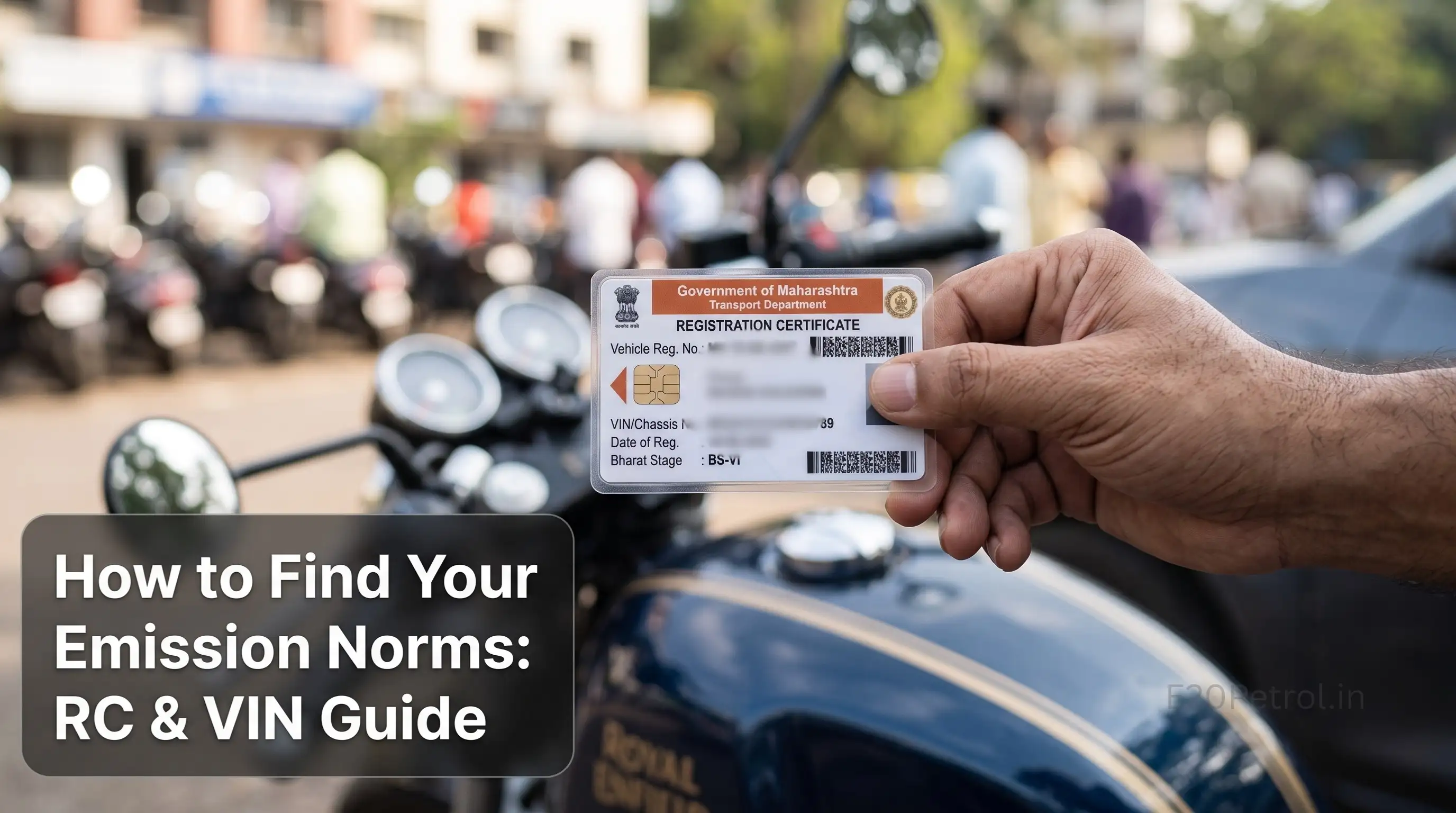
- Ajit Khandekar
- 05 Jul, 2026
Is Your Bike BS4 or BS6? How to Check and Why It Matters for E20 Petrol
Since 1 April 2026, every petrol pump in India dispenses E20 as the sole standard fuel grade. Your motorcycle's emission standard (whether it is BS3, BS4, BS6 Phase 1, or BS6 Phase 2) determines how that fuel affects mileage, fuel system components, and long-term engine wear. A BS6 Phase 2 bike needs minimal intervention. A BS4 carburetted bike needs an active maintenance plan. And a BS3 bike carries the highest risk exposure of all. The problem is that most riders do not know their exact emission standard. The sticker on the bike is often worn. The owner manual references a model name, not an emission standard. And the terms BS4 and BS6 are used loosely in conversation without precision about Phase 1 versus Phase 2, a distinction that actually matters for E20 compatibility. This guide explains exactly where to find the emission standard for your motorcycle, what each classification means for E20, and what the government's own database will tell you. Table of ContentsWhere to Find Your Emission Standard - RC Card and VAHAN How to Read the VIN to Determine Manufacturing Year The Transition Dates - When BS4 Ended and BS6 Began What Each Standard Means for E20 Compatibility BS6 Phase 1 vs BS6 Phase 2 - A Difference That Actually Matters OEM Declarations on E20 Compatibility by Standard SourcesWhere to Find Your Emission Standard - RC Card and VAHAN The most direct source is your physical RC smart card, issued under Form 23A of the Central Motor Vehicles Rules (CMVR). On the card, look for the field labelled "Emission Norms." For a BS4 vehicle, this field reads "BS-IV" or "BHARAT STAGE IV." For a BS6 vehicle, it reads "BS-VI" or "BHARAT STAGE VI." The card does not distinguish Phase 1 from Phase 2, for that distinction, the manufacturing date is what matters, as explained below. If your physical RC card is worn, faded, or the field is not visible, the digital equivalent is available through two official channels. The first is the VAHAN NR e-Services portal, maintained by the Ministry of Road Transport and Highways. By entering your vehicle registration number and the last five digits of the chassis number, the system returns the full digital RC record including the "Emission Norms" or "Norms Type" field directly from the VAHAN central database. The second is the mParivahan mobile application, which provides the same query function. Both pull from the same VAHAN database, which is populated using Form 22, the manufacturer's Compliance to Emission and Noise Standards certificate submitted at the time of first registration. If the VAHAN query returns "BHARAT STAGE IV," your bike is a BS4. If it returns "BHARAT STAGE VI," it is BS6. The absence of any emission data in the VAHAN record for very old registrations typically indicates a pre-BS4 vehicle. How to Read the VIN to Determine Manufacturing Year The VIN is a 17-character alphanumeric code stamped on the vehicle frame, typically on the right side of the steering headstock or the main frame tube. The structural format follows Bureau of Indian Standards and Automotive Industry Standard AIS-065, which aligns with the international ISO 3779 standard. The 10th character of the VIN is the year of manufacture code. This is the character you need. There is no character dedicated to BS standard in the VIN, emission compliance is inferred from the manufacturing year, since BS transition dates are fixed and publicly documented. The 10th character follows a standardised alphanumeric sequence that excludes I, O, Q, U, and Z to prevent reading errors. The relevant year codes for the E20 era are as follows. The character "H" represents 2017. "J" represents 2018. "K" represents 2019. "L" represents 2020. "M" represents 2021. "N" represents 2022. "P" represents 2023. "R" represents 2024. "S" represents 2025. "V" represents 2026. A bike with "K" in the 10th position was manufactured in 2019, placing it firmly in the BS4 era. A bike with "M" in that position was manufactured in 2021 and is BS6 Phase 1. A bike with "P" was manufactured in 2023 and may be late BS6 Phase 1 or early Phase 2, depending on the exact month, Phase 2 began in April 2023. The characters in positions 1 to 3 are the World Manufacturer Identifier. For reference, "MD2" identifies Bajaj Auto, "ME3" identifies Royal Enfield, and "ME8" identifies Hero MotoCorp. These help confirm the manufacturer when cross-checking against production records. The Transition Dates - When BS4 Ended and BS6 Began These dates are fixed by MoRTH notification and determine which standard your bike falls under. BS4 emissions norms were mandatory for all new two-wheelers from 1 April 2017. The Supreme Court of India directed that no BS4 vehicles would be registered after 31 March 2020. The sale and registration of BS4 motorcycles therefore ended on that date, though some manufacturers received limited extensions for pre-manufactured stock. Any motorcycle first registered between 1 April 2017 and 31 March 2020 is a BS4 vehicle. BS6 Phase 1 began on 1 April 2020. Vehicles manufactured under this phase met BS6 emission targets but were calibrated for E10 fuel. Fuel system materials in BS6 Phase 1 vehicles were not mandated to be E20-compatible. Any motorcycle first registered between 1 April 2020 and 31 March 2023 is BS6 Phase 1. BS6 Phase 2, also referred to as BS6 OBD2B, began from April 2023. MoRTH mandated that all new vehicles type-approved from this date must comply with On-Board Diagnostics level 2B and be calibrated for E20 reference fuel as specified in BIS IS 17943:2022. Any motorcycle manufactured after 1 April 2023 is BS6 Phase 2 and is factory E20-compliant. What Each Standard Means for E20 Compatibility The emission standard is a proxy for the engineering decisions made when the motorcycle was designed and manufactured. Each standard corresponds to a different set of fuel system materials and ECU calibration strategies. BS3 and older motorcycles use mechanical carburettors with fully open-loop fuel delivery. There is no sensor feedback, no adaptive compensation, and fuel system materials predate any ethanol compatibility requirements. On E20, these bikes run lean, overheat, and face the highest risk of fuel line degradation and tank corrosion. The ARAI joint study documented mileage drops of 10% to 20% for this category. Riders in this segment should consider the Royal Enfield retrofit approach or consult the OEM directly before continuing on E20 for high-mileage use. BS4 motorcycles span two fuel delivery types. Carburetted BS4 bikes share the open-loop limitation of BS3 vehicles. Early fuel-injected BS4 bikes use narrow-band oxygen sensors and are better positioned than carburettors but still calibrated for pure petrol or low-ethanol blends. Mileage drops of 7% to 15% are the documented range, and nitrile rubber fuel system components are at risk. BS6 Phase 1 bikes have closed-loop fuel injection and can partially compensate for E20's oxygen content through sensor feedback. However, they were not calibrated for E20, so the compensation is imperfect. Mileage drops of 5% to 8% are typical. Injector deposits accumulate faster than on E20-calibrated engines. BS6 Phase 2 bikes are fully E20-compliant from the factory. ECUs are programmed with E20 reference fuel data, fuel system materials meet ethanol-compatibility specifications, and OBD2B diagnostics can flag fuel quality deviations. Mileage drops are in the 2% to 3% range and are attributable purely to ethanol's lower energy density, not to calibration mismatch. BS6 Phase 1 vs BS6 Phase 2 - A Difference That Actually Matters This distinction is consistently overlooked in media coverage of E20 but is practically significant. A Yamaha FZ-S purchased in 2021 is BS6 Phase 1. The same model purchased in mid-2023 or later is BS6 Phase 2. They look identical. They may have the same model name. But the Phase 2 version has different ECU calibration software, updated fuel injector specifications, and fuel system materials that passed E20 compatibility testing under BIS IS 17943:2022. The Phase 1 version has none of these. ARAI confirmed that BS6 Phase 1 vehicles see a 5% to 8% fuel efficiency penalty on E20 compared to 2% to 3% for Phase 2 vehicles. Over 10,000 km, that gap compounds to a meaningful cost difference. For Phase 1 bikes still under warranty, check with the OEM service centre about any software updates that may improve E20 compensation on their ECU. Some manufacturers have issued over-the-air or dealer-applied updates for this. The manufacturing date cutoff for Phase 2 is April 2023. If your BS6 bike's manufacturing date precedes this, treat it as Phase 1 for maintenance planning purposes. OEM Declarations on E20 Compatibility by Standard Hero MotoCorp has declared its BS6 Phase 2 lineup (including the XPulse 200, Xtreme 160R, and Glamour) as factory E20-compliant. The company has also launched dedicated flex fuel variants of the Splendor+ and HF Deluxe capable of running on E20 to E100, with deliveries starting July 2026 per the Hero MotoCorp press release dated 3 June 2026. Bajaj Auto, TVS Motor Company, Honda Motorcycle and Scooter India, and Yamaha India have all declared their BS6 Phase 2 models as E20-compliant. None of these manufacturers has issued a retroactive compatibility declaration for BS4 models. Royal Enfield occupies a distinct position. The Classic 350, Bullet 350, and Thunderbird 350 in BS4 configuration are acknowledged as needing fuel system retrofits for E20 compatibility, and the company has supplied conversion kits. The BS6 Phase 2 Classic 350 is factory E20-compliant and has been arriving at dealerships in this configuration since late 2023. Suzuki launched the Gixxer SF 250 Flex Fuel at Auto Expo 2025, priced at Rs 2.17 lakh, making it the first 250cc motorcycle in India with official flex fuel certification for E20 to E85 operation. If your OEM is not on this list, check the official brand website's E20 compatibility page or contact the authorised service centre with your VIN. The answer will differ by manufacturing date. SourcesMoRTH Form 23A CMVR - RC Smart Card Specifications MoRTH Form 22 - Compliance to Emission and Noise Standards BIS IS 17943:2022 - E20 Reference Fuel Specifications for Type Approval Hero MotoCorp Press Release - Flex Fuel Motorcycles Launch, June 2026 Hero Splendor+ and HF Deluxe Flex Fuel Launched, Deliveries from July 2026 - India Today Suzuki Gixxer SF 250 Flex Fuel Launched at Rs 2.17 Lakh - Autocar India ARAI Reaffirms Validation Standards for E20 - PIB E20-Compliant Royal Enfield Classic 350 at Dealerships - BikeWale Government Mandates 95 Octane E20 Petrol Across India from Today - NDTV Auto Automotive Industry Standard AIS-065 - VIN Structure, ISO 3779
- Ajit Khandekar
- 04 Jul, 2026
E20 Petrol and Your Car - Complete Guide for Indian Drivers
From 1 April 2026, the Ministry of Petroleum and Natural Gas mandated E20, petrol blended with up to 20% anhydrous ethanol, as the sole standard fuel grade at every retail petrol outlet in India. The directive was issued through gazette notification under Section 3 of the Essential Commodities Act, 1955. It provides no standing exemption for older vehicles, the central government retains only a limited right to grant temporary, localised relaxations for feedstock shortages or supply disruptions. E10 no longer exists. The only alternative is XP100 or HPCL Power 100 at approximately Rs 160 per litre, ethanol-free 100 RON fuels not intended for everyday use. For car owners, this change is not theoretical. If you drive a Maruti Swift, a Hyundai i20, a Tata Nexon petrol, or a Honda City, you have been running on E20 since April. The question is what that fuel does differently to a car compared to a motorcycle, and the answer involves some car-specific physics that rarely make it into general E20 coverage. This guide covers the regulatory baseline, how E20 affects petrol cars differently from two-wheelers, which engine types carry more risk, and what OEMs have officially confirmed. Table of ContentsThe Regulatory Baseline - What Changed from April 2026 How E20 Affects Cars Differently from Motorcycles Mileage Impact - What the Data Says Turbo Petrol Engines and E20 - Higher Risk, Different Symptoms Plastic vs Steel Fuel Tanks - The Material Question OEM Compatibility Declarations - Who Has Said What SourcesThe Regulatory Baseline - What Changed from April 2026 The MoPNG notification dated 17 February 2026 established E20 as the mandatory baseline petrol specification across all states and union territories effective 1 April 2026. The regulation requires E20 to carry a minimum RON of 95, up from the previous 91 RON standard for regular petrol. The higher octane is a natural consequence of ethanol's own RON of approximately 108, blending it at 20% concentration raises the overall octane profile of the mix. There are no exemptions for older cars in the current regulatory framework. The notification does allow the central government to grant temporary, localised relaxations in cases of feedstock shortage or supply chain disruption, but no standing exemption for pre-E20 vehicles has been issued. If you drive a BS4 car manufactured before April 2020, you are running on a fuel your engine was not designed for and your owner manual does not recommend. E20 has minimum RON 95 as the floor. XP95, Speed 97, and Shell V-Power are all E20 blends, they differ in additive packages and detergent quality, not in ethanol content. Independent gas chromatography testing confirmed that IOCL XP95 contains 19.88% ethanol by volume, essentially identical to regular petrol. These premium grades are not a workaround for E20 exposure. How E20 Affects Cars Differently from Motorcycles Cars and motorcycles share the chemistry of ethanol exposure, but the scale and design differences create distinct risk profiles. The first difference is fuel tank material. Most Indian market cars manufactured in the last decade use high-density polyethylene (HDPE) fuel tanks. HDPE has documented chemical resistance to ethanol at E20 concentrations, it does not absorb ethanol at the rate nitrile rubber does, and phase separation risk in HDPE tanks is present but lower than in steel tanks because the internal surface does not corrode. Older cars, particularly those manufactured before 2010, may have steel tanks with internal coatings that can degrade under continuous ethanol exposure. The second difference is engine type. Cars sold in India span a wider range of injection systems than motorcycles. Maruti Suzuki's widely used K-series engines use multi-point port fuel injection (MPFI). Hyundai, Kia, Tata, and Volkswagen offer gasoline direct injection (GDI) or turbo GDI (TGDI) engines in their higher variants. GDI engines inject fuel directly into the combustion chamber rather than the intake port, which changes how ethanol's solvent properties interact with valve stem deposits. Port fuel injection engines have a natural cleaning effect on intake valves, fuel sprayed onto the intake port keeps valves washed. GDI engines spray fuel directly into the cylinder, bypassing the intake valve entirely, which means carbon deposits on intake valves accumulate faster. E20 can accelerate this process. The third difference is turbocharger calibration. Turbocharged petrol engines are more sensitive to fuel quality than naturally aspirated units because they operate at higher combustion pressures and temperatures. The implications for E20 are covered separately below. Mileage Impact - What the Data Says The 2021 NITI Aayog Ethanol Roadmap, cited by the government in its own policy justifications, documented specific efficiency projections for four-wheelers on higher ethanol blends. The document recorded a 6% to 7% drop in fuel efficiency for four-wheelers when transitioning from E0 to E20 blended fuel. This projection has been partially validated in field conditions. The official and independent numbers differ, so it is worth putting both on the table. On the official side, the government's headline estimate is a 2% to 3% efficiency drop, and ARAI's own laboratory testing reported a 2% to 6% drop depending on vehicle age, while ruling out engine failures (ARAI, via Business Today, July 2026). On the independent side, a 2026 Autocar India instrumented real-world test found larger losses in older cars: a naturally aspirated 2016 Maruti Dzire dropped 12.4%, a 2016 Hyundai Grand i10 9.2%, and a turbocharged direct-injection 2017 VW Polo GT TSI 5.2%, while a newer E20-optimised Dzire lost just 3.8% (Autocar India, 2026 test). Read together, the two sets of figures point to a consistent pattern rather than a contradiction: modern E20-calibrated cars sit at the low end, roughly 2% to 4%, while older and naturally aspirated engines sit higher, in the 5% to 12% band. We present both the official and the independent numbers here, with their sources, so you can judge where your own vehicle is likely to land. The underlying physics is energy density. Anhydrous ethanol contains approximately 30% to 35% less energy per litre than petrol. At a 20% blend ratio, E20's theoretical energy content is roughly 3% to 4% lower than pure petrol. In well-calibrated, closed-loop fuel-injected systems, the ECU compensates by delivering more fuel to maintain the stoichiometric air-fuel ratio, which partially offsets the energy density deficit but increases fuel consumption volume. In older engines without adaptive compensation, both lean running and increased consumption occur. For a Maruti Swift with a naturally aspirated 1.2-litre K12N engine doing 18 kmpl on regular fuel, a 5% to 7% mileage drop means 16.7 to 17.1 kmpl on E20 under the same driving conditions. The actual impact varies with driving style, maintenance condition, and how well the ECU software manages the transition. Owners of Hyundai i20 and Honda City report similar ranges in user forums, consistent with the NITI Aayog projection. Cars with BS6 Phase 2 engines (those manufactured after April 2023) experience lower mileage penalties in the 2% to 4% range, since their ECUs are calibrated for E20 reference fuel as per BIS IS 17943:2022. Turbo Petrol Engines and E20 - Higher Risk, Different Symptoms Turbocharged petrol engines in the Indian market (the Hyundai 1.0 T-GDI in the i20, Venue, and Creta, the Volkswagen 1.0 TSI in the Polo and Vento, and Tata's 1.2-litre Revotron turbo) operate under higher cylinder pressures and temperatures than naturally aspirated units. This changes the risk profile for E20. On the positive side, E20's higher octane (minimum 95 RON) provides better knock resistance than the old 91 RON regular petrol. Turbocharged engines are knock-sensitive because of their high effective compression ratios under boost. The RON upgrade that E20 brings is genuinely beneficial for turbo petrol engines running at full throttle under load. The risk is on the deposit side. GDI turbo engines that do not receive regular cleaning agents in the fuel are more susceptible to intake valve carbon buildup, and E20's interaction with combustion chamber surfaces can accelerate deposit formation on pre-E20-calibrated engines. ARAI's unpublished material compatibility study, parts of which were reported by India Today on 7 July 2026, indicated that pre-2023 engine components including NBR-PVC fuel lines and Epichlorohydrin seals experience significant swelling and accelerated physical degradation under continuous E20 exposure. The government classified this study as confidential under Section 8(1)(d) of the RTI Act when RTI applicants sought the full report. Toyota's official response to E20-related incidents, including a viral Hycross breakdown reported in June 2026, attributed the failure to contaminated fuel rather than E20 itself. Independent experts took a more cautious view, noting that the Hycross uses a 2.0-litre naturally aspirated petrol hybrid engine not originally calibrated for E20 operation. Plastic vs Steel Fuel Tanks - The Material Question The fuel tank material in your car determines the nature of E20 risk rather than the magnitude. Steel tanks corrode from the inside when ethanol-moisture mixtures form condensation on the tank walls, particularly in cars parked for extended periods with less than a quarter tank of fuel. Pre-2010 cars with steel tanks and internal enamel or epoxy coatings may see coating degradation under continuous E20 exposure. Most cars sold in India since approximately 2010 use HDPE fuel tanks. HDPE is chemically resistant to ethanol at E20 concentrations, the polymer does not swell or absorb ethanol the way nitrile rubber does. However, HDPE tanks have a different vulnerability: the fuel sender unit, fuel pump assembly, and associated wiring harnesses that sit inside the tank use gaskets, O-rings, and insulation materials that vary by manufacturer and model year. Some of these materials in BS4 vehicles were specified for E10 maximum and may degrade under sustained E20 contact. The practical indicators to watch for in plastic-tank cars are fuel odour from the engine bay (a sign of gasket or seal weeping), hard starting after the car sits overnight or over a weekend (a sign of fuel pump strain or pressure loss), and rough idling at warm operating temperatures (a sign of lean running or injector deposit build-up). OEM Compatibility Declarations - Who Has Said What Honda Cars India is in the strongest position. The company declared E20 material compatibility for all models manufactured after 1 January 2009, a claim that covers effectively the entire active Honda fleet in India. Honda's official FAQ states that all current models are E20-compatible and that the company's warranty terms remain fully applicable. Maruti Suzuki has confirmed that BS6 Phase 2 models are E20-compliant from the factory. For older models, Maruti's warranty documentation contains Section 4(b), which explicitly excludes hoses, filters, and all rubber parts from warranty coverage, making warranty claims for fuel system degradation on BS4 models practically unenforceable regardless of E20's role. Hyundai Motor India is nuanced. The owner manual for the Venue (June 2019 to June 2022) explicitly states not to use gasoline with more than 10% ethanol and warns that warranty coverage may be limited for fuel-system damage resulting from non-approved fuels. The updated manual for the i20 and i20 N Line manufactured after October 2023 revises this threshold to E20. No retroactive update has been issued for pre-2023 Hyundai models. Tata Motors and Mahindra have confirmed E20 material compatibility for vehicles manufactured after 1 April 2020, corresponding to the start of BS6 Phase 1. Skoda and Volkswagen India similarly limit confirmed compatibility to post-April 2020 production. At the industry level, SIAM has stated that member manufacturers will fully honour existing warranties for E20 fuel usage. The Society of Indian Automobile Manufacturers framed this as an industry commitment. However, most BS4 cars are already beyond their standard 3-year warranty period, making this commitment practically inapplicable to the most at-risk segment of the fleet. SourcesMoPNG E20 Mandate - Legal Analysis, IndusLaw March 2026 Ethanol Blending in India - PIB Press Release PRID 2281287 Do Older BS4 Cars Have a Higher Drop in Fuel Efficiency on E20? Real-World Test - Autocar India E20 Mileage Drop: ARAI Finds Up to 6% Loss, Rules Out Engine Breakdowns - Business Today, 4 July 2026 E20 Can Damage Rubber Parts in Older Cars, Says ARAI Report - India Today, 7 July 2026 Warranties Valid Even on E20 Fuel, Say Govt and Industry Panel - Autocar India Honda Cars India E20 Compliance - Official Press Release Maruti Suzuki E20 Compatibility Model-wise - Spinny Hyundai Venue Owner Manual E10 Threshold Clause - Hyundai India Toyota Hycross Viral Breakdown and E20 - Autocar Professional Maruti, Toyota Assure Customers Over E20 Fuel - NDTV Auto How E20 Affects Your Car and What's Next on E85 Rollout - Times of India
- Ajit Khandekar
- 03 Jul, 2026
E20 Petrol and Your Motorcycle - What Every Indian Rider Needs to Know
From 1 April 2026, every petrol pump in India dispenses E20 (petrol blended with up to 20% anhydrous ethanol) as the sole standard fuel grade. The change was mandated by the Ministry of Petroleum and Natural Gas through gazette notification S.O. 860(E) dated 17 February 2026, issued under Section 3 of the Essential Commodities Act, 1955. There is no low-ethanol alternative at the pump. E10 no longer exists. The only ethanol-free petrol available is XP100 or Power 100, priced at approximately Rs 160 per litre, and intended for a narrow set of use cases. For riders of 150cc to 450cc motorcycles, this is not a distant policy headline. It is a change to the fuel entering your engine at every refuel. Whether you ride a Royal Enfield Classic 350, a Bajaj Pulsar NS200, a KTM Duke 390, or a TVS Apache RTR 200, the question is the same: what does this fuel do to your machine, and what do you need to do about it? This guide answers that question by emission standard, engine type, and fuel system design, using data from ARAI, BIS, and OEM technical positions. Table of ContentsWhat E20 Actually Is - and What It Is Not How E20 Affects Mileage by BS Standard What Ethanol Does to Fuel System Components Phase Separation - Why Monsoon Season Raises the Stakes What the Government and OEMs Have Said A Practical Maintenance Plan for Your Motorcycle SourcesWhat E20 Actually Is - and What It Is Not E20 is a blend of 80% conventional petrol and 20% anhydrous ethanol by volume, supplied at a minimum Research Octane Number of 95 RON. The higher RON compared to the old 91 RON base fuel is a direct consequence of ethanol's naturally high octane rating of approximately 108.5 RON. When blended at 20% concentration, it raises the overall octane profile of the mix. This point matters for one common misconception: XP95 is not ethanol-free. Independent gas chromatography testing conducted per the ASTM D4815 standard confirmed that IOCL's XP95 contains 19.88% ethanol by volume (essentially identical to regular E20 petrol. XP95 and regular petrol now differ in additive packages and detergent levels, not in ethanol content. The only commercially available E0 fuels are XP100 and HPCL's Power 100, both 100-octane premium petrols that contain effectively no ethanol) independently measured at under 0.2 percent by volume. E10 is gone. If your owner manual says E10, that recommendation is now obsolete. The fuel it described is no longer available anywhere in India. How E20 Affects Mileage by BS Standard The mileage impact of E20 is real, measurable, and varies significantly by emission standard. The authoritative reference is the joint study conducted by ARAI, IOCL, and SIAM in 2021, which subjected vehicles to chassis dynamometer testing under controlled laboratory conditions. The 2021 NITI Aayog Ethanol Roadmap also published efficiency projections that have since been validated in field conditions. The core physics is straightforward. Anhydrous ethanol contains approximately 30% to 35% less energy per unit volume than petrol. At a 20% blend ratio, the overall energy content of E20 drops by roughly 3% to 3.5% compared to pure petrol. In engines calibrated to compensate for this via closed-loop feedback, the mileage penalty tracks closely to this theoretical loss. In engines that cannot compensate, the drop is larger. The practical impact by BS standard is as follows. BS6 Phase 2 motorcycles, those manufactured after April 2023, are factory E20-compliant. Their ECUs are calibrated for E20's oxygen-rich stoichiometry, and their fuel system materials are ethanol-resistant. Real-world mileage drops on these bikes sit in the 2% to 3% range. BS6 Phase 1 motorcycles (April 2020 to March 2023) use closed-loop fuel injection but were calibrated for E10. The mileage drop is higher, typically 5% to 8%, with some injector deposit accumulation over extended use. BS4 motorcycles (2017 to 2019) include both carburetted and early fuel injection variants. Carburetted BS4 bikes cannot adjust their air-fuel mixture dynamically, so they run lean on E20. Mileage drops of 7% to 15% are documented, along with increased operating temperatures. BS3 and older motorcycles show the steepest drops, 10% to 20% in ARAI and field data, with the highest risk of fuel system damage. A Royal Enfield Classic 350 BS4 owner doing 500 km per tank on E10 may now see that range fall to 425 to 465 km on E20. The calculation varies by riding conditions, but the directional impact is consistent. What Ethanol Does to Fuel System Components Ethanol is a polar solvent. This property, which makes it effective as a fuel oxygenate, also makes it chemically aggressive toward certain materials that were standard in motorcycles manufactured before the E20 era. The most critical vulnerability is nitrile rubber, also called NBR. Standard low-grade NBR was widely used for fuel hoses, float bowl gaskets, O-rings, and injector seals in BS3, BS4, and early BS6 Phase 1 motorcycles. Under continuous E20 exposure, NBR absorbs ethanol, swells, softens, and eventually cracks or leaks. Owners of older TVS Apache and Bajaj Avenger models have documented rubber fuel feed lines cracking and weeping fuel at the hose clamp joints. Swollen float bowl gaskets are a common carburetor complaint on BS4 carburetted bikes, causing fuel overflow and (critically) fire risk when fuel contacts a hot engine casing. Fuel tank corrosion is a separate concern. Ethanol is hygroscopic: it actively absorbs moisture from the air. Steel fuel tanks, particularly in bikes that sit partially fuelled for days or weeks, develop internal condensation as the ethanol-water mixture interacts with the tank lining. Riders on Team-BHP and BikeWale forums have documented rust flakes visible around fuel filler caps and on the tank floor. In fuel-injected motorcycles, these particles bypass coarse pump strainers, clog fuel injectors, cause RPM-dependent fuel starvation, and accelerate fuel pump motor wear. On carburetted bikes, rust contamination blocks jets and pilots. Fuel-injected motorcycles in the BS6 Phase 1 range (KTM Duke 390, Yamaha FZ-S V3, Honda CB300R) report a different symptom set: increased secondary vibrations at highway speeds after refuelling with E20, slight reduction in throttle response at the top of the rev range, and accumulation of injector deposits over 15,000 to 20,000 km. These bikes were not designed for E20 but handle it better than carburetted platforms due to their closed-loop feedback systems. Phase Separation - Why Monsoon Season Raises the Stakes Phase separation occurs when the water concentration dissolved in an ethanol-petrol blend crosses a threshold that causes the ethanol and water to separate from the hydrocarbons and sink to the bottom of the fuel tank as a dense, corrosive layer. BIS standard IS 2796:2017 specifies a maximum water tolerance of 10°C phase separation temperature for summer and non-winter conditions. India's monsoon season significantly raises the risk. Ethanol's hygroscopic nature means that a partially filled steel tank in a high-humidity environment (Maharashtra, Kerala, West Bengal, Assam between June and September) absorbs atmospheric moisture at a measurable rate. A tank that is 25% full has three times the headspace air volume of a tank at 75% capacity, and therefore three times the surface area available for moisture absorption and condensation. The consequence of phase separation entering the fuel system is severe. The water-ethanol layer at the tank bottom has essentially zero calorific value, causes immediate lean misfire if it enters the injector or carburettor jet, and rapidly corrodes any steel or zinc components it contacts. Prevention is straightforward: keep the tank at 90% or above capacity during extended parking, particularly during monsoon months. If the bike is being stored for more than three weeks, use a fuel stabiliser or drain the tank and carburettor bowl entirely. What the Government and OEMs Have Said The official government position is that E20 poses no significant risk of engine failure or widespread damage to legacy vehicles. At a government press conference on 4 July 2026, Maruti Suzuki presented data from 2.84 crore vehicles serviced through its official network in FY 2025-26, stating that no verified cases of E20-related corrosion or fuel pump failure were documented. The OEM position on motorcycles is more nuanced. Royal Enfield has offered E20 retrofit kits for the Classic 350, Bullet 350, and Thunderbird 350 BS4 models, priced between Rs 1,700 and Rs 4,000. The existence of a retrofit kit is itself an acknowledgement that the original fuel system components are not E20-ready. Hero MotoCorp has stated that BS6 Phase 2 models are fully E20-compliant from the factory. Bajaj, TVS, Yamaha, and Honda have made similar declarations for their post-April 2023 lineups, while not issuing retroactive compatibility guarantees for BS4 vehicles. The critical tension is this: the 2021 NITI Aayog Ethanol Roadmap explicitly recommended that "E10 should be made available on a pan-India basis as a protection-grade fuel for the existing pool of legacy vehicles." That recommendation was overruled to accelerate the E20 rollout. BS4 and older motorcycle owners now run on a fuel their engines were not designed for, with no standard-grade alternative available and no official mechanism for compensation if components degrade. A Practical Maintenance Plan for Your Motorcycle The maintenance response to E20 depends on your bike's emission standard. BS6 Phase 2 bikes require the least intervention, follow the OEM service schedule, consider using an ethanol-compatible fuel additive every 5,000 km, and monitor injector performance at the 30,000 km mark. BS6 Phase 1 bikes should add a fuel system cleaner every 8,000 to 10,000 km and inspect injector deposits at the 20,000 km service. Change the fuel filter on schedule. BS4 bikes require the most proactive response. The highest-priority action is fuel hose inspection and replacement. Any hose that shows surface cracking, softening, or fuel seepage at clamp points should be replaced immediately with Viton FKM hoses, fluorinated elastomers that are chemically resistant to ethanol at all blend concentrations. Standard NBR hoses should be treated as a scheduled replacement item at 10,000 km or 12 months, whichever comes first. O-rings and injector seals should follow the same interval using high-grade silicone or Viton replacements. Carburettor cleaning is now a more frequent requirement than manufacturer schedules reflect. On BS4 carburetted bikes, aim for a full carburettor disassembly and jet cleaning every 10,000 km or when rough idling appears. Fuel filter replacement should move to every 8,000 km rather than the typical 15,000 km factory interval. Treat the tank with an ethanol-specific fuel stabiliser containing corrosion inhibitors at each refuel if the bike sits for more than three to five days between rides. For any BS4 bike being stored for more than three weeks, drain the fuel tank and carburettor float bowl completely. E20 left in a partially filled tank during an extended parking period is the single fastest path to phase separation damage and internal tank corrosion. Keep all service records, they form the evidence trail if you need to raise a dispute. SourcesMoPNG Gazette Notification S.O. 860(E), February 2026 - Direction for Sale of E20 Petrol with RON 95 PIB - Ethanol Blending in India, Press Release PRID 2281287 ARAI Reaffirms Validation Standards for E20 Ethanol-Blended Fuel - PIB, PRID 2281084 Autocar India - How Much Ethanol Is in Your Petrol? Royal Enfield E20 Conversion Kits for Classic 350, Bullet 350 and Thunderbird 350 - BikeWale Government Defends E20 Rollout Amid Rising Consumer Backlash - Autocar Professional E20 Petrol: Safe if Managed Correctly - BikeWale ARAI Journal - Impact of E20 on Metals and Non-Metals in Fuel System Components E20 Ethanol Fuel in India: What It Does to Your Engine - RawTorque Government Mandates 95 Octane E20 Petrol Across India - NDTV Auto
- Ajit Khandekar
- 02 Jul, 2026
What Is a Flex Fuel Vehicle? India's FFV Explained Simply
India completed its E20 mandate on 1 April 2026. Five years earlier than the original schedule, every petrol pump in the country now dispenses ethanol-blended fuel as the only standard grade. The next stage in the same ethanol roadmap is already underway: E85 went on commercial sale at 48 retail outlets from 5 June 2026, and two production flex fuel motorcycles (the Hero Splendor+ Flex Fuel and the Hero HF Deluxe Flex Fuel) are available for private buyers from July 2026. These are not concept vehicles. They are the first consumer products in India designed to run on any blend from E20 to E85, and they mark a structural shift in what is possible at an Indian fuel pump. But the term "flex fuel vehicle" is used loosely, and the mechanics of what makes a vehicle genuinely flex-fuel capable are not widely understood. This article explains what an FFV actually is, how it differs from a standard petrol vehicle, what the Indian regulatory framework requires, and what the current vehicle landscape looks like. Table of ContentsThe Official Indian Definition of a Flex Fuel Vehicle How an FFV Engine Differs from a Standard Petrol Engine The BIS Standards Framework - IS 16634 and IS 19850:2026 What Fuel Blends an FFV Can Use - and at What Cost FFVs Now Available in India Why Brazil Matters - The Only Country That Has Done This at Scale SourcesThe Official Indian Definition of a Flex Fuel Vehicle In India's regulatory framework, a Flex Fuel Vehicle is officially defined as a vehicle equipped with an internal combustion engine designed to run on more than one type of fuel, or on any mixture of those fuels, typically any blend of petrol and anhydrous ethanol ranging from E20 up to E85 or E100. The legal foundation for FFVs was established under the Central Motor Vehicles Rules (CMVR), 1989. MoRTH issued the foundational safety guidelines through gazette notification G.S.R. 343(E) dated 25 May 2021. This notification is backed by the Automotive Industry Standard AIS-171, titled "Safety Requirements for Type Approval of Anhydrous Ethanol and Ethanol Blended Motor Gasoline (EBMG) Vehicles." AIS-171 was formulated on behalf of MoRTH and published by ARAI. It establishes the safety, material compatibility, electrical conductivity, and emission testing protocols for all vehicles operating on ethanol-gasoline blends of 20% and above. The distinction between an FFV and a standard E20-compliant vehicle is important to state precisely. A BS6 Phase 2 motorcycle manufactured after April 2023 is E20-compliant, it can handle 20% ethanol without material degradation. It is not an FFV. An FFV can handle any blend from E20 to E85, or E20 to E100 in some configurations, because it has additional engineering specifically designed for variable fuel composition. The two terms are not interchangeable. How an FFV Engine Differs from a Standard Petrol Engine A standard petrol engine is calibrated for a specific fuel composition. Its injector sizing, fuel delivery pressure, ignition timing, and ECU calibration maps are set to optimise for that composition. When the fuel composition changes (say, from E10 to E20) the engine's closed-loop feedback makes partial adjustments but cannot fully optimise because its calibration range is limited. An FFV engine is designed for a range of fuel compositions. The changes required to support this range are interconnected and cannot be done piecemeal. The first is a fuel composition sensor, commonly called a flex fuel sensor or ethanol content sensor. This sensor sits in the fuel line between the tank and the injectors and measures the ethanol concentration in the incoming fuel in real time. The ECU uses this reading to continuously adjust injection duration, fuel rail pressure, and ignition timing across the full range from E20 to E85 or E100. Without this sensor, an engine cannot identify what blend it is running on and cannot calibrate dynamically. The second is injector sizing. Ethanol has approximately 30% to 35% less energy per unit volume than petrol. To deliver the same power output on E85 as on E20, the engine needs to inject a larger volume of fuel. FFV injectors are sized 30% to 40% larger than equivalent petrol injectors to accommodate this. A standard petrol injector running on E85 would starve the engine of fuel at higher load because it cannot flow enough volume. The third is fuel system materials. All seals, hoses, O-rings, fuel pump internals, and tank coatings must be chemically compatible with anhydrous ethanol at concentrations up to 85% or 100%. Materials that pass E20 testing may fail under continuous E85 exposure. FFVs use Viton FKM seals throughout the fuel system, stainless steel fuel rails, and corrosion-resistant fuel pump assemblies. The fourth is ECU calibration maps. An FFV ECU contains multiple calibration tables, effectively a petrol calibration, an E85 calibration, and a continuous interpolation function that blends between them based on the flex fuel sensor reading. The ECU also accounts for the fact that ethanol's higher octane rating (100 to 105+ RON for E85) allows more aggressive ignition advance at high loads without knock. The BIS Standards Framework - IS 16634 and IS 19850:2026 Two BIS standards govern different parts of the ethanol fuel landscape. Understanding which standard applies to which fuel is important. BIS IS 16634:2017 governs E85 and other high-blend ethanol fuels in the 70% to 85% ethanol range. This is the standard that applies to E85 as it currently exists at retail pumps. It specifies physical and chemical parameters including ethanol concentration limits, water content, sulphur limits, and vapour pressure requirements. E85 under IS 16634 contains 80% to 85% anhydrous ethanol by volume, with the "anhydrous" specification critical to prevent phase separation in the distribution network. BIS IS 19850:2026 is a newer standard, notified on 15 May 2026, which establishes technical specifications for intermediate blends, specifically E22, E25, E27, and E30. This standard does not cover E85. It is significant as a forward signal: E30 standards now exist on paper, even though E30 is not yet available at retail pumps. When E30 does arrive, IS 19850:2026 is the document that will govern its fuel quality parameters. E20, the current mandatory fuel, remains governed by the established BIS standard for motor gasoline, IS 2796:2017 with its subsequent amendments, which set the 95 RON floor and 4.2% maximum oxygen content by mass. What Fuel Blends an FFV Can Use - and at What Cost The practical benefit of an FFV is fuel blend flexibility. A Hero Splendor+ Flex Fuel owner can refuel with standard E20 petrol today, switch to E85 at an E85-equipped pump, or use any blend in between, and the vehicle will calibrate automatically. The mileage trade-off is real and should not be obscured. E85 contains approximately 30% to 35% less energy per unit volume than standard petrol. An FFV running on E85 will use a higher volume of fuel to cover the same distance compared to E20. In real-world testing of comparable FFV models, efficiency drops of 25% to 35% on E85 relative to E20 are documented. However, E85 is currently priced approximately Rs 20 per litre cheaper than E20 in Delhi, at Rs 82.12 per litre versus Rs 102.12 per litre. The cost-per-kilometre calculation depends on both the price gap and the efficiency penalty, and the breakeven point varies by vehicle and engine tune. The energy-adjusted cost comparison is what matters. If an FFV covering 100 km uses 3.5 litres on E20 at Rs 102 per litre, that is Rs 357. The same distance on E85 may require 4.5 litres at Rs 82 per litre, totalling Rs 369, marginally more expensive despite the lower pump price. As the E85 station network expands and supply competition increases, the pump price discount may widen enough to shift this calculation. E100, the ultimate flex fuel blend, is theoretically possible with appropriate engine calibration. Its commercial availability in India is a long-horizon prospect, current infrastructure and supply chain planning centres on E85 as the near-term high-blend target. FFVs Now Available in India The Hero Splendor+ Flex Fuel is India's first commercially available flex fuel motorcycle for the mass market. Launched on 3 June 2026 with deliveries beginning July 2026, it is officially rated to run on E20 to E85. Hero MotoCorp's press release confirms AIS-171 compliance and flex fuel sensor fitment. The HF Deluxe Flex Fuel, launched simultaneously at Rs 72,792, targets the high-volume entry commuter segment. The Suzuki Gixxer SF 250 Flex Fuel was launched at Auto Expo 2025 at Rs 2.17 lakh, extending the FFV category to the 250cc performance segment. It is AIS-171 compliant and certified for E20 to E85 operation. The Maruti Wagon R Flex Fuel was launched at Rs 7.24 lakh, Rs 86,000 more than the standard Wagon R petrol variant. It represents the first mass-market flex fuel passenger car in India and is positioned to benefit from the E85 station expansion roadmap. Upcoming FFV cars with confirmed timelines include the Maruti Fronx Flex Fuel, Tata Punch Flex Fuel, and Mahindra XUV 3XO FFV through the 2026 to 2027 period. Why Brazil Matters - The Only Country That Has Done This at Scale Brazil is the only country that has operated a nationwide flex fuel vehicle ecosystem at scale, and its trajectory is the closest operational precedent India has. The Brazilian Automobile Manufacturers Association, ANFAVEA, documented that Brazil introduced commercial flex fuel vehicles in 2003 and reached a point where over 90% of new petrol cars sold in the country were flex fuel capable within a decade. This adoption was driven by a combination of commercially priced ethanol derived from sugarcane and a retail infrastructure that made E85 and E100 genuinely available. India's starting point is different, sugarcane-derived 1G ethanol at scale, 48 E85 stations versus Brazil's mature 45,000-station network, and a far larger legacy fleet of non-FFV vehicles. But the Brazilian precedent confirms that nationwide FFV adoption is technically and commercially achievable when retail fuel infrastructure and vehicle availability move in parallel. The government's target of 5,000 E85 stations by December 2027 is the infrastructure signal that OEMs have cited as justification for their FFV launch commitments. SourcesMoRTH Gazette Notification G.S.R. 343(E), May 2021 - FFV Safety Guidelines AIS-171 - Safety Requirements for Type Approval of EBMG Vehicles, ARAI BIS IS 19850:2026 - Standards for E22, E25, E27, E30 - Vision IAS Current Affairs Hero MotoCorp Press Release - Flex Fuel Motorcycles Launch, June 2026 Hero Splendor+ and HF Deluxe Flex Fuel Deliveries from July 2026 - India Today Maruti Suzuki WagonR Flex Fuel Launched at Rs 7.24 Lakh - V3Cars Suzuki Gixxer SF 250 Flex Fuel Launched at Rs 2.17 Lakh - Autocar India ANFAVEA - History and Technical Information, Brazilian Automobile Manufacturers Association PIB - Ethanol Blending in India, Press Release PRID 2281287 The Flex Fuel Dilemma: All You Need to Know - BikeWale
- Editorial Team
- 01 Jul, 2026
The 3:1 Tank Method, Does Mixing XP100 With Regular Petrol Actually Help?
In the months since E20 became mandatory, a specific refuelling strategy has spread through Indian automotive communities on Team-BHP, Reddit's r/CarsIndia, and various RE owner forums. It goes like this: fill up with regular E20 petrol for three tanks, then fill the fourth with XP100. Repeat indefinitely. The logic behind it is intuitive. XP100 is ethanol-free and contains high-quality detergent additives. Three tanks of E20 followed by one of XP100 dilutes the average ethanol exposure and periodically flushes the injectors or carburettor with a premium, ethanol-free fuel. At roughly one-quarter of the cost of running XP100 full-time, it sounds like a sensible compromise. Is the chemistry behind this method sound? For some vehicle types, partially. For others, the method addresses the wrong problem. This article breaks it down. Table of ContentsWhat the 3:1 Method Is Trying to Achieve The Injector Flushing Argument, Does It Hold? The Ethanol Dilution Argument, What Actually Happens in the Tank Who the Method Actually Helps Who the Method Does Not Help The Cost Calculation Better Alternatives for Specific Problems SourcesWhat the 3:1 Method Is Trying to Achieve The 3:1 method attempts to solve two distinct problems simultaneously, and understanding which problem applies to your vehicle is the key to evaluating whether the method makes sense. The first problem is injector fouling. Modern GDI and TGDI engines accumulate carbon deposits on fuel injectors and intake valves over time, particularly when running on E20. The detergent additive packages in premium fuels, both XP95 and XP100, are formulated to dissolve these deposits and maintain clean injector spray patterns. Running a periodic tank of a high-detergent fuel is a documented maintenance strategy in markets where fuel quality is variable. The second problem is ethanol exposure in vulnerable fuel systems. Older vehicles with nitrile rubber seals, untreated steel tanks, and carburetted fuel delivery are at risk of corrosion and elastomer degradation from continuous E20 use. The theory is that introducing a tank of E0 XP100 periodically dilutes the effective ethanol concentration the fuel system sees over time. Both objectives are real. Whether the 3:1 method achieves them effectively depends on the specific failure mode you are trying to prevent. The Injector Flushing Argument, Does It Hold? For fuel-injected engines, particularly GDI and TGDI units, there is a rational basis for periodic premium fuel use as a cleaning strategy. XP100's additive package includes detergent compounds that target injector deposits. Running a full tank of XP100 every three to four tanks means that roughly 25% of the fuel passing through the injectors contains these detergents at full concentration. The effectiveness depends on whether the detergent concentration is sufficient to dissolve existing deposits during a single tank's worth of operation, or whether it simply maintains cleanliness in an already-clean system. For the latter, a newer BS6 Phase 2 engine with minimal deposit build-up, the method provides incremental maintenance benefit. For an older BS6 Phase 1 engine that has accumulated deposits over 30,000 km of E20 use, a single tank of XP100 may not be sufficient to meaningfully reduce existing fouling. It is also worth noting that XP95 carries a similar detergent additive package to XP100. If the objective is purely injector cleanliness, running XP95 consistently is cheaper and provides continuous detergent action rather than periodic bursts. The specific advantage of XP100 over XP95 in the cleaning context is the absence of ethanol, for some deposit types, ethanol's solvent properties are actually beneficial for cleaning, though ethanol also contributes to some deposit formation mechanisms on intake valves in GDI engines. For carburetted engines, the injector flushing argument does not apply. A carburettor has no injectors to foul. The relevant components, jets, pilots, needle, float bowl, can benefit from a detergent fuel, but the cleaning effect of a premium fuel on a carburettor is minimal compared to a physical carburettor disassembly and cleaning. The Ethanol Dilution Argument, What Actually Happens in the Tank This is where the method requires more careful thinking. The premise is that one tank of E0 XP100 every four tanks reduces the average ethanol concentration the fuel system experiences. Let us follow the chemistry. A typical motorcycle tank holds 12 to 15 litres. At tank three of E20, the system contains approximately 2.4 to 3 litres of ethanol (20% of 12 to 15 litres). When you fill the fourth tank with XP100, you add 12 to 15 litres of E0 to whatever E20 remains in the tank, perhaps 1 to 2 litres at low fuel warning. The resulting mix in the fourth tank is approximately 90% XP100 and 10% residual E20. The ethanol concentration in that tank drops to roughly 2%, effectively negligible. For the one tank that contains XP100, yes, the ethanol exposure is dramatically reduced. But the fuel system components, the hoses, the seals, the float bowl gasket, have been in contact with E20 for the three preceding tanks. The nitrile rubber degradation process in those three tanks is not reversed by the subsequent E0 tank. Nitrile rubber absorbs ethanol and swells progressively. Each E20 tank advances that degradation. The XP100 tank does not un-swell the rubber or repair micro-cracking that has already occurred. The dilution argument works best as a prevention strategy before significant degradation has occurred, not as a remediation strategy once the fuel system has been exposed to several thousand kilometres of E20. And as a prevention strategy, it competes against the more permanent solution of simply replacing NBR components with Viton FKM equivalents from the start. Who the Method Actually Helps The 3:1 method has genuine value in a specific, narrow set of scenarios. Owners of high-compression performance vehicles (Volkswagen EA888 Evo4, BMW inline-six turbos, high-displacement sports bikes above 400cc) who cannot justify full-time XP100 on cost grounds but want periodic optimal combustion. One tank of XP100 in four means the engine operates at full ECU timing advance for roughly 25% of its running hours, better than never, and meaningfully cheaper than constant XP100 use. Owners of vintage or classic vehicles who use their vehicles occasionally, weekend rides, monthly runs, rather than daily. For a bike covering 200 km per month, one XP100 fill per four months adds approximately Rs 600 to Rs 800 in fuel cost per year. The ethanol-free exposure during actual running is more consistent because the vehicle is not sitting with E20 in the tank for extended periods between the XP100 fills. Owners who are transitioning from a vulnerable fuel system (pre-Viton hoses, original steel tank) to a properly upgraded one and want to reduce ethanol load during the transition period. Once the Viton hoses are fitted, the ethanol dilution objective of the 3:1 method is no longer necessary. Who the Method Does Not Help Owners of commuter motorcycles and standard naturally aspirated cars. As covered in the XP95 vs XP100 article, these engines cannot use 100 RON's additional knock resistance, so the XP100 portion of the 3:1 cycle provides no performance or efficiency benefit. The ethanol dilution benefit is outweighed by the cost. Owners who are using the method as a substitute for fuel system repairs that are actually needed. If your BS4 bike's nitrile hoses are already cracking and leaking, rotating through XP100 tanks does not slow the degradation meaningfully. The hoses need replacement. Owners of BS6 Phase 2 vehicles with fully E20-compatible fuel systems. These vehicles do not have an ethanol vulnerability the method is protecting against. XP95 full-time is the better choice, same detergent benefit, lower cost, consistent protection. The Cost Calculation The financial difference between the 3:1 method and full-time E20 use depends on your vehicle's fuel consumption and local prices. For a motorcycle using 15 litres per fill covering approximately 600 km, the 3:1 cycle means one XP100 fill every 1,800 km. At Rs 160 per litre for XP100 versus Rs 105 for E20, one XP100 fill adds Rs 825 to the cost of four tanks (Rs 160 × 15 = Rs 2,400 vs Rs 105 × 15 = Rs 1,575, difference Rs 825). Spread across 1,800 km, the 3:1 method adds approximately Rs 0.46 per km over full E20 operation. For a car using 40 litres per fill, one XP100 fill every three E20 fills adds Rs 2,200 to the four-tank cycle cost (Rs 160 × 40 = Rs 6,400 vs Rs 105 × 40 = Rs 4,200, difference Rs 2,200). Spread across approximately 1,600 km (four fills at 400 km range), the additional cost is Rs 1.37 per km. Whether this additional cost is justified depends entirely on which of the method's objectives applies to your vehicle, and whether those objectives cannot be achieved more cost-effectively through other means. Better Alternatives for Specific Problems If the objective is injector cleaning: use a quality fuel system cleaner additive every 8,000 to 10,000 km in the regular E20 tank. Products from Liqui-Moly, Wynn's, and STP formulated for direct injection are available on Amazon India and provide targeted detergent action at a fraction of the cost of an XP100 fill. If the objective is ethanol protection for a BS4 fuel system: replace the nitrile rubber hoses and seals with Viton FKM equivalents. One-time job, permanent solution, cost comparable to one or two months of 3:1 cycling. If the objective is phase separation prevention during storage: drain the tank and carburettor bowl before storage periods exceeding three weeks. Alternatively, fill to 90% with XP100 before storage and drain when recommissioning. This achieves the E0 storage benefit without the ongoing cost of cycling XP100 through active use. The 3:1 method is not wrong. For the right vehicle in the right situation, it is a reasonable and cost-aware compromise. But it is not a universal solution, and for many vehicles it addresses problems that either do not exist or are better solved with more targeted interventions. SourcesIOCL XP100, Official Product Page Speed 97 and High RON Petrol Discussion Thread, 3:1 Method Discussion, Team-BHP How Much Ethanol Is in Your Petrol?, Autocar India E20 Ethanol Fuel in India: What It Does to Your Engine, RawTorque ARAI Journal, Impact of E20 on Metals and Non-Metals in Fuel System Components Used Full Tank of XP100 in My XUV700 Petrol, Team-BHP High-Octane Petrol Prices Hiked, JM Financial Services, March 2026
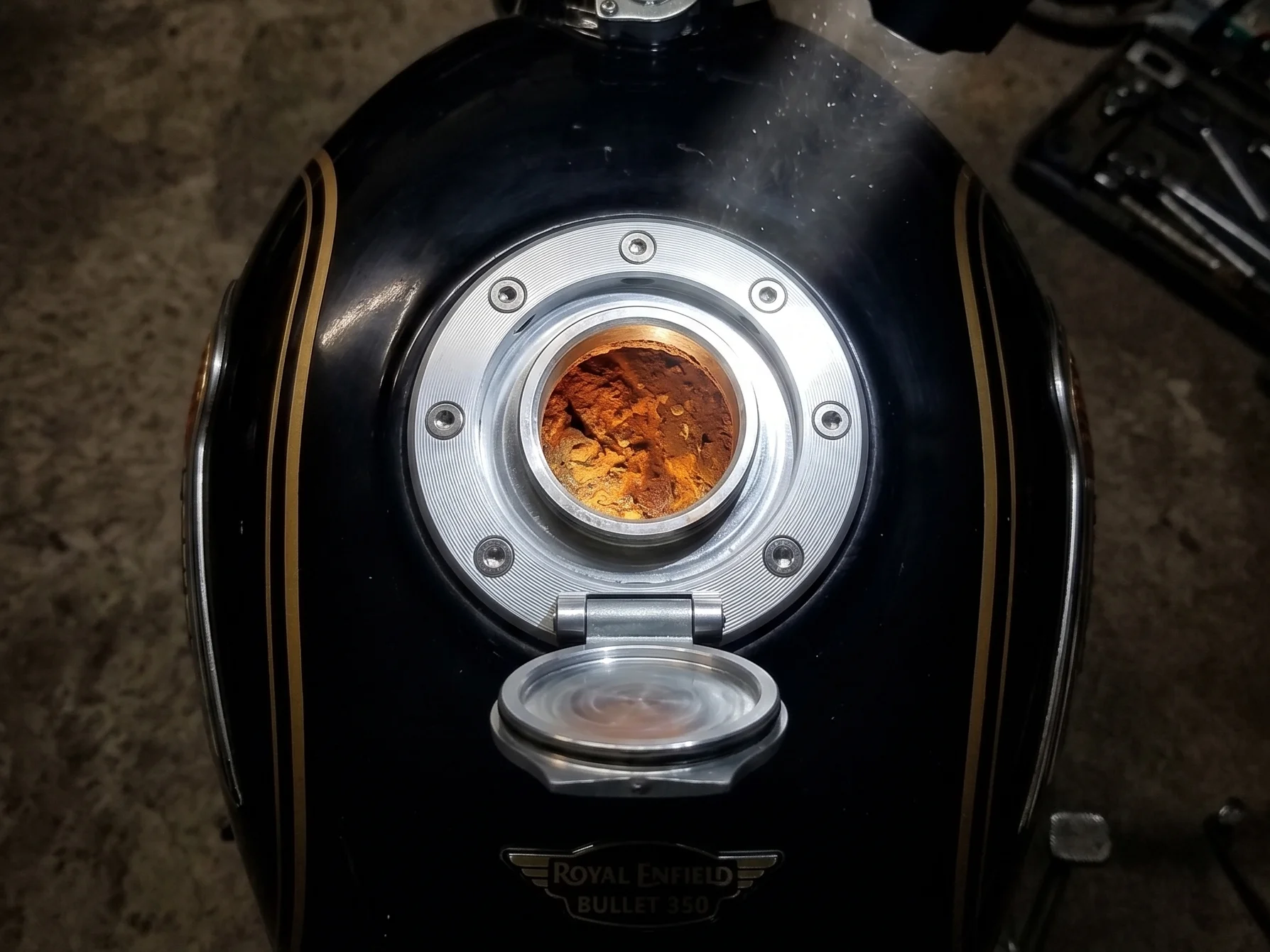
- Ajit Khandekar
- 19 Jun, 2026
E20 Petrol and Fuel Tank Corrosion, What Is Happening Inside Your Tank Right Now
The inside of a motorcycle fuel tank is not visible during routine maintenance. Unlike a tyre or a brake pad, you cannot look at it and assess its condition. You only discover tank corrosion when rust particles have already travelled through the fuel system to clog the filter, block the carburettor jet, or, in the worst cases, allow a rust-contaminated fuel supply to reach the engine. E20 petrol attacks steel fuel tanks through mechanisms that pure petrol or E10 petrol does not. The combination of ethanol's hygroscopic nature, the acidity that develops in stored ethanol-petrol blends, and ethanol's solvent action on protective coatings creates a corrosion environment inside older tanks that their designers never anticipated. This article explains each mechanism, describes the symptoms and diagnostic checks available without removing the tank, and gives the specific interventions that stop the process before it becomes a repair bill. Table of ContentsWhy Older Motorcycle Tanks Are Specifically Vulnerable The Three Corrosion Mechanisms in E20 How Fast Does Corrosion Progress The Components Most Damaged by Tank Corrosion How to Diagnose Tank Corrosion Without Removing the Tank Intervention Options, From Prevention to Repair Tank Liner Treatment, What It Is and Whether It Works When to Replace the Tank SourcesWhy Older Motorcycle Tanks Are Specifically Vulnerable Most Indian motorcycle fuel tanks manufactured before 2020 are made from stamped mild steel, welded along the centreline, and protected on the interior surface by either a thin phosphate treatment or a factory-applied coating. Neither protection was designed for sustained exposure to ethanol blends above E10. The tank design compounds the problem in two ways. First, the seam weld along the tank's centreline creates a metallurgical transition zone where the steel's crystalline structure differs from the parent metal on either side. This transition zone is more susceptible to electrochemical corrosion than the bulk steel. Second, the typical tank geometry creates a sump area, the lowest point of the tank above the petcock, where water and ethanol-water mixtures from phase separation settle and remain in contact with the metal continuously. Aluminium tanks, used on some premium models, are less susceptible to rust but are not immune. Research into aluminium alloy corrosion in ethanol-petrol blends has documented attack on the alloy's surface when acetic acid and water are present, the Cu-containing precipitates in common aluminium alloys are particularly susceptible to galvanic micro-corrosion in this environment. The Three Corrosion Mechanisms in E20 Mechanism 1, Acetic acid from microbial activity: This is the least understood and most underreported mechanism. Ethanol does not exist in a sterile environment inside a fuel tank. Bacteria from the Acetobacter family, naturally present in fuel storage environments, feed on ethanol and convert it to acetic acid, the same organic acid that gives vinegar its characteristic smell and corrosive character. These bacteria have been identified as the dominant microorganisms in contaminated fuel storage systems. They produce acetic acid in the air space above the fuel, the headspace, as well as in the fuel itself when conditions allow. Research has shown that acetic acid vapour in the headspace above an ethanol-petrol blend corrodes both steel and copper surfaces that may not even be submerged in the liquid fuel. The brass float valve inside a carburettor float bowl, for example, sits partly in the air space above the fuel and is exposed to acetic acid vapour continuously in a tank with bacterial contamination. The acetic acid production is accelerated by warmth, which makes Indian conditions, particularly in summer and in tanks stored in warm garages, more conducive to this mechanism than temperate climates where most of the fuel compatibility research was originally conducted. Mechanism 2, Water-ethanol phase separation at the tank bottom: As covered in article 8 in this series, ethanol absorbs atmospheric moisture through the air space in a partially filled tank. When moisture absorption exceeds the phase separation threshold, approximately 0.3 to 0.5 percent water by volume, depending on temperature, the ethanol and water separate from the petrol and settle at the tank bottom as a dense, mildly acidic layer. This layer remains in continuous contact with the lowest point of the steel tank interior. Unlike pure water, which would simply cause uniform rust, the ethanol-water mixture at phase separation conditions is both mildly acidic and a good electrolyte, it conducts the electrochemical current that drives metallic corrosion. The result is accelerated corrosion at the tank sump, concentrated in the area immediately above the petcock. Mechanism 3, Solvent action on protective coatings: Ethanol is a polar solvent. Many of the internal protective coatings applied to steel motorcycle tanks, particularly the phosphate treatments and alkyd-based factory coatings common in pre-2015 Indian manufacturing, were not formulated for sustained ethanol exposure. Ethanol gradually dissolves or delaminate these coatings, exposing bare steel to the fuel. Once the coating is compromised, corrosion proceeds rapidly because the mechanism shifts from surface attack on a protected steel to direct attack on bare steel in an acidic, oxygenated environment. The coating delamination also produces particulates, flakes of old coating mixed with rust, that enter the fuel stream and clog downstream components. How Fast Does Corrosion Progress The rate of corrosion varies significantly by tank condition, usage pattern, and storage environment. The following is a general timeline based on documented patterns in older carburetted Indian motorcycles running on E20 from 2025 onwards. Tanks in good pre-E20 condition, no existing rust, intact internal coating, ridden daily, show minimal visible change in the first six to twelve months of E20 exposure. The mechanisms are active but operating on intact surfaces. Tanks with pre-existing minor corrosion, small rust spots, coating degradation from normal ageing, show accelerated progression on E20. Existing rust acts as a nucleation site for further corrosion and also traps moisture. These tanks may show significant rust deposits in the filter within twelve to eighteen months of E20 exposure. Tanks stored for extended periods with partially filled E20 fuel, the highest-risk scenario, can show visible corrosion within weeks under Indian monsoon humidity conditions, particularly at the sump area where phase-separated water-ethanol settles. The LocalCircles survey of October 2025 found that 52 percent of owners of pre-2022 vehicles were experiencing unusual wear and repair needs, double the figure from two months earlier. This rate of acceleration is consistent with progressive fuel system degradation in tanks where initial corrosion seeded further damage. The Components Most Damaged by Tank Corrosion Fuel filter: The filter is the first downstream component to show evidence of tank corrosion. Brown or reddish particles in a removed fuel filter, or premature filter clogging before the normal service interval, is the primary diagnostic indicator that corrosion is active in the tank. The filter is catching what the tank is producing. Petcock and fuel tap: The petcock valve sits at the lowest point of the fuel delivery path. The brass or zinc alloy components of the petcock are susceptible to the same acetic acid environment described above. A petcock that has become stiff, difficult to operate, or that shows green or white deposits on its body is showing early corrosion effects. Carburettor jets and needle valve: Rust particles and coating flakes that pass through a degraded or absent fuel filter reach the carburettor float bowl. They settle in the bowl, partially block the main jet orifice, or lodge under the float needle valve, preventing it from seating fully and causing fuel to overflow. A carburettor that floods repeatedly after cleaning, or that shows rust-coloured particles in the float bowl, indicates ongoing tank contamination. Fuel pump (fuel-injected vehicles): In fuel-injected motorcycles, the in-tank fuel pump draws from the bottom of the tank. Rust particles in a corroded tank pass through the pump's inlet strainer, wear the pump's internal components, and may eventually cause pump failure. Fuel pump replacement is significantly more expensive than a tank treatment or filter replacement at the early-detection stage. How to Diagnose Tank Corrosion Without Removing the Tank The following checks are accessible at any service interval without tank removal. Check the fuel filter: At every service, ask your mechanic to cut open the old fuel filter if it is an inline filter, or inspect the bowl filter if fitted. Brown or reddish particles indicate rust. An unusually thick brown residue on the filter paper indicates coating delamination particles alongside rust. Inspect the petcock during oil changes: When the bike is on its side stand for an oil change, look at the petcock body for any white, green, or brown deposits. These are corrosion products from the petcock's metallic components. Check the carburettor float bowl: Request that the float bowl be drained and inspected at each carburettor service. A clean, translucent float bowl with clear petrol inside is normal. A bowl with visible rust particles, a rust-coloured bottom layer, or coating flakes indicates upstream tank corrosion. Smell the fuel when filling: Fresh E20 petrol has a characteristic slightly sweet smell from the ethanol. A fuel sample from a tank with active microbial-induced acetic acid production may have a faintly vinegary or sour note, subtle, but distinguishable from fresh petrol. This is an unreliable diagnostic on its own but worth noting alongside other indicators. Torch inspection through the filler neck: On a completely empty tank, a small torch angled through the filler neck can reveal the interior surface condition. Brown or orange discolouration on the visible interior surfaces, pitting, or visible flaking are indicators of active corrosion. This requires an empty tank and is best done at a planned service rather than casually. Intervention Options, From Prevention to Repair Prevention, active tank, good condition: For a tank in good condition with no corrosion evidence, the primary interventions are keeping the tank full during storage and using E0 petrol for extended storage periods. Both prevent the moisture accumulation that enables phase separation, the primary entry point for water-accelerated corrosion. A corrosion-inhibitor fuel additive appropriate for ethanol-blended petrol adds a layer of electrochemical protection. These additives form a protective film on metal surfaces within the fuel system. They are not a substitute for physical tank condition but provide meaningful protection in tanks exposed to E20 continuously. Article 20 in this series covers specific products. Early intervention, minor corrosion, no through-rust: If filter inspection reveals early rust particles but the tank surface has not developed through-rust or significant pitting, a tank flush followed by a tank liner treatment is the appropriate response. Flush the tank with clean petrol to remove loose particles and residue. Follow with a phosphoric acid-based tank cleaner to convert surface rust to iron phosphate, a stable, non-hygroscopic compound. Then apply a tank sealer/liner to create a fresh ethanol-resistant barrier over the treated surface. Tank liner products available in India include POR-15 Tank Sealer, Caswell Tank Liner, and domestic equivalents available through automotive supply shops. These are two-part epoxy or polyurethane formulations that cure to an ethanol-resistant surface inside the tank. Application requires a completely clean, dry tank interior, follow the product instructions exactly for preparation. Advanced corrosion, significant pitting or local through-rust: If inspection reveals through-rust, pin holes visible when the tank is held to light, or deep pitting that a liner treatment cannot bridge, the options narrow. A specialist tank repair involving welding the affected area followed by re-lining is one path. Tank replacement is the other. For common Indian models, replacement tanks are available from OEM and aftermarket suppliers at significantly lower cost than the engine damage that a failed tank eventually causes. Tank Liner Treatment, What It Is and Whether It Works Tank liner treatments are two-component coatings, typically epoxy or polyurethane resin systems, that cure to a hard, smooth, ethanol-resistant film on the interior of the treated tank. When applied correctly to a properly prepared surface, they are effective at: Sealing surface rust and minor pitting against further moisture contact. Providing a stable, non-reactive barrier between the fuel and the base metal. Resisting ethanol-blended fuels including E20 and E85 when formulated specifically for fuel compatibility. They do not work on heavily rusted tanks where the metal has lost structural integrity. They do not work on tanks that were not thoroughly cleaned and dried before application. They are not reversible, a liner applied incorrectly, or to an inadequately prepared surface, can delaminate inside the tank and create particles worse than the original rust. The preparation sequence is critical: drain and clean with petrol, flush with tank cleaner, treat rust with phosphoric acid converter, rinse and dry completely, apply liner per manufacturer instructions. Cutting corners on any step produces a failed application. This is a job that takes a full day to do correctly, a morning for cleaning and rust treatment, an afternoon for liner application and curing initiation. For tanks in early-stage corrosion where the metal is structurally sound, a correctly applied liner treatment is a cost-effective and long-lasting intervention. A quality liner applied to a well-prepared tank may outlast the vehicle's remaining service life under E20 conditions. When to Replace the Tank Replace the tank when any of the following are true: Through-rust has created pin holes or structural compromise that welding cannot practically address. The tank has been repaired previously and the repair has failed. The interior surface is so heavily pitted that a liner treatment cannot produce a smooth, bonded surface. The tank has suffered significant phase-separation-induced corrosion at the sump that extends through the metal in the area above the petcock. For common Indian models, Bajaj Pulsar, Hero Splendor variants, Honda CB series, Royal Enfield UCE-era models, replacement tanks are available from OEM dealers and aftermarket suppliers. Prices range from Rs 1,500 to Rs 8,000 depending on model and source. This is a fraction of the cost of a carburettor rebuild from rust contamination or a fuel pump replacement on an injected model. The correct time to address tank corrosion is at the filter inspection stage, when particles are appearing in the filter but no downstream damage has yet occurred. At that stage the intervention is a tank treatment costing Rs 800 to 2,500 in materials and a day of labour. Waiting until carburettor damage or fuel pump failure makes it a Rs 3,000 to 15,000 repair. SourcesScienceInsights, How Does Ethanol Damage Engines: Corrosion to Clogs, March 2026 ScienceDirect, Corrosion Behaviour of Aluminium Alloy in Bio-Ethanol Blended Gasoline, 2025 Business Standard, E20 Fuel Hits Mileage of Older Petrol Vehicles, Survey October 2025 CarToq, E20 Petrol Becomes Mandatory, April 2026 Autocar India, How E20 Petrol Affects Your Bike and Scooter, September 2025 Bureau of Indian Standards, IS 2796 E20 Petrol Specification Ministry of Petroleum and Natural Gas, Ethanol Blending Programme
- Ajit Khandekar
- 18 Jun, 2026
E20 and Carburettor Lean Running, Why Your Old Bike Misfires and What Fixes It
A fuel-injected motorcycle running on E20 measures the oxygen content in its exhaust through a lambda sensor, calculates that the mixture is slightly lean, and instructs the injector to deliver a small additional fuel pulse, all in a few milliseconds, dozens of times per second. The rider notices nothing except a marginal mileage reduction. A carburetted motorcycle has no such capability. Its carburettor is a fixed mechanical device. It delivers an air-fuel mixture determined by the physical dimensions of its jets, needle, and air passages, dimensions calibrated for a specific fuel. When the fuel changes, the carburettor does not adapt. It continues delivering the same volume of fuel to a mixture that now requires more of it. This is lean running. It is the defining problem for carburetted BS3 and BS4 motorcycles on E20 petrol, and it explains a significant portion of the misfiring, rough idle, hesitation, and performance degradation that owners of older bikes have been reporting since the E20 rollout. Table of ContentsWhy E20 Makes a Carburettor Run Lean What Lean Running Feels Like, The Symptoms Which Throttle Positions Are Affected and Why What Lean Running Does to Your Engine Over Time What Rejetting Actually Is Which Carburettor Components Are Adjusted for E20 What to Tell Your Mechanic Royal Enfield Retrofit Kits, What They Include What Rejetting Does Not Fix SourcesWhy E20 Makes a Carburettor Run Lean A carburettor meters fuel by drawing it through calibrated orifices, jets, using the vacuum created by intake airflow. The size of the main jet determines how much fuel is delivered at mid to full throttle. The pilot jet controls fuel delivery at idle and low throttle. The jet needle and needle jet manage the transition range between them. These components are sized during factory calibration to deliver a specific air-fuel ratio, typically between 13.5:1 and 14.7:1 by mass for a four-stroke petrol engine, when the bike runs on the specified fuel. For carburetted Indian motorcycles manufactured before E20, that specified fuel was E0 or E10 petrol with a calorific value of approximately 44 to 46 MJ per kilogram. E20 petrol has a lower calorific value, approximately 42 to 43 MJ per kilogram, because ethanol contains roughly 34 percent less energy per litre than pure petrol. Ethanol also contains oxygen within its molecular structure, approximately 35 percent by weight. This oxygen is already present in the fuel when it enters the carburettor. The combined effect is that when E20 passes through a carburettor calibrated for E0 or E10, the mixture arriving at the combustion chamber has more oxygen relative to combustible hydrocarbons than the calibration intended. The mixture is lean, not dramatically, but consistently and measurably across the throttle range. Autocar India confirmed this directly: older BS4 two-wheelers with carburettors end up running a lean air-fuel mixture due to the higher oxygen content in E20 fuel, leading to rising combustion temperatures and potential long-term engine harm. What Lean Running Feels Like, The Symptoms Not every carburetted bike may exhibit all of these symptoms on E20. The severity depends on how far the carburettor was from the lean edge of its calibration range on E10, the condition of the engine, and altitude. But these are the indicators to watch for. Rough or unstable idle: The idle circuit, pilot jet and air screw, is the circuit most sensitive to small mixture changes. A carburettor running lean at idle will produce an irregular idle speed that hunts up and down, a tendency to stall at traffic lights when the throttle is released, and occasionally popping or spitting through the intake on overrun. Hesitation or stumble at partial throttle: Lean running in the needle jet circuit, which governs the mixture from roughly one-quarter to three-quarter throttle, produces a characteristic stumble or hesitation when accelerating from low speed. The engine feels like it momentarily loses power before picking up again. In Indian riding conditions, frequent stop-start traffic, low-speed lane changes, constant partial-throttle use, this is one of the more noticeable E20 symptoms on older carburetted bikes. Misfiring under load: At higher throttle openings, a lean main jet circuit causes misfiring under load, typically felt as an irregular firing pattern or slight surging when riding at a constant speed on an incline or at highway speeds. The engine does not feel smooth. Overheating: Lean mixtures burn hotter than correct or slightly rich mixtures. The excess oxygen in the combustion chamber raises peak combustion temperature. In air-cooled engines, which rely entirely on airflow and engine oil to dissipate heat rather than a coolant circuit, this temperature increase is less well-managed than in liquid-cooled engines. Sustained lean running in an air-cooled carburetted engine raises cylinder head temperatures and accelerates wear on valve seats, guides, and piston crowns. White or light grey spark plug colour: A spark plug removed from an engine running lean will show a white or very light grey electrode colour rather than the correct tan or light brown. This is a reliable diagnostic indicator. If your mechanic does a plug chop, removing the plug immediately after a sustained run and reading its colour, white indicates lean. Which Throttle Positions Are Affected and Why Understanding which carburettor circuit governs which throttle position helps you describe the problem to a mechanic precisely. The pilot jet governs mixture from idle to approximately one-quarter throttle. Lean running here produces rough idle, stalling, and poor low-speed response. The jet needle and needle jet govern mixture from one-quarter to three-quarter throttle, the range used in almost all Indian urban riding conditions. Lean running here produces the hesitation and stumble that most riders describe as their primary E20 symptom. The main jet governs mixture from three-quarter to full throttle. Lean running here produces misfiring under hard acceleration and overheating under sustained high-speed riding. E20's lean effect is present across all three circuits because the oxygen content in the fuel affects the mixture throughout the throttle range. However, the symptoms are most noticeable in the pilot and needle jet circuits because those are the ranges most Indian riders spend most of their time in. What Lean Running Does to Your Engine Over Time This is the section most carburetted bike owners need to read carefully because the effects are gradual and initially invisible. Valve seat recession: The valve seats in an air-cooled four-stroke engine act as both a sealing surface and a heat transfer path, the valve closes against the seat, transfers heat into the cylinder head, and opens again. In a correctly fuelled engine, this cycle maintains valve temperatures within design limits. In a chronically lean engine running at elevated combustion temperatures, exhaust valve seats in particular see higher peak temperatures on every combustion event. Over months and years of daily use, this accelerates wear of the valve seat, a condition called valve seat recession, leading to compression loss and eventually the need for a cylinder head rebuild. Piston crown damage: Lean combustion raises the temperature of the combustion gases in contact with the piston crown. In an air-cooled engine without the thermal buffer of liquid cooling, sustained lean running can cause discolouration and eventually surface erosion of the piston crown. This is a long-term effect but one that shortens engine life measurably. Detonation risk: Under load, climbing a gradient, carrying a pillion, accelerating onto a highway, a lean mixture in a carburetted engine raises the risk of detonation. Detonation is uncontrolled combustion that generates a sharp pressure spike rather than the smooth pressure rise of normal combustion. Individual detonation events are inaudible on most single-cylinder Indian motorcycles due to their mechanical noise level, but sustained detonation damages piston crowns and big-end bearings. None of these effects destroy your engine in a week. They are the difference between an engine that runs well for 80,000 to 100,000 kilometres and one that needs significant work at 50,000 to 60,000 kilometres. What Rejetting Actually Is Rejetting is the process of replacing one or more of the carburettor's metering components, jets, needle, or air screw adjustment, with different-sized equivalents to shift the air-fuel ratio toward the correct range for the new fuel. For E20 compensation, rejetting typically means installing a slightly larger main jet and pilot jet, larger orifice means more fuel delivery at the same vacuum, compensating for the lower energy density of E20. The needle clip position may also be adjusted to lower the needle slightly, enriching the mid-throttle mixture. The air screw is adjusted to optimise idle mixture with the new pilot jet. The result is a carburettor that delivers more fuel per unit of intake air, correcting the lean condition that E20's oxygen content and lower energy density would otherwise produce. The engine runs at or near its correct air-fuel ratio, idle smooths out, hesitation reduces, and the elevated combustion temperatures from chronic lean running return to normal. What rejetting does not do is recover the mileage loss from ethanol's lower energy density. That loss is inherent to the fuel. A correctly rejetted carburettor running on E20 will deliver better power and smoother running than an unrejetted one, but it may still return lower mileage than the same engine on E0 petrol because E20 carries less energy per litre regardless of how well the carburettor is calibrated. Which Carburettor Components Are Adjusted for E20 On a typical Indian 150cc to 350cc four-stroke carburetted motorcycle, covering most Bajaj, TVS, Hero, Honda, and Royal Enfield carburetted models, the E20 rejetting typically involves: Main jet: Typically one to two sizes larger than the factory calibration. If the factory main jet is a 112, the rejetted equivalent for E20 may be a 115 or 118. The exact size depends on engine displacement, carburettor model, and current running condition. This is determined by plug chop or dyno, not by a generic table. Pilot jet: One size larger in most cases, to correct the lean condition at idle and low throttle. Alternatively, the air screw may be adjusted outward by half a turn to one turn to richen the pilot circuit without replacing the jet, this is the easier first step and may be sufficient for mild lean symptoms. Jet needle clip position: Moving the clip from the middle groove to one groove lower raises the needle, enriching the mid-throttle mixture. This is a no-cost adjustment that requires only removing the slide from the carburettor. For Royal Enfield UCE 350 BS4 carburetted models, Classic 350, Bullet 350 in their pre-Reborn carb variants, Royal Enfield has released an OEM E20 carburettor upgrade kit designated KLT00004/A, priced at approximately Rs 1,700 to 4,000 depending on model and dealer. This kit includes a rejetted carburettor specification, OEM-grade seals, and an E20 fuel tank label. It is the most straightforward rejetting solution for eligible RE models. What to Tell Your Mechanic Most mechanics in India are familiar with carburettor rejetting in principle, it is standard practice for altitude compensation and performance modifications. However, not all mechanics have rejetted specifically for E20, and the correct jet sizes for E20 compensation vary by model. At your next service, say: "My bike has a carburettor and it is running lean on E20. I want you to check the air-fuel ratio by reading the spark plug colour after a run, and if it is lean, rejet the pilot and main circuits for E20. The needle clip position should also be checked." If the mechanic is unfamiliar with the specific jet sizes for your model on E20, ask them to start with the air screw adjustment, turning it out by half a turn from the current setting, and assess whether idle and low-throttle response improves. This is a reversible, tool-free starting point that does not require jet replacement. Do not accept an ECU remap recommendation for a carburetted motorcycle. Carburetted bikes do not have an ECU controlling fuelling. Any suggestion to remap the ECU of a carburetted bike indicates the mechanic is either confused about the engine type or recommending an irrelevant service. The only fuelling adjustment available on a carburetted engine is mechanical, jets, needle position, and air screw. Royal Enfield Retrofit Kits, What They Include For owners of Royal Enfield Classic 350, Bullet 350, and equivalent UCE 350 carburetted models manufactured before the BS6 transition, Royal Enfield has produced an OEM retrofit kit specifically addressing E20 compatibility. The kit includes a carburettor jet specification adjusted for E20, new jet needle and jets for the correct air-fuel ratio on E20 fuel, along with OEM-grade rubber seals and gaskets that address the parallel concern of nitrile rubber degradation on ethanol. A fuel tank E20 label is included to mark the vehicle as having undergone the retrofit. The kit is designed for workshop installation during a carburettor service or overhaul. It does not require any special tools beyond standard carburettor service equipment. Royal Enfield recommends installation at an authorised dealer, though any experienced mechanic familiar with the UCE engine can perform the work. The kit is not compatible with fuel-injected models including the Classic 350 Reborn (J-series engine), Meteor 350, Hunter 350, and Himalayan 452, these vehicles are BS6 Phase 2 compliant and do not require carburettor modification for E20. What Rejetting Does Not Fix Rejetting addresses lean running. It does not address the other E20-related concerns that affect carburetted bikes. It does not protect rubber fuel hoses and carburettor gaskets from ethanol-related degradation, that requires material replacement, covered in article 7 in this series. It does not prevent phase separation in stored fuel, that requires keeping the tank full and using E0 petrol for storage, covered in article 8. It does not prevent corrosion of a steel fuel tank interior, that requires tank inspection and, where corrosion is present, tank treatment or lining. Rejetting is one component of an E20 adaptation strategy for carburetted bikes, not a complete solution by itself. The full checklist, including hose inspection, gasket replacement, and storage precautions, is covered in article 19 in this series. SourcesAutocar India, How E20 Petrol Affects Your Bike and Scooter, September 2025 Autocar India, BS6 Phase 2 Emissions Regulations Explained, April 2023 Riders Junction, Royal Enfield E20 Carburettor Upgrade Kit KLT00004/A CarToq, E20 Petrol Becomes Mandatory, April 2026 Bureau of Indian Standards, IS 2796 E20 Petrol Specification Ministry of Petroleum and Natural Gas, Ethanol Blending Programme
- Ajit Khandekar
- 17 Jun, 2026
Phase Separation Explained, Why Parking Your Bike in Monsoon Is Now Riskier Than Before
Before the E20 mandate, a motorcycle parked for two weeks during monsoon was mostly a battery and tyre concern. The petrol in the tank, pure or E10, absorbed very little atmospheric moisture, and whatever it absorbed stayed in solution without causing problems. E20 changes that calculation. The ethanol in E20 can absorb significantly more moisture than pure petrol, and once it absorbs enough, it does not stay in solution. It separates. The result is two distinct layers inside your fuel tank, one that is essentially low-octane petrol, and one that is an acidic ethanol-water mixture. Your engine does not run well on either layer. It runs badly on one and may not start on the other. This is phase separation. It is not a theoretical risk. It has been documented in vehicle fuel tanks across India since the E20 rollout, and India's monsoon season, June through September, is when the conditions for it are most favourable. Table of ContentsWhat Phase Separation Actually Is The Chemistry, Why E20 Is More Vulnerable Than E10 Why Monsoon Makes It Worse What Happens to Your Engine When You Start on Phase-Separated Fuel Which Vehicles and Storage Situations Are at Highest Risk Four Steps That Prevent Phase Separation What to Do If You Suspect Phase Separation Has Already Occurred SourcesWhat Phase Separation Actually Is Ethanol and water are chemically compatible, they mix readily and stay mixed. In an ethanol-petrol blend like E20, the ethanol acts as a bridge between the water molecules it absorbs from the air and the petrol in the blend. As long as the amount of water ethanol has absorbed stays below a certain threshold, everything remains in a single stable solution. The fuel in your tank looks and behaves like normal petrol. When the water content exceeds that threshold, approximately 0.3 to 0.5 percent by volume depending on temperature and blend concentration, the ethanol can no longer hold the water in solution with the petrol. The ethanol and water separate out from the petrol as a distinct layer. This is phase separation. The result inside your fuel tank is a visible layered structure. Pure petrol, now stripped of its ethanol content and lower in octane than when you filled the tank, floats on top. Below it sits a denser, milky-coloured mixture of ethanol and water. In tanks with very high water absorption, a third layer of nearly pure water may sit at the bottom. The tank is still full, the total volume has not changed. But the fuel composition has changed dramatically, and the fuel that your pump draws from the bottom of the tank is the ethanol-water layer, not the petrol. The Chemistry, Why E20 Is More Vulnerable Than E10 E20 is more vulnerable to phase separation than E10 for a straightforward reason: it contains more ethanol. More ethanol means greater capacity to absorb atmospheric moisture, which means phase separation requires more water ingress to trigger, but also that the fuel is actively pulling more moisture from the air over the same period of time. Research from the US National Renewable Energy Laboratory found that E20 can absorb nearly 50 times more water than pure petrol before reaching its phase separation threshold. That sounds reassuring until you consider the other side: because ethanol in E20 is hygroscopic, it actively seeks out and retains moisture, it is continuously drawing water from any air space inside the tank. The air space above the fuel in a partially full tank is the entry point. Every time the tank cools after riding, it contracts slightly, drawing in a small amount of fresh air. That air carries humidity. In an E10 or E0 fuel, the tiny amount of moisture in that air exchange is inconsequential. In an E20 fuel in a tank that is half-full and experiencing daily temperature cycles in monsoon conditions, the cumulative moisture absorption over two weeks can approach the phase separation threshold. The phase separation threshold is also temperature-dependent. At warmer temperatures, ethanol-petrol blends can hold more water in solution. When temperature drops, overnight or in a cool garage, the threshold falls, and fuel that was stable at 35 degrees Celsius may begin to phase-separate at 22 degrees Celsius. This is why monsoon nights, which bring temperature drops after humid days, are particularly risky for stored vehicles. Why Monsoon Makes It Worse India's monsoon season, running from June through September across most of the country, creates the conditions for phase separation more reliably than any other time of year. High relative humidity: Monsoon air regularly reaches 80 to 95 percent relative humidity across coastal and inland regions. The moisture content of air drawn into a fuel tank during temperature cycling is at its maximum during monsoon months. More moisture per air exchange means faster moisture accumulation in the fuel. Frequent temperature swings: Monsoon weather in India is characterised by warm humid days followed by cooler evenings after rainfall. These temperature swings increase the frequency and magnitude of the tank breathing cycle, expansion and contraction that pumps humid air in and out. Each cycle deposits a small amount of moisture. Over two weeks, the cumulative effect is significant. Longer storage periods: Monsoon weather in India also coincides with a behaviour pattern of keeping vehicles parked for extended periods, heavy rain discourages riding, festivals and school holidays coincide with the season, and some owners put recreational or premium motorcycles into storage during the worst monsoon months. A bike with a half-full tank of E20 parked for three weeks in monsoon conditions in Mumbai, Pune, or Chennai is in the optimal environment for phase separation to occur. The combination matters: Any one of these factors alone, high humidity, temperature swings, or extended storage, is manageable. All three together, sustained over two to three weeks, brings the risk from theoretical to real. What Happens to Your Engine When You Start on Phase-Separated Fuel The symptom pattern of starting a vehicle on phase-separated fuel is distinctive and worth knowing. Difficult or failed cold start: The fuel pump draws from the bottom of the tank. If phase separation has produced an ethanol-water layer at the tank bottom, the first fuel the pump delivers to the carburettor or injectors is mostly ethanol and water. This mixture does not ignite reliably at cold start. The engine cranks, may fire partially, and either stalls immediately or runs very roughly. Rough running and misfiring after start: Even if the engine starts, the ethanol-water mixture produces incomplete combustion. The engine runs lean, misfires under load, and may produce white or grey exhaust smoke as water vapour passes through the exhaust. In severe cases the engine stalls repeatedly. Reduced octane in the petrol layer: When ethanol separates out from the petrol, it takes octane with it. The petrol layer left behind has a lower octane rating than the original E20 blend. For carburetted engines tuned for a specific octane range, this can cause knock or detonation under load. Corrosion of tank and fuel system components: The ethanol-water layer that settles at the tank bottom is mildly acidic. If it sits in a steel tank for days or weeks, it accelerates corrosion of the tank interior, the fuel tap float, and any metal components in the lower fuel system. This is the damage pathway that leads to the significant repair bills documented in post-E20 survey data. A vehicle that experiences phase separation once and is properly remediated typically suffers no permanent damage if caught early. A vehicle that is started repeatedly on phase-separated fuel, or left stored with the separated layer sitting in the tank for weeks, may require fuel system cleaning, carburettor service, and tank inspection. Which Vehicles and Storage Situations Are at Highest Risk Highest risk, older carburetted BS3 and BS4 motorcycles parked during monsoon: These vehicles have steel fuel tanks (more corrosion-vulnerable than aluminium), gravity-fed fuel systems without return lines, and no ECU compensation for fuel quality changes. Phase separation damage in these vehicles goes directly to the carburettor and tank. High risk, any vehicle with a partially full tank stored for more than two weeks: The air space above the fuel is the moisture entry point. A half-full tank has twice the air space of a full tank and accumulates moisture proportionally faster. Vehicles stored with a quarter-tank or less are at highest risk. Moderate risk, weekend-use motorcycles in coastal or high-humidity cities: Motorcycles ridden only on weekends and parked in garages the rest of the week accumulate six days of moisture absorption per week. In Mumbai, Chennai, Kochi, or Mangaluru, where monsoon humidity stays extreme for four months, this is sufficient for gradual moisture accumulation even without extended storage. Lower risk, daily commuter bikes ridden every day: Regular use prevents moisture accumulation from reaching phase separation levels. The fuel turns over completely every few days and is replaced with fresh E20 before moisture build-up becomes critical. Daily riders in high-humidity cities should not be materially concerned about phase separation under normal use. Four Steps That Prevent Phase Separation These are ordered by effectiveness and ease. Do all four for full protection. Step 1, Keep the tank as full as possible during storage: A full tank has minimal air space. Minimal air space means minimal moisture entry per temperature cycle. This is the single most effective and free intervention for any vehicle being stored during monsoon. Fill the tank completely before any storage period of more than three to four days. If the bike is being stored for a week or more, fill the tank to the brim immediately before parking. Step 2, Use E0 petrol for the final fill before extended storage: XP100, Speed 100, or Power 100, the 100-octane, ethanol-free petrol grades available at select pumps, eliminate the hygroscopic component entirely. A tank filled with E0 petrol has no ethanol to absorb moisture and cannot phase-separate. For a seasonal storage period of two weeks or more, the Rs 50 to 60 per litre premium on a 10 to 15 litre fill, a one-time cost of Rs 500 to 900, is a small price to eliminate the phase separation risk entirely. Step 3, Use a fuel stabiliser additive for storage periods of three weeks or more: Fuel stabiliser additives approved for ethanol-blended fuels work by inhibiting the oxidation and moisture absorption processes that lead to phase separation and fuel degradation. They do not reverse phase separation that has already occurred, they prevent it from occurring in the first place. Add the stabiliser to a full tank immediately before the storage period begins, run the engine for two to three minutes to circulate the treated fuel through the entire fuel system, then park. Dosage and specific products are covered in article 20 in this series. Step 4, Store in a cool, dry environment with minimum temperature variation: A garage or covered parking that maintains a relatively stable temperature and low humidity reduces the tank breathing cycle frequency and the moisture content of any air drawn in. Not everyone has access to climate-controlled storage, but even a covered parking spot that prevents direct rain exposure and minimises temperature swings is meaningfully better than open outdoor parking for monsoon storage. What to Do If You Suspect Phase Separation Has Already Occurred If your vehicle has been stored for two or more weeks during monsoon and is now showing difficult starting, rough running, or misfiring that was not present before storage, phase separation is a reasonable first hypothesis. Do not repeatedly attempt to start the engine on what may be phase-separated fuel. Each start attempt pumps the ethanol-water layer through the fuel system and deepens the contamination. The correct response is to drain the fuel tank. For a carburetted motorcycle, open the petcock to the reserve position and drain into a clean container. Examine what comes out, if the fuel looks cloudy, milky, or shows visible layering, phase separation has occurred. Dispose of the contaminated fuel responsibly. Do not pour it into another vehicle. After draining, flush the tank briefly with a small amount of fresh petrol to displace any residual ethanol-water mixture. Refill with fresh E20 and, if the vehicle sat for an extended period, have the carburettor cleaned before riding. The float bowl will have accumulated the contaminated fuel and may need to be drained and cleaned separately. For fuel-injected vehicles, the fuel rail and injectors may require professional cleaning if they have been exposed to the ethanol-water mixture under pressure. Visit an authorised service centre and describe the storage duration and symptoms clearly. Prevention is straightforward and inexpensive. Remediation after the fact is significantly more involved. The four steps above cost nothing beyond the optional E0 fill and additive, the discipline is free. SourcesCarToq, E20 Petrol Phase Separation: Why Keeping Your Fuel Tank Full Is Critical, 2025 US National Renewable Energy Laboratory, Water Uptake and Weathering of Ethanol-Gasoline Blends in Humid Environments, 2016 Autocar India, How E20 Petrol Affects Your Bike and Scooter, September 2025 Bureau of Indian Standards, IS 2796 E20 Petrol Specification Ministry of Petroleum and Natural Gas, Ethanol Blending Programme CarzSpa, The Indian Car Owner's Survival Guide to E20 Fuel, January 2026
- Ajit Khandekar
- 16 Jun, 2026
How E20 Damages Rubber Fuel Lines, And Which Material Actually Holds Up
The fuel hoses on your bike or car are not a single piece of rubber. They are a layered assembly, an inner tube that contacts the fuel, a reinforcing braid for pressure, and an outer cover for protection. The inner tube material is what determines whether your fuel system holds up or deteriorates on E20 petrol. In most pre-BS6 Phase 2 vehicles, that inner tube is made from nitrile rubber. Nitrile rubber and ethanol have a problem. This article explains exactly what that problem is, how to identify early degradation before it becomes a failure, and what the correct replacement material is and where to source it in India. Table of ContentsWhat Nitrile Rubber Is and Why It Was Used What Ethanol Does to Nitrile Rubber Which Hoses Are at Risk in Your Vehicle How to Identify Nitrile Rubber Degradation Early Viton FKM, What It Is and Why It Holds Up Other Materials, What Works and What Does Not Sourcing Viton Fuel Hose in India What to Tell Your Mechanic How Much Does Replacement Cost SourcesWhat Nitrile Rubber Is and Why It Was Used Nitrile rubber, technically acrylonitrile-butadiene rubber, abbreviated NBR, became the dominant fuel hose material in the Indian automotive industry because it performs well in the application it was designed for: carrying petroleum-based fuel at low to moderate temperatures and pressures. Nitrile's properties match the original fuel system requirements precisely. It is resistant to mineral oils, petrol, and diesel. It is flexible across the temperature range that Indian motorcycles and cars operate in. It is inexpensive to manufacture at scale. It meets the SAE J30 specifications that most OEM fuel system suppliers were designing to when India's current vehicle fleet was built. The acrylonitrile content in nitrile rubber, typically between 28 and 45 percent, determines how oil-resistant the compound is. Higher acrylonitrile content improves petroleum resistance. Most automotive-grade nitrile runs at 33 to 40 percent acrylonitrile, which gives excellent performance in petroleum fuels. The problem is that nitrile's petroleum resistance does not extend to ethanol. Ethanol is an alcohol, not a petroleum derivative. Its molecular behaviour in contact with nitrile rubber is fundamentally different from petrol's behaviour, and the result is chemical degradation of the rubber matrix rather than mere surface contact. What Ethanol Does to Nitrile Rubber Ethanol is a polar solvent. Nitrile rubber, despite its resistance to non-polar solvents like petroleum, is susceptible to polar solvents. When ethanol in E20 fuel contacts nitrile rubber continuously over weeks and months, three things happen in sequence. Swelling: Ethanol molecules penetrate the rubber matrix and displace the cross-linked polymer chains. The rubber absorbs ethanol and expands. A nitrile hose that was a tight fit on a carburettor nipple may swell enough to restrict fuel flow or, paradoxically, to loosen if the expansion causes it to deform outward rather than inward. Internal diameter restriction reduces fuel delivery. Loss of grip on nipple fittings creates leak risk. Softening: As ethanol displaces the cross-links in the rubber matrix, the material loses its mechanical integrity. A hose that was firm and resilient becomes soft and pliable, not in the way that new rubber is pliable, but in the way that overcooked food is pliable. It has lost structural strength. At this stage the hose may feel normal on the outside but may fail under the pulsing fuel pressure that a running engine generates. Permeation and cracking: In the later stages of degradation, ethanol physically permeates through the hose wall. You may notice a faint petrol smell around the fuel system even when there is no visible leak. This is ethanol vapour passing through softened nitrile rubber. Eventually the outer surface cracks, and a hairline crack in a softened hose under fuel pressure is a fuel leak waiting to happen. The timeline for this progression on E20 depends on the original nitrile compound quality, hose age, and operating temperature. High-acrylonitrile nitrile compounds (above 40 percent) have somewhat better ethanol resistance and may progress more slowly. Standard automotive-grade nitrile at 33 to 36 percent acrylonitrile content, which is what most Indian OEM fuel hoses use, begins showing measurable swelling within six months of continuous E20 exposure in testing conditions. Which Hoses Are at Risk in Your Vehicle Not all rubber in your fuel system is the same material, and not all of it is at equal risk. Main fuel delivery hose (tank to carburettor or fuel pump): This is the primary risk component. It carries fuel continuously whenever the engine is running. It is typically 6mm to 8mm inner diameter on Indian 150cc to 350cc motorcycles. If this hose is nitrile, it is degrading on E20. Carburettor overflow and vent hoses: Smaller diameter, typically 4mm to 6mm, and carry fuel intermittently. Lower pressure than the main delivery hose, but still in continuous contact with E20 when the fuel system is full. Also at risk. Carburettor bowl gasket: Not a hose, but the same material concern. The carburettor bowl gasket is typically nitrile rubber in BS3 and BS4 carburetted vehicles. It seals the float bowl against the carburettor body. A swollen or softened gasket leaks, and a petrol leak at the carburettor bowl is a fire risk in addition to a performance issue. Fuel injector O-rings (fuel-injected vehicles): In BS6 Phase 1 and some BS4 fuel-injected vehicles, the O-rings sealing the fuel injectors to the rail and intake manifold are rubber compounds. These are typically higher-specification materials than standard nitrile in modern FI systems, but older BS4 FI vehicles may have more vulnerable O-ring compounds. A leaking injector O-ring presents as a rough idle and fuel smell under the fuel tank. Return hose (fuel-injected vehicles): Fuel injection systems have a return line from the fuel rail back to the tank. This hose carries returned fuel, still E20, and is subject to the same degradation as the delivery hose. Tank-to-tap hose and petcock seal: On carburetted motorcycles with a petcock fuel tap, the rubber seal inside the petcock and the short hose between the tank and the tap are also nitrile in most cases. These are small components but frequently overlooked in service. How to Identify Nitrile Rubber Degradation Early Early detection is the difference between a planned Rs 300 to 500 hose replacement and an unplanned fuel leak on the road. The squeeze test: With the engine off and the fuel system unpressurised, grip the main fuel delivery hose between your thumb and forefinger and squeeze gently. New or undegraded nitrile should feel firm and resilient, it springs back immediately when you release. Degraded nitrile that has been softened by ethanol exposure feels noticeably softer, does not spring back as crisply, and may feel slightly tacky on the surface. Ask your mechanic to do this test specifically at each service. Check for visible swelling: Where the hose fits over carburettor nipples or fuel tap connections, look at whether the hose still sits flush and tight or whether there is a slight bulge at the connection point. Ethanol-swollen nitrile may sometimes show a visible bulge just behind the clamp or hose clip. If a hose clip has been re-tightened recently by a mechanic without investigation, this is a sign that swelling has been noticed. The smell test: A faint but persistent petrol smell around the fuel system that is not explained by a visible wet leak is often ethanol permeating through degraded nitrile rubber. This is the hose warning you before it fails. Do not ignore a fuel smell that appears between services. Discolouration: Nitrile rubber that has absorbed ethanol may show surface discolouration, slight whitening or cloudiness, compared to the uniform black of a healthy hose. This is more visible on hoses that have not been exposed to road grime. Service history marker: If your BS4 bike has been running on E20 for more than 12 to 18 months and has not had its fuel hoses replaced or inspected, treat it as overdue. The degradation window on standard nitrile at E20 exposure puts meaningful deterioration in the 12 to 24-month range for Indian riding conditions. Viton FKM, What It Is and Why It Holds Up Viton is the trade name for fluoroelastomer rubber, generically designated FKM. It was developed in the 1950s by DuPont (now Chemours) specifically to address the limitations of standard elastomers in aggressive chemical environments. The chemistry behind Viton's resistance is the fluorine content. FKM compounds contain 65 to 70 percent fluorine by weight, bonded directly to the carbon backbone of the polymer chain. Fluorine-carbon bonds are among the strongest in organic chemistry. They do not break down in contact with alcohols, aromatic hydrocarbons, oxygenated solvents, or most automotive fuels, including ethanol blends up to E100. In direct contrast to nitrile, Viton FKM does not swell measurably in contact with ethanol. Independent testing shows near-zero volume change for FKM compounds in E85 and E100 immersion tests, conditions far more aggressive than E20. For E20, Viton FKM is essentially inert. It does not absorb the ethanol, does not soften, does not permeate, and does not crack. The trade-off is cost. FKM material costs significantly more than nitrile rubber. A Viton fuel hose for an Indian motorcycle, typically 500mm to 800mm of 6mm ID hose, costs approximately Rs 200 to 600 depending on source and quality, compared to Rs 50 to 150 for a nitrile replacement. For a one-time replacement that eliminates the primary E20 failure risk in your fuel system, this is not a significant cost. Other Materials, What Works and What Does Not PTFE (polytetrafluoroethylene): Fully ethanol-resistant, zero permeation. Used in high-performance fuel systems and braided stainless racing hoses. Excellent for E85 and E100 applications. For a standard Indian motorcycle on E20, PTFE lined hose is the premium option but more expensive than needed. EPDM (ethylene propylene diene monomer): Sometimes proposed as an alternative. EPDM has reasonable ethanol resistance but poor resistance to petroleum fuels. It is not suitable as a petrol or E20 fuel hose. Do not use EPDM as a fuel hose replacement. Silicone rubber: Good temperature resistance but poor resistance to petrol and ethanol. Not suitable for fuel hose applications. Silicone hoses are correct for coolant and intake air; wrong for fuel delivery. High-acrylonitrile nitrile (above 40 percent ACN content): Marginally better than standard nitrile on E20 but not fully resistant. If the only option available is a quality nitrile replacement, high-ACN content is preferable to standard-ACN. However, if Viton FKM is available, it is the correct choice. Sourcing Viton Fuel Hose in India Viton FKM fuel hose availability in India has improved significantly since the E20 rollout began. Several sourcing channels are currently reliable. Amazon.in: Search for "Viton fuel hose 6mm" or "FKM fuel hose 6mm", available from multiple sellers, typically in 1-metre lengths. Prices range from Rs 200 to 500 per metre. Verify the listing explicitly states Viton or FKM inner liner. Generic descriptions of "high-quality rubber hose" are not sufficient, the inner liner material must be specified. Automotive rubber suppliers: Shore Auto Rubber (TVS Mobility Group), based in Pune, manufactures FKM fuel hoses for automotive applications commercially. Their products are available through industrial rubber distributors in most major cities. This is the correct channel if you need hose in specific lengths or non-standard internal diameters. OEM retrofit kits: Royal Enfield's E20 retrofit kit for BS3 and BS4 Classic 350 and Bullet 350 models (priced at Rs 1,700 to 4,000) includes fuel system components validated for E20. If your vehicle is an eligible RE model, the OEM kit is the most straightforward option. Local automotive hose suppliers (industrial areas): In Pune, Bengaluru, Chennai, Mumbai, Delhi, and other manufacturing hubs, industrial rubber suppliers stock Viton hose for local manufacturing needs. These suppliers can often cut to length and are competitively priced compared to online options. When purchasing, confirm: inner diameter matches your existing hose, the inner liner is explicitly Viton or FKM fluoroelastomer, and the pressure rating is suitable for a gravity-fed or low-pressure carburetted fuel system (very low pressure, under 1 bar) or a fuel-injected system (3 to 5 bar depending on the system). What to Tell Your Mechanic At your next service, use this specific language: "I want you to replace the main fuel delivery hose, the carburettor overflow hoses, and the carburettor bowl gasket with Viton or FKM-rated components. The current hoses are nitrile rubber and I want to upgrade them for E20 resistance." If the mechanic says Viton hose is not available, ask them to use high-acrylonitrile nitrile as an interim and note that you want Viton at the next opportunity. If they are not familiar with the material distinction, show them the internal diameter of the existing hose and ask them to source a Viton-compatible replacement of the same dimension. Do not accept a replacement with generic nitrile hose if Viton is available. The cost difference is small. The service life difference is significant. How Much Does Replacement Cost For a typical Indian 150cc to 350cc motorcycle: The main fuel delivery hose and carburettor overflow hoses combined use approximately 500mm to 1,000mm of hose material. At Rs 300 to 500 per metre for Viton FKM hose, the material cost is Rs 150 to 500. Labour at a standard service centre for hose replacement is typically Rs 200 to 400 depending on the workshop and city. Carburettor bowl gasket replacement adds Rs 50 to 150 for the part and is often included in a carburettor service charge. Total cost for a complete fuel hose and gasket upgrade: approximately Rs 400 to 1,000 at a standard service centre, depending on model, city, and whether the mechanic charges separately for each component. This is a one-time investment. Viton FKM hose, once installed, does not need to be replaced on an E20 schedule, it may outlast the vehicle's remaining service life in this application. SourcesDelta Rubber, Nitrile vs Viton Rubber: Which Seal Material Should You Specify, April 2026 Autocar India, How E20 Petrol Affects Your Bike and Scooter, September 2025 Shore Auto Rubber (TVS Mobility Group) - FKM Fuel Hoses for Automotive Applications, Pune Business Standard - E20 Fuel Hits Mileage of Older Petrol Vehicles, Survey October 2025 Ministry of Petroleum and Natural Gas - Ethanol Blending Programme Bureau of Indian Standards - IS 2796 E20 Petrol Specification

- Ajit Khandekar
- 15 Jun, 2026
Your Owner Manual Says E10, Here Is What to Do Now That E10 No Longer Exists
Open the owner manual for any Indian motorcycle or car manufactured before April 2023 and look at the fuel specification section. In most cases, it recommends petrol with up to 10 percent ethanol, E10, as the maximum permissible blend. Some older manuals specify E5 or pure petrol. A handful say nothing about ethanol at all. None of that matters at the pump anymore. E10 has not been available at any Indian retail fuel station since the nationwide E20 rollout was completed in 2025. The only petrol at every pump in India, standard or premium, IOCL, BPCL, HPCL, Shell, or Nayara, is E20. Your manual says E10. Your tank is getting E20. The gap between those two facts is what this article addresses. Table of ContentsHow Many Vehicles Are Affected What the Manual Recommendation Actually Means Did OEMs Communicate This Change? What Happens When You Run E20 in an E10-Spec Vehicle The Practical Maintenance Response, By Vehicle Type What to Tell Your Mechanic Warranty, Insurance, and Legal Position SourcesHow Many Vehicles Are Affected The scale of this conflict is significant. India has approximately 240 million two-wheelers and 40 million cars on the road. Of these, every vehicle manufactured before April 2023 was designed and tested with E10 as the maximum ethanol blend. Vehicles manufactured between April 2020 and March 2023, the BS6 Phase 1 period, are fuel-injected and partially tolerant, but were not factory-validated for E20. The most affected segment is the largest: BS4 vehicles manufactured between April 2017 and March 2020, and all BS3 and older vehicles. These were designed for E10 at most, have fuel system components, hoses, gaskets, carburettor parts, specified for E10 tolerance, and are now running E20 with no official retrofit guidance from most manufacturers. There is no government mechanism requiring OEMs to notify existing owners when the fuel specification changes. The burden falls entirely on the vehicle owner. What the Manual Recommendation Actually Means Owner manual fuel specifications are not arbitrary suggestions. They represent the maximum ethanol concentration the manufacturer has validated against every fuel system component, rubber hoses, float bowl gaskets, carburettor jets, injector seals, fuel pump membranes, and fuel tank coatings. When a manual specifies E10, it means the manufacturer tested the vehicle on E10 and confirmed that no component degrades beyond acceptable limits over the vehicle's expected service life at that blend. It does not mean the vehicle will fail immediately on E20. It means degradation beyond the validated threshold was not tested, and the manufacturer makes no representation about performance or durability above that blend level. Running E20 in an E10-spec vehicle is not a catastrophic event on day one. It is a progressive degradation event that accelerates over months and years. The components most vulnerable, nitrile rubber hoses and gaskets, begin absorbing ethanol and swelling at a rate proportional to ethanol concentration. On E10, this rate was within acceptable tolerance. On E20, for components not specified for higher ethanol exposure, the rate is outside the validated range. Did OEMs Communicate This Change? For most vehicle owners, the answer is no. Honda India issued guidance on its website confirming that Honda cars sold since January 2009 are E20 material-compatible, and that all Honda two-wheelers from April 2023 onwards are E20-ready. For pre-April 2023 Honda two-wheelers, Honda's position is that owners should use E10 or below, a recommendation that is now impossible to follow. Bajaj Auto has acknowledged E20's arrival and referenced fuel additives as a mitigation measure for older vehicles. Royal Enfield developed retrofit kits for BS3 and BS4 Classic 350 and Bullet 350 models, priced at approximately Rs 1,700 to 4,000, covering carburettor rejetting specifically for E20. Most other manufacturers have not issued active owner communications about the E10-to-E20 transition. If you have not received a letter, SMS, or email from your manufacturer advising you on E20 compatibility, you are in the majority. The practical consequence is that millions of vehicle owners are making fuelling decisions with no guidance, leading to a pattern documented by the LocalCircles survey of October 2025: 80 percent of owners of pre-2022 vehicles reported mileage drops, and 52 percent reported unusual wear and repair needs, double the figure from two months earlier as E20 exposure continued. What Happens When You Run E20 in an E10-Spec Vehicle The failure modes operate on different timescales, which is part of why the damage is difficult to attribute directly. Immediate effects (within first few tankfuls): Mileage reduction, typically 7 to 15 percent in carburetted BS4 vehicles. Possible rough idle or slight hesitation under load in carburetted engines as the air-fuel mixture runs lean. No mechanical damage at this stage, just performance changes. Short-term effects (one to six months): Nitrile rubber hoses begin to swell slightly as ethanol permeates the material. This reduces internal diameter and can restrict fuel flow. Carburettor bowl gaskets show early signs of swelling. Fuel filter may clog earlier than the usual service interval if it is trapping ethanol-degraded particulates from hose or gasket breakdown. None of these are visible without inspection. Medium-term effects (six months to two years): Fuel hose degradation accelerates. A hose that was firm and crack-free may become soft and porous. In some cases owners notice a faint petrol smell near the fuel system, this is ethanol permeating through softened nitrile rubber, a precursor to a fuel leak. Carburettor jets may show deposits from ethanol's solvent action loosening old varnish and carbon from the fuel system. Fuel pump diaphragm in carburetted vehicles may show deterioration. Long-term effects (two years or more): In high-humidity environments or vehicles that sit unused for extended periods, phase separation can cause the ethanol-water mixture to settle at the tank bottom, creating an acidic layer that corrodes steel tank interiors and brass float valves. Seal failures, fuel leaks, and injector fouling become more likely. A LocalCircles survey found that a luxury car owner in Chennai spent nearly Rs 4 lakh on repairs after water contamination from E20 caused engine damage. The timeline varies significantly by vehicle age, kilometres on the odometer, how often it is ridden, and local climate. Monsoon humidity accelerates moisture absorption. The Practical Maintenance Response, By Vehicle Type This is the section that translates the problem into action. Carburetted BS3 and older vehicles: These vehicles face the highest risk and have the least factory protection. The priority actions in order of urgency: First, inspect rubber fuel hoses at the next service. Ask the mechanic to physically flex the hoses and check for softness, swelling, or any surface cracking. Nitrile rubber that has been exposed to E20 for an extended period will feel noticeably softer than new. If hoses show any degradation, replace them with Viton FKM rubber hoses. Viton is ethanol-resistant and is the correct replacement material for E20 conditions. Second, inspect and replace the carburettor bowl gasket. This is an inexpensive part, typically under Rs 100, and accessible at any service centre. If it shows swelling or deformation, replace it. Do this proactively at every second service interval going forward. Third, if you are experiencing misfiring, rough idle, or hesitation at partial throttle, have the carburettor rejetted for E20. Rejetting adjusts the air-fuel mixture to compensate for ethanol's lower energy content. This is a mechanic task. It does not involve the ECU and is straightforward for any experienced two-wheeler mechanic. Fourth, if the vehicle is parked for more than two weeks at a time, consider using E0 petrol, XP100, Speed 100, or Power 100, for the last fill before storage. This eliminates the phase separation risk during the storage period. Carburetted BS4 vehicles: Same priority actions as BS3, but the fuel system materials are generally more tolerant and degradation will be slower. The carburettor bowl gasket inspection is still the most cost-effective preventive step. Rejetting is worth considering if you have noticed misfiring, do not wait for the problem to worsen. Fuel-injected BS4 vehicles: Lean running is not a concern, the lambda sensor and closed-loop fuel injection system adapt to E20 automatically. Corrosion and seal degradation remain relevant. Inspect fuel lines at service. The fuel filter is the most likely first point of evidence of ethanol-related degradation, a clogged or discoloured filter before its expected service interval is a signal worth investigating. BS6 Phase 1 vehicles (April 2020 to March 2023): These vehicles are fuel-injected with more modern materials than BS4. E20 is within the adaptive range of their fuel injection systems. However, their fuel system materials were specified to E10 tolerances, not E20. Practical experience over the first year of E20 exposure will determine how quickly any degradation becomes visible. Monitor fuel system components at scheduled service intervals and flag any fuel smell or starting difficulty promptly. What to Tell Your Mechanic Many service centre mechanics have not been formally briefed on E20-related fuel system issues by OEMs. Some are aware through their own research or customer complaints. Many are not proactively looking for ethanol-related degradation unless instructed. At your next service, say this specifically: "My bike was manufactured before 2023. My owner manual says E10. The pump now has E20. I want you to check the rubber fuel hoses, the carburettor bowl gasket, and the fuel filter for any signs of ethanol-related swelling or degradation." This framing gives the mechanic a specific task with a known cause. It is more likely to produce a useful inspection than a general "check the fuel system" instruction. If the mechanic says there is no issue with E20 in older vehicles, ask them to show you the condition of the hose material specifically. The physical condition of the nitrile rubber is the evidence. Keep a record of the inspection findings and any parts replaced. If a pattern of fuel system degradation becomes apparent over multiple services, this documentation is useful context for any warranty or insurance discussion. Warranty, Insurance, and Legal Position The warranty position for most pre-April 2023 vehicles is straightforward: the vehicle is out of its standard warranty period for any mechanical components, so manufacturer warranty is not a primary concern for most owners in this category. For vehicles still within warranty, typically BS6 Phase 1 vehicles registered between 2020 and 2023 that may have remaining warranty coverage, the situation is less clear. The Ministry of Petroleum clarified publicly that E20 fuel has no impact on vehicle insurance validity. Insurance companies confirmed this through official statements in 2025. A misinterpreted social media post in 2025 suggested E20 damage would void insurance; the Ministry dismissed this as baseless. However, the warranty question, whether an OEM will cover fuel system component failure in a vehicle whose manual specifies E10 when the owner has been running E20 because no alternative is available, has not been definitively tested. The government mandated E20 at all pumps without a parallel mandate requiring OEMs to extend warranty coverage or issue compatibility bulletins. This is a gap in the policy framework. The practical advice: document your fuel system inspections, replace degrading components proactively, and if a significant repair arises that you believe is directly attributable to E20 exposure in a vehicle specified for E10, raise it with your OEM's customer service before authorising the repair. The response will vary by manufacturer, but creating a paper trail is more useful than having none. SourcesAutocar India, How E20 Petrol Affects Your Bike and Scooter, September 2025 Business Standard, E20 Fuel Hits Mileage of Older Petrol Vehicles, Survey, October 2025 CarToq, E20 Petrol Becomes Mandatory, April 2026 Honda India, E20 Compatibility by Model Ministry of Petroleum and Natural Gas, E20 Insurance Clarification, 2025 Bureau of Indian Standards, IS 2796 E20 Petrol Specification 91Wheels, How to Save Your Car or Bike If Not E20 Compliant, September 2025
- Ajit Khandekar
- 14 Jun, 2026
India's Ethanol Blending Roadmap, E20 to E100, Timelines and What It Means for Your Vehicle
India's ethanol blending programme has consistently moved faster than anyone anticipated. The E20 target was originally set for 2030. It was advanced to 2025, then achieved ahead of that. E30 standards are now published. E85 is dispensing at pumps in Delhi and other cities this week. The direction is not subtle, and it is not reversing. This article documents the complete roadmap, what has happened, what is legally in place, what is at pumps today, and what is still on paper, so you can make informed decisions about your vehicle now rather than when the next transition arrives without warning. Table of ContentsHow to Read This Roadmap E5 and E10, The Foundation Years E20, The Current Mandate E22, E25, E27, E30, Standards Published, Pumps Pending E85, Live at Select Pumps Now E100, Long-Term Direction, No Confirmed Timeline What Each Stage Means for Your Vehicle How to Stay Ahead of the Next Transition SourcesHow to Read This Roadmap Not every stage of this roadmap carries the same weight. There is an important distinction between three levels of policy status: Standard published means the Bureau of Indian Standards has issued a technical specification for the fuel. The fuel can legally be produced and sold in India. It does not mean it is at pumps. Mandate in force means the government has directed oil marketing companies to sell the fuel at retail outlets. This is the stage at which a blend affects every vehicle on the road. Live at pumps means the fuel is physically available for purchase at retail stations, either nationally or at named locations. Confusing these three levels is where most coverage of India's ethanol programme goes wrong. This article is precise about which stage each blend is at. E5 and E10, The Foundation Years India's ethanol blending programme began formally in 2003 under the Ethanol Blended Petrol programme, initially as a voluntary scheme in nine states. Progress was slow through the 2000s due to supply constraints and state-level implementation inconsistencies. By the ethanol supply year 2013 to 2014, blending had reached just 1.5 percent nationally. The shift accelerated through the mid-2010s as sugarcane surplus created both supply and political will to increase ethanol offtake. E10, 10 percent ethanol, was the national standard from approximately 2022 onwards, achieved five months ahead of its November 2022 deadline. For most vehicles built after 2005, E10 caused no meaningful fuel system issues. Rubber components tolerant to E10 were standard equipment in BS4 and later vehicles. E10 is no longer available at any retail pump in India. It has been fully superseded by E20. E20, The Current Mandate Status: Mandate in force nationwide from April 2026. The E20 mandate was originally set for 2030 under the National Policy on Biofuels 2018. It was advanced to 2025 by cabinet amendment in 2022, and further advanced to April 2023 for a gazette notification permitting oil marketing companies to begin selling E20 across all states. Nationwide completion, E20 at every retail pump, was achieved in 2025, five years ahead of the original target and the fastest ethanol blending ramp-up of any major economy outside Brazil. From 1 April 2026, E20 is the only standard petrol grade available at approximately 90,000 retail fuel stations across India. Every litre of standard or premium petrol purchased at any Indian pump, including XP95, Speed 95, Power 95, Speed 97, and Shell V-Power, contains 20 percent ethanol. The sole exception is 100-octane petrol: XP100, Speed 100, and Power 100 remain E0. E20 under BIS IS 2796 mandates a minimum Research Octane Number of 95. All standard petrol in India is now RON 95 minimum as a direct consequence of the ethanol blending programme. The current E20 mandate is stated to remain in force until at least October 31, 2026. Beyond that date, the government retains discretion to maintain E20 or begin transitioning pumps to higher blends as infrastructure readiness permits. E22, E25, E27, E30, Standards Published, Pumps Pending Status: BIS standard IS 19850:2026 published 15 May 2026. Not yet at retail pumps. On 15 May 2026, the Bureau of Indian Standards published IS 19850:2026, establishing formal fuel quality specifications for E22, E25, E27, and E30 petrol. The standard covers admixtures of anhydrous ethanol and motor gasoline for positive ignition engine-powered vehicles, the technical definition covering all standard petrol cars and motorcycles. The standard defines permissible ethanol content levels, octane requirements, sulphur content limits, and vapour pressure specifications for each blend. It took effect immediately from 15 May 2026 under Rule 15(1) of the Bureau of Indian Standards Rules 2018. What this means precisely: these fuels can now legally be manufactured and sold in India. The standard does not mandate that oil marketing companies must sell these blends at retail pumps, nor does it set a timeline for retail availability. It is the regulatory prerequisite for the next transition, the foundation that must be laid before pumps can dispense higher blends. The government has separately advised state-run oil marketing companies, IOCL, BPCL, and HPCL, along with private retailers Jio-bp Mobility, Nayara Energy, and Shell, to begin building infrastructure for dispensing E22, E25, and E30 fuels. This is advisory, not yet mandated. The Automotive Research Association of India has been asked by the Ministry of Petroleum to study the impact of E25 fuel on vehicles compliant with E10 and E20. That study has not yet published findings. This is relevant for the timeline: retail availability of E30 at pumps is unlikely before ARAI's findings are published and the government is satisfied with vehicle compatibility data. Industry experts and current affairs analysts suggest commercial E30 rollout could begin between 2028 and 2030, depending on vehicle readiness, infrastructure development, and ethanol availability. This is an estimate, not a government commitment. What E30 means for vehicles: The same failure modes that affect BS3 and BS4 vehicles on E20, rubber degradation, corrosion, lean running in carburettors, may be amplified on E30. Vehicles designed for E20 but not E30 will experience the same compatibility gap that E10-designed vehicles face on E20 today. The transition will land hardest on BS6 Phase 1 vehicles manufactured between April 2020 and March 2023, which are calibrated for E20 but not validated for higher blends. E85, Live at Select Pumps Now Status: Live at select pumps in Delhi and other cities. Exclusive to flex fuel vehicles. E85 is an 85 percent ethanol, 15 percent petrol blend. It is not a new concept in India, IOCL ran E100 pilot dispensing stations in Pune as far back as 2021. But retail E85 infrastructure is new and moving fast. As of June 2026, E85 is available at 48 retail outlets operated by public sector oil marketing companies across India, primarily in Delhi and select Maharashtra locations. The government's confirmed plan is to expand this to 500 E85 dispensing stations by December 2026 and 5,000 outlets across major Indian cities by end-2027. Pricing: E85 is priced at approximately Rs 20 per litre less than standard E20 petrol in Delhi. At current Delhi E20 prices of approximately Rs 102 per litre, E85 is approximately Rs 82 per litre. The price advantage exists because ethanol is a domestically produced commodity, not an imported one, and is priced at government-determined procurement rates. The price advantage does not offset the mileage penalty. Flex fuel vehicles running on E85 return approximately 25 to 35 percent lower mileage than the same vehicle on E20, owing to ethanol's lower energy density. The per-kilometre fuel cost on E85 is higher than on E20 for most vehicles despite the lower pump price. E85 is exclusively for flex fuel compatible vehicles. A flex fuel vehicle has an engine, fuel system, and ECU specifically designed to run on any ethanol-petrol blend from E20 to E85 without modification or damage. Standard vehicles, including all BS6 Phase 2 cars and motorcycles that are factory E20-compliant, are not flex fuel compatible. Filling a standard vehicle with E85 will cause immediate and serious damage to rubber fuel system components, injectors, and engine internals. Currently available flex fuel vehicles in India include the Hero flex fuel 97.2cc motorcycles launched in Delhi and select Maharashtra regions from July 2026, the Suzuki Gixxer 250 SF Flex Fuel launched at the 2025 Bharat Mobility Expo, and the Maruti Wagon R Flex Fuel in production-ready form for the commercial sector. Tata Motors has indicated its first flex fuel passenger vehicle could be ready by end-2026. Toyota has showcased flex fuel Innova Hycross prototypes. E100, Long-Term Direction, No Confirmed Timeline Status: Pilot stations existed in Pune since 2021. No confirmed national rollout timeline. E100 is pure ethanol fuel, 100 percent ethanol, zero percent petrol. It requires a dedicated flex fuel engine and cannot be used in any current standard or E20-compliant vehicle. E85-compatible vehicles can typically also run on E100, but standard flex fuel vehicles sold in markets like Brazil are calibrated for the full E0 to E100 range. Union Minister Nitin Gadkari has repeatedly championed E100 as India's long-term energy self-reliance goal, targeting the country's approximately 87 percent crude oil import dependency. India's current ethanol production capacity stands at approximately 19 to 20 billion litres annually, while E20 blending demand consumes roughly 11 billion litres. Scaling to E85 and E100 across a significant portion of the fleet would absorb the surplus and create new demand. The Ministry of Road Transport and Highways has proposed draft amendments to the Central Motor Vehicles Rules to formally incorporate E85 and E100 fuels as recognised fuel grades, alongside proposed emission standards for flex fuel vehicles. These amendments are under consultation. E100 as a national fuel standard requires a complete generational shift in vehicle technology. The current fleet of approximately 240 million two-wheelers and 40 million cars on Indian roads is not E100-compatible and cannot be made so through retrofit. E100 will be a parallel fuel for a new category of vehicles, not a replacement for petrol in existing ones. What Each Stage Means for Your Vehicle The practical impact of each blend level depends entirely on when your vehicle was manufactured and what fuel system materials it has. For BS3 and older vehicles, every step up the ethanol ladder increases existing damage rates. These vehicles were not designed for E10. They are running on E20 today. E30 may accelerate rubber degradation and corrosion measurably faster than E20. The priority action is fuel system inspection and component replacement now, not after the next mandate arrives. For BS4 vehicles, E20 is the primary concern today. E30 readiness should be on your medium-term radar, within the next two to three years. BS4 vehicles calibrated for E10 will face the same compatibility gap on E30 that BS3 vehicles face on E20. The Viton hose replacement and carburettor maintenance that is appropriate for E20 now is also the preparation for E30. For BS6 Phase 1 vehicles manufactured between April 2020 and March 2023, E20 is manageable. E30 may require attention, these vehicles were not factory-validated for E30, and the higher ethanol concentration will test fuel system materials that were specified to E20 tolerances. Monitor fuel system components and watch for ARAI's E25 compatibility study results when published. For BS6 Phase 2 vehicles manufactured from April 2023, E20 is no concern. E30 readiness depends on whether manufacturers proactively update ECU calibration and validate fuel system materials for the higher blend, some may, through software updates, and some may require a service centre visit. Watch for OEM advisories when E30 retail availability is announced. For flex fuel vehicle owners, E85 is available now at select pumps and expanding. The per-kilometre cost calculation at current prices does not favour E85 for daily use unless the discount widens. Use the fuel if it suits your usage pattern; do not use it to save money on fuel at current prices. How to Stay Ahead of the Next Transition The E20 transition arrived without adequate public communication. Many vehicle owners discovered their fuel had changed only after noticing mileage drops or running problems. The E30 transition may follow the same pattern, a BIS standard is already published, and retail rollout may follow when infrastructure and vehicle readiness align. Three actions are worth taking now regardless of your vehicle's BS standard: Document your current mileage baseline over three consecutive tanks. This gives you a reference point to detect degradation when the next blend arrives. At your next service, ask your mechanic to note the condition of rubber fuel system components. If they are showing early degradation signs on E20, they may fail faster on E30. Follow official channels for E30 retail announcements, MoPNG's press releases and BIS gazette notifications are the only authoritative sources. Social media and forum discussions about ethanol content are frequently wrong, as the XP95 myth demonstrated. Verify through official sources before making fuel or maintenance decisions. This site will track E30 and E85 developments as they occur. The roadmap above will be updated when new notifications, retail announcements, or ARAI study findings change any stage's status. SourcesBureau of Indian Standards, IS 19850:2026, E22 to E30 Fuel Standards, 15 May 2026 Bureau of Indian Standards, IS 2796, E20 Petrol Specification Ministry of Petroleum and Natural Gas, National Policy on Biofuels 2018 DriveSpark, India's First E85 Fuel Station Opens in Delhi, June 2026 ProKerala, Government to Roll Out 5,000 E85 Stations by 2027, June 2026 Autocar India, Government Notifies Standards for Petrol Blends Beyond E20, May 2026 Newsgram, BIS Notifies Standards E22 to E30 Fuel, May 2026 Deccan Herald, E20 Rollout Row: Government Has No Plan to Go Back to E0 GKToday, India Notifies E30 Petrol Norms, May 2026

- Ajit Khandekar
- 13 Jun, 2026
Is XP95 Ethanol Free? The Myth Every BS4 Owner Needs to Stop Believing
XP95 is not ethanol free. It contains 20 percent ethanol, the same as standard petrol. This has been confirmed by an RTI filed with Indian Oil Corporation, independently verified by a laboratory gas chromatography test conducted by Autocar India, and corroborated by multiple Right to Information replies across cities. If you have been paying the XP95 premium believing it protects your BS4 or older vehicle from ethanol-related damage, you have been paying for additives while receiving identical ethanol exposure. This article presents the evidence, explains why the myth persists, and tells you what actually works. Table of ContentsIs XP95 Ethanol Free? The Evidence, RTI Replies and a Lab Test Why the Myth Persists What XP95 Actually Is What About Speed 95, Power 95, and Shell V-Power? What Should BS4 Owners Do Instead? The Only Ethanol-Free Option at Indian Pumps SourcesIs XP95 Ethanol Free? No. XP95 is E20 petrol. It contains 20 percent ethanol by volume, the same as standard petrol at every other pump in India. There is no reduced-ethanol or ethanol-free option available in the XP95 grade or any other sub-100-octane premium grade at Indian retail pumps. This is not ambiguous. It is not a matter of interpretation or regional variation. It is confirmed by the oil company itself through an official government transparency mechanism. The Evidence, RTI Replies and a Lab Test RTI Reply, IOCL, July 2025: A Right to Information application filed with Indian Oil Corporation in June 2025 asked two direct questions: what is the ethanol percentage in XP95 petrol sold in Kolkata, and what is the ethanol percentage in standard Motor Spirit sold in Kolkata. The reply, issued by IOCL's Public Information Officer on 3 July 2025, gave the same answer to both questions: 20 percent. XP95 and standard petrol contain identical ethanol content. A separate RTI filed earlier confirmed the same finding across Delhi outlets. IOCL's pan-India response has been consistent: XP95 is blended with up to 20 percent ethanol across India, depending on availability of ethanol at supply locations. The upper limit is 20 percent. There is no minimum-ethanol or ethanol-free XP95 variant. Gas Chromatography Lab Test, Autocar India, September 2025: Autocar India obtained fuel samples of standard petrol and XP95 from retail pumps and sent them for independent gas chromatography testing, the only scientifically reliable method for measuring ethanol content in fuel. The results were unambiguous. Standard petrol tested at 20.86 percent ethanol, slightly above the stated 20 percent, within blending tolerances. XP95 tested at 19.88 percent ethanol. Both grades are E20 fuels by any reasonable definition. Autocar India also tested XP100 and Power 100 from the 100-octane segment. Both returned zero percent ethanol, confirming that E0 status is genuine and exclusive to the 100-octane grades. The chromatography test is important because it eliminates the ambiguity created by water separation tests, a popular DIY method used by enthusiasts to detect ethanol in fuel. Water separation tests are unreliable. Fuel additives including MTBE can produce false positives, suggesting ethanol-free fuel when ethanol is present, or vice versa. The GC test is definitive. Why the Myth Persists Several factors reinforce the XP95-is-ethanol-free belief, none of them accurate. The price premium signals quality: XP95 costs more than standard petrol. Consumers reasonably infer that a premium price means a purer or higher-quality product. In terms of performance additives, that is partially true, XP95 contains a detergent and deposit-control additive package that standard petrol does not. But those additives have no bearing on ethanol content. The price premium reflects additive cost, not ethanol reduction. The name "XP95" sounds performance-oriented: "XP" implies extra performance. "95" appears to reference the octane rating. Neither part of the name says anything about ethanol content, but the branding positions the fuel as a cut above standard, leading buyers to assume it is better in every dimension. Oil companies initially gave contradictory answers: When vehicle owners contacted IOCL, BPCL, and HPCL on social media in 2025 asking about ethanol content in premium grades, some responses incorrectly stated that premium fuels contained E10 or E15. Those responses were inaccurate. The RTI mechanism and independent testing have since provided authoritative confirmation that all sub-100-octane grades are E20. Water separation tests produced confusing results: Home ethanol testing using the water separation method became popular on forums and YouTube in 2025. These tests frequently produced inconsistent results, sometimes suggesting low or zero ethanol in XP95, sometimes suggesting high ethanol. The inconsistency led some owners to conclude that XP95 had variable or lower ethanol content. The GC test confirmed this interpretation was wrong. The water separation method is not reliable for these fuels. What XP95 Actually Is XP95 is standard E20 petrol with a performance additive package. The additives serve real purposes: Detergent additives help prevent carbon deposits on fuel injectors and intake valves, particularly relevant for fuel-injected engines that accumulate deposits over time. Deposit-control chemistry helps maintain fuel system cleanliness in engines that see varied fuel quality or extended service intervals. The 95 RON octane rating is not meaningfully higher than standard E20 petrol. Before the E20 mandate, standard petrol in India had a RON of approximately 91. Blending 20 percent ethanol raises the octane rating to approximately 95 RON. Standard E20 petrol now meets the 95 RON minimum under BIS IS 2796. XP95 and standard petrol are both 95 RON fuels. The octane gap that once existed between them has been eliminated by the ethanol mandate itself. In practical terms: XP95 offers cleaner injectors and intake valves compared to standard petrol in fuel-injected engines. It offers no ethanol reduction, no corrosion protection from ethanol, and no mileage improvement beyond the small cleaning benefit for deposit-laden injectors. What About Speed 95, Power 95, and Shell V-Power? The same answer applies to all of them. Bharat Petroleum's Speed 97 contains 20 percent ethanol. BPCL confirmed this directly. Hindustan Petroleum's Power 95 contains 20 percent ethanol. Shell V-Power, sold at select Shell outlets in India, contains 20 percent ethanol. All premium petrol grades below 100 octane in India are E20. CarDekho independently confirmed this through oil company responses: there is no intermediate blending in India's retail fuel market. The choice is binary, standard E20 petrol, premium E20 petrol with additives, or 100-octane E0 petrol. There is no reduced-ethanol middle ground at any price point. What Should BS4 Owners Do Instead? The underlying concern driving XP95 purchases among older vehicle owners is legitimate: ethanol damages fuel system components in BS3 and BS4 vehicles not designed for it. That concern is real and well-founded. The solution, however, is not premium petrol. It is targeted maintenance. Replace nitrile rubber fuel hoses with Viton FKM equivalents. Nitrile rubber degrades under sustained ethanol exposure. Viton, also called FKM fluoroelastomer, is ethanol-resistant and is the appropriate replacement material. This is a one-time intervention that eliminates the primary mechanical risk. The relevant article on this site covers the replacement process in detail. Inspect and replace carburettor bowl gaskets at service intervals. The carburettor bowl gasket in a carburetted BS4 bike is typically nitrile rubber. It is inexpensive and accessible. At your next service, ask the mechanic to check its condition and replace it if there is any sign of swelling or degradation. Rejett the carburettor if misfiring. Carburetted engines running lean on E20, because ethanol has lower energy density than petrol, may exhibit rough idle, misfiring under load, or hesitation at partial throttle. Rejetting the carburettor corrects the air-fuel ratio for E20. This is a mechanic task, not DIY. It does not involve the ECU and applies only to carburetted engines. Establish a mileage baseline. Measure your kmpl over three full tanks using a consistent method. Knowing your actual mileage gives you a reference point. A drop of more than 10 to 15 percent from your pre-E20 baseline suggests a fuel system issue worth investigating, not simply the expected mileage reduction from ethanol. None of these steps involve premium petrol. The additive package in XP95 does not prevent ethanol-related seal degradation, does not reduce moisture absorption, and does not compensate for lean running in carburettors. The Only Ethanol-Free Option at Indian Pumps If you genuinely need ethanol-free petrol, for a vintage motorcycle, for long-term vehicle storage, or for a superbike with a 100-RON engine requirement, the options are XP100 from IOCL, Speed 100 from BPCL, and Power 100 from HPCL. All three are 100-octane, E0 fuel, confirmed ethanol-free by independent testing and RTI. They are available at select pumps in major cities and priced at approximately {{price_range_100}}. They are not practical for daily commuting on cost grounds. For daily use in a BS4 bike, targeted maintenance is the answer. For long-term storage or a vehicle that genuinely requires ethanol-free fuel, XP100 and its equivalents are the correct choice. XP95 is neither. It is E20 with additives. Use it for cleaner injectors if that matters to you. Do not use it as a substitute for ethanol-free petrol, because it is not one. SourcesIOCL RTI Reply, XP95 Ethanol Content 20%, July 2025, via Trak.in CarToq, IOCL Premium Fuel XP95 Confirmed 20% Ethanol, August 2025 Autocar India, How Much Ethanol Is in Your Petrol? GC Lab Test, September 2025 CarDekho, E20 Petrol Blending Explained: Which Grades Contain Ethanol Bureau of Indian Standards, IS 2796 E20 Petrol Specification, RON 95 Minimum CarToq, IOCL RTI XP100 Confirmed No Ethanol, September 2025
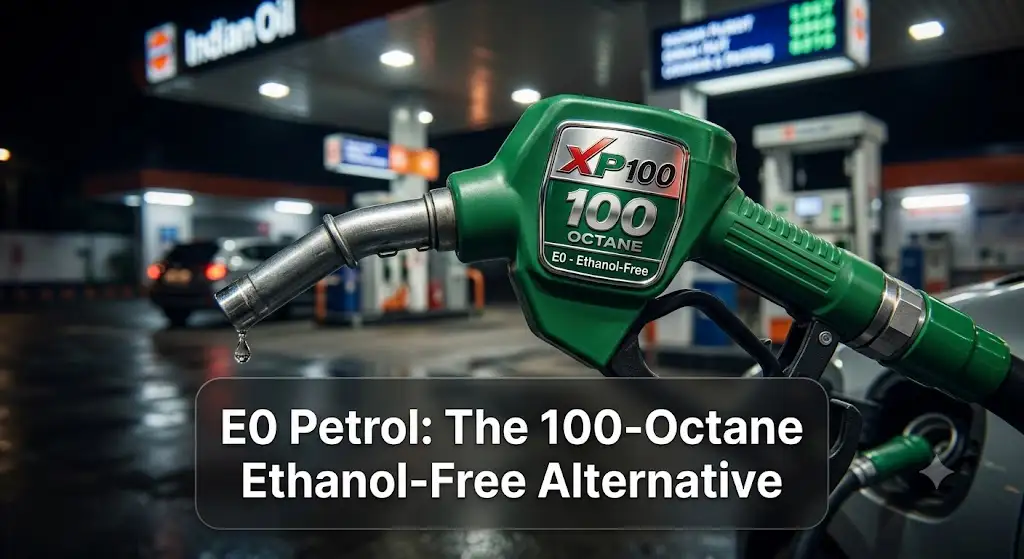
- Ajit Khandekar
- 12 Jun, 2026
What Is E0 Petrol in India, XP100, Speed 100 and Power 100 Explained
Every standard petrol grade at every pump in India is now E20, blended with 20 percent ethanol. XP95, Speed 95, Shell V-Power, Power 95, Speed 97, all of them contain ethanol. There is no ethanol-free option in the standard or premium segments. But there is one category that remains E0: 100-octane petrol. XP100 from Indian Oil, Speed 100 from Bharat Petroleum, and Power 100 from Hindustan Petroleum are the only grades of petrol available at Indian retail pumps that contain zero percent ethanol. This article explains exactly what they are, where to find them, what they cost, and, critically, who actually needs them and who does not. Table of ContentsWhat E0 Petrol Actually Means The Three E0 Options in India Why Only 100-Octane Petrol Remains Ethanol-Free Where to Find E0 Petrol and What It Costs Who Should Use E0 Petrol Who Should Not Use E0 Petrol The XP95 Myth, and Why It Keeps Spreading SourcesWhat E0 Petrol Actually Means E0 is simply petrol with zero percent ethanol content. Pure petrol, refined from crude oil, with no alcohol blended in. Before India's ethanol blending programme began in earnest, all petrol was effectively E0. Today, E0 at a retail pump is the exception, not the rule, and it comes at a significant price premium. The E in E0, E10, E20, E85 refers to the percentage of ethanol in the fuel blend by volume. E0 is 100 percent petrol. E20 is 80 percent petrol and 20 percent ethanol. The number is not an octane rating, it is an ethanol content label. This distinction matters because many vehicle owners conflate ethanol content with fuel quality, assuming that premium-grade petrol must have less ethanol. That assumption is wrong, and it has led to a widespread misconception that is actively causing problems for older vehicle owners. E0 petrol has a higher energy content per litre than any ethanol blend. Ethanol contains roughly 34 percent less energy per litre than pure petrol. A litre of E0 delivers more potential energy to your engine than a litre of E20. This is why mileage on E0 is always higher than mileage on E20 in the same vehicle, regardless of the octane rating. The Three E0 Options in India XP100, Indian Oil Corporation (IOCL): Launched in December 2020, XP100 was India's first commercially available 100-octane petrol. It carries a Research Octane Number of 100 and contains zero percent ethanol. IOCL confirmed via a Right to Information reply that XP100 does not have ethanol blending, making it the most authoritatively documented E0 option currently available. XP100 is available at select IOCL pumps across major cities. Current pricing is approximately {{price_xp100}} depending on city and state taxes. Speed 100, Bharat Petroleum (BPCL): BPCL's 100-octane offering, available at select pumps across eight cities as of early 2026. Zero percent ethanol, 100 RON. Priced at approximately {{price_speed100}}. The fuel has been independently tested and confirmed ethanol-free. BPCL's own response on social media confirmed that Speed 97 contains E20, while Speed 100 remains E0, the distinction between the two grades is not just octane, it is ethanol content. Power 100, Hindustan Petroleum (HPCL): HPCL's 100-octane, ethanol-free grade. Available at select HPCL outlets. Pricing is approximately {{price_power100}}. Same fuel specification as the other two, 100 RON, E0. All three are functionally equivalent in their ethanol-free status. The minor differences in formulation, detergent additives, lubricity improvers, may vary by brand but the core specification is identical: 100 RON, zero ethanol. Why Only 100-Octane Petrol Remains Ethanol-Free This is the question most vehicle owners do not think to ask, and the answer explains the entire landscape. Ethanol blending raises the octane rating of petrol. Pure petrol without additives typically has a Research Octane Number of around 88 to 91. Blending in 20 percent ethanol raises that to approximately 95 RON, which is why all standard E20 petrol in India now meets the minimum 95 RON specification under BIS IS 2796. For premium grades like XP95, Speed 95, Speed 97, and Shell V-Power, the octane boost from ethanol actually helps meet their octane targets without additional refining costs. There is no technical barrier to blending ethanol into these grades, and no commercial incentive for the oil marketing companies to keep them ethanol-free. For 100-octane petrol, the situation is different. Achieving a genuine 100 RON requires either high-quality base refining, specific performance additives, or both. Blending ethanol at E20 levels into a 100-octane base would raise the RON further, creating a fuel above 100, not a problem in itself, but it would change the product specification and require re-testing and re-certification. More practically, the target market for 100-octane petrol is high-performance vehicles and superbikes whose owners have heightened sensitivity to fuel quality. Introducing ethanol into this grade may likely reduce demand. The oil marketing companies have chosen to keep 100-octane as E0. This is not a regulatory requirement. There is no BIS standard mandating that 100-octane petrol must be ethanol-free. It is a commercial and technical decision by IOCL, BPCL, and HPCL. In theory, E0 100-octane fuel could be withdrawn or reformulated at any point. Where to Find E0 Petrol and What It Costs E0 petrol is available in major cities only. It is not at every pump, it is at select high-traffic outlets and those near premium vehicle dealerships and motorsport venues. For XP100, IOCL has outlets in Delhi, Gurugram, Noida, Agra, Jaipur, Chandigarh, Ludhiana, Mumbai, Pune, Ahmedabad, Chennai, Bengaluru, Hyderabad, Kolkata, and Bhubaneswar among others. To find the nearest XP100 pump, search the IOCL fuel station locator on the IndianOil website and filter by fuel type. For Speed 100, BPCL outlets are currently in eight cities. For Power 100, check the HPCL pump locator. On cost: at approximately {{price_range_100}} versus Rs 100 to 110 for standard E20 petrol in most cities, E0 petrol carries a significant premium. On a 15-litre tank fill, that is Rs 600 to 900 extra per tankful. For daily commuting on a 150cc to 250cc bike doing 40 to 50 kmpl, that translates to approximately Rs 2,500 to 4,000 extra per month in fuel costs. For a 350cc to 500cc bike covering 25 to 35 kmpl, the monthly premium is Rs 1,500 to 2,500. The E0 Fuel Finder tool on this site is being developed to show verified E0 pump locations near you, initially covering Maharashtra with expansion planned. Who Should Use E0 Petrol E0 petrol is appropriate and practically justified for three categories of vehicle and use case. Long-term vehicle storage: This is the most unambiguous use case for E0. When a vehicle is stored for more than two weeks, during an extended trip, monsoon storage for a vintage bike, or simply a vehicle used only on weekends, E0 petrol eliminates the risk of phase separation. Ethanol in E20 absorbs atmospheric moisture during storage. If enough moisture accumulates, the ethanol-water mixture can separate from the petrol and settle at the bottom of the tank as a layer of dilute alcohol. This layer does not combust cleanly and can cause starting difficulty, rough running, and accelerated corrosion of the fuel tank interior. Filling with E0 before long-term storage prevents this entirely. Vintage and classic motorcycles with no retrofit available: Pre-BS3 bikes, Royal Enfield bullets from the 1980s and 1990s, Yezdi, Rajdoot, older Jawas, have fuel systems that were designed for pure petrol. Viton hose upgrades may not be available for all models, and carburettor rejetting alone does not address corrosion risk. For these vehicles, E0 petrol on a full-time basis is the most conservative approach to fuel system preservation. The price premium is justified by the cost and difficulty of replacing irreplaceable parts. High-performance superbikes with 100-RON engine requirements: Some superbikes, primarily imported litre-class motorcycles, have ECUs and compression ratios tuned for 100 RON fuel. Using lower-octane petrol in these engines can cause knock under high loads. XP100, Speed 100, and Power 100 are the correct fuel grade for these vehicles. The ethanol-free aspect is a secondary benefit; the primary reason to use them is the octane requirement. Who Should Not Use E0 Petrol This is the section that most people need to read most carefully. BS4 and BS6 commuter bikes and standard motorcycles: A standard BS4 Bajaj Pulsar, TVS Apache, or Yamaha FZ running on E0 petrol may not experience any performance improvement. These engines are not tuned for 100 RON, their compression ratios and ignition timing are calibrated for 91 to 95 RON fuel. Running 100 RON in a 91-RON engine does not produce more power, better mileage, or reduced wear. The only guaranteed outcome is a significantly higher fuel bill. The mileage improvement from E0 versus E20 in a standard bike is real, approximately 5 to 8 percent in a BS4 model, because E0 has higher energy density. But at Rs 50 to 60 extra per litre, that mileage recovery costs far more than the mileage lost. The arithmetic does not work for daily use. BS4 owners seeking to protect their fuel system from ethanol damage: This is the most important misconception to address. Some BS4 owners have concluded that filling with XP100 on every tankful will protect their fuel system from ethanol damage. This logic is correct in its premise, E0 eliminates ethanol exposure. But the solution is disproportionate to the problem. The correct response to ethanol-related fuel system concerns in a BS4 bike is targeted maintenance: replacing nitrile rubber hoses with Viton FKM equivalents, inspecting and replacing carburettor gaskets, and cleaning the fuel system at appropriate intervals. These interventions cost a fraction of the ongoing E0 fuel premium and address the actual failure modes directly. BS6 Phase 2 vehicles: These are factory E20-compliant. There is no fuel system risk from E20 in a BS6 Phase 2 vehicle. Using E0 petrol provides no benefit beyond the marginal energy density improvement, at a cost that makes no financial sense for daily use. The XP95 Myth, and Why It Keeps Spreading A separate article on this site addresses the XP95 misconception in full detail. The short version: XP95 contains 20 percent ethanol. It is E20. It is not ethanol-free, it is not lower-ethanol than standard petrol, and filling with XP95 instead of standard petrol provides no protection against ethanol-related fuel system damage in older vehicles. The misconception persists because the name "XP95" sounds premium, because it costs more than standard petrol, and because people reasonably assume that a more expensive fuel must be better in every dimension, including ethanol content. None of these assumptions are correct. IOCL confirmed via Right to Information that XP95 is blended with up to 20 percent ethanol pan India, the same as standard petrol. The only meaningful difference between XP95 and standard E20 petrol is the additive package, detergent and deposit-control additives that may help keep fuel injectors and intake valves cleaner. On ethanol content, they are identical. If you have been filling your BS4 or older vehicle with XP95 believing it to be ethanol-free, you have been paying a premium for additives while getting the same ethanol exposure as standard petrol. Switch to XP100 if you need genuine E0 petrol for storage or a vintage vehicle. If you are using a standard commuter or mid-range motorcycle daily, the maintenance approach is more cost-effective than any fuel premium. SourcesIOCL Right to Information Reply, XP100 Ethanol Content Confirmed, September 2025 Bureau of Indian Standards, IS 2796 E20 Petrol Specification, RON 95 Minimum CarDekho, E20 Petrol Blending Explained: Which Grades Contain Ethanol CarToq, Bharat Petroleum Speed 100 Ethanol Fuel Test, March 2026 IndianOil Corporation, XP100 Product Page Bharat Petroleum, Speed Fuels Official Page Ministry of Petroleum and Natural Gas, Ethanol Blending Programme
- Ajit Khandekar
- 11 Jun, 2026
BS3, BS4, BS6: Which Emission Standard Is Your Vehicle and Why It Decides Everything About E20
When someone asks whether their bike or car is safe on E20 petrol, the first question is always the same: which BS emission standard is it? Not the brand. Not the model name. The BS standard. That single answer determines how much mileage you may lose, which components are at risk, and what maintenance your vehicle needs right now. Table of ContentsWhat BS Emission Standards Actually Are The Four Standards That Matter for E20 How to Find Your Vehicle's BS Standard in Under Two Minutes What Each Standard Means for E20 Petrol The BS6 Phase 1 vs Phase 2 Distinction Most Owners Miss What to Do Once You Know Your Standard SourcesWhat BS Emission Standards Actually Are Bharat Stage emission standards are pollution control regulations set by the Government of India that define the maximum amount of harmful gases a vehicle's exhaust may emit. Each successive stage is stricter than the last. The numbering follows India's own regulatory progression, BS1 in 2000 through BS6 today, loosely based on Euro emission standards but implemented on India's own timeline. For vehicle owners, the BS standard matters for three practical reasons: resale value, city-specific restrictions on older vehicles, and now, since the E20 mandate, fuel compatibility. The same engine that ran fine on E10 petrol in 2024 may behave very differently on E20 in 2026, depending entirely on the BS standard it was built to. The standards do not describe fuel compatibility directly. They describe engine design, fuel system materials, and emissions control technology. But those design choices are what determine whether your vehicle tolerates ethanol blends, adapts to them automatically, or degrades under them over time. The Four Standards That Matter for E20 India has had six Bharat Stage standards, but for the practical question of E20 compatibility, four are relevant. BS3 (2005 to 2010 for two-wheelers, 2010 nationwide): Carburetted engines almost universally. No electronic fuel management. Fuel system components (hoses, gaskets, float bowls) built for pure petrol or at most E5. The highest-risk category for E20 damage. BS4 (April 2017 nationwide): A significant step forward in emissions but not in ethanol tolerance. Both carburetted and early fuel-injected variants exist depending on model. Fuel system materials were designed for E10 at most. This is the standard that affects the largest number of vehicle owners currently on Indian roads, with an estimated 75 to 80 million pre-BS4 bikes alone still registered and in daily use. BS6 Phase 1 (April 2020 to March 2023): India skipped BS5 entirely and moved directly to BS6 from April 2020. Phase 1 brought fuel injection and closed-loop lambda sensors to virtually all petrol vehicles. The lambda sensor allows the ECU to adjust the air-fuel mixture in real time, which partially compensates for ethanol's lower energy content. However, Phase 1 vehicles were not factory-calibrated specifically for E20 and were not tested under E20 conditions. BS6 Phase 2 (April 2023 onwards): This is the E20-compliant standard. From April 2023, all new petrol vehicles were required to have their ECUs calibrated for E20 operation, pass Real Driving Emissions testing under RDE norms, and include OBD2 onboard diagnostics. A vehicle manufactured from April 2023 onwards is factory E20-ready. Any mileage reduction it shows on E20 is inherent to ethanol's lower energy density, not a compatibility fault. How to Find Your Vehicle's BS Standard in Under Two Minutes There are five methods, in order of reliability. Method 1, VAHAN portal (most accurate): Go to vahan.parivahan.gov.in and enter your vehicle's registration number. The portal pulls data directly from the Ministry of Road Transport and Highways database. Look for the field labelled "Emission Norms" or "Norms Type." It will show BS-IV, BS-VI, or similar. This is the authoritative government record. Method 2, Your RC book or smart card: The physical Registration Certificate or RC smart card shows the emission standard under a field labelled "Emission Norms" or "Bharat Stage." Check both the front and back of the card. The smart card RC issued after 2019 carries an embedded chip with this data. If the field is blank, use Method 1. Method 3, mParivahan or DigiLocker app: Open your digital RC in the mParivahan or DigiLocker app. The emission standard appears in the vehicle details section alongside fuel type, engine capacity, and registration date. MoRTH confirmed in 2024 that the digital RC is legally equivalent to the physical card. Method 4, Registration date as a guide: If none of the above work, your registration date narrows it down significantly. Vehicles registered before April 2017 are BS3 or earlier. Vehicles registered between April 2017 and March 2020 are BS4. Vehicles registered between April 2020 and March 2023 are BS6 Phase 1. Vehicles registered from April 2023 onwards are BS6 Phase 2. Note that registration date is approximate, some vehicles were sold just before a regulatory deadline and may have been manufactured under the previous standard. Method 5, Chassis number at an authorised service centre: For older vehicles where documentation is incomplete or unclear, an authorised service centre can confirm the BS standard using the chassis number. This is particularly useful for pre-2010 bikes where RC details may not have been fully populated in the VAHAN system. What Each Standard Means for E20 Petrol BS3 and older: Your vehicle was designed for E0 to E5 petrol. It has no ethanol tolerance built into its fuel system. Running E20 continuously causes progressive nitrile rubber degradation in hoses and gaskets, increased corrosion risk in the fuel tank, and lean running in the carburettor due to ethanol's lower energy content and higher oxygen content. Mileage drops of 10 to 20 percent are typical. These are not dramatic sudden failures, they are gradual, which makes them easy to miss until a seal fails or the carburettor starts misfiring under load. Inspect fuel system components at every service and refer to articles on rubber hose damage, carburettor lean running, and fuel tank corrosion in this series. BS4: This is where the majority of the problem lies. BS4 fuel systems were designed for E10 at most. Carburetted BS4 bikes face lean running and rubber degradation. Fuel-injected BS4 models handle lean running better via the lambda sensor, but remain vulnerable to corrosion and seal deterioration. The Ministry of Petroleum acknowledged that in vehicles with more than 20,000 km on the odometer, rubber gaskets may need replacement. Expect 7 to 15 percent mileage loss on carburetted BS4 models. BS6 Phase 1 (April 2020 to March 2023): These vehicles are fuel-injected with closed-loop mixture control. The lambda sensor compensates for ethanol's lower calorific value up to approximately E27, meaning your engine self-adjusts on E20 without misfiring. Rubber components in Phase 1 vehicles are generally more ethanol-tolerant than BS4, though not fully validated to E20 specifications. Expect a 5 to 8 percent mileage reduction. Monitor fuel system components at service intervals and report any unusual fuel smell or starting difficulty. BS6 Phase 2 (April 2023 onwards): Factory E20-compliant. ECU calibrated for E20, OBD2 diagnostics, and real-world emissions tested under RDE norms. A 3 to 5 percent mileage reduction compared to what you would see on E0 petrol is normal and expected, it is the energy density difference between ethanol and petrol, not an engineering fault. If you are seeing more than 5 percent, the cause is maintenance-related, not fuel-related. The BS6 Phase 1 vs Phase 2 Distinction Most Owners Miss This is the most commonly misunderstood point in the entire E20 conversation. Many BS6 vehicle owners assume that because their vehicle is BS6, it is fully E20-compatible. That is only true for BS6 Phase 2, manufactured from April 2023 onwards. BS6 Phase 1 vehicles, sold between April 2020 and March 2023, are not factory-calibrated for E20. They may run on E20 and the fuel injection system may adapt, but their fuel system materials and ECU calibration were not specifically validated against E20 operating conditions. The practical difference is relatively small compared to the gap between BS4 and BS6, but it is real. The simplest rule: if your vehicle was manufactured from April 2023 onwards, it is E20-ready by regulation. If it was manufactured before April 2023, regardless of whether it is BS6 Phase 1, BS4, or older, it was not factory-designed for E20. To check which phase of BS6 your vehicle falls under, the registration date method above applies directly. If your RC shows registration before April 2023 and the emission norm shows BS-VI, you have a Phase 1 vehicle. What to Do Once You Know Your Standard BS3 or older: Inspect rubber fuel hoses and carburettor bowl gaskets at your next service. Ask specifically whether the hose material is nitrile rubber (if it is, replacement with Viton FKM hoses is the appropriate step. Rejett the carburettor if you are experiencing misfiring or rough idle. Ethanol-free petrol (XP100, Speed 100, Power 100) is available at select pumps at approximately {{price_range_100}}) practical for storage or long-term parking, not for daily commuting on cost grounds. BS4: Same fuel system inspection applies. For fuel-injected BS4 models, lean running is less of a concern, but corrosion and seal degradation still apply. Establish a mileage baseline now by tracking kmpl over three consecutive tanks. If you see a drop of more than 15 percent from your pre-E20 baseline, visit your service centre and specifically mention ethanol as a possible cause. BS6 Phase 1: No immediate action required. Monitor mileage and report any fuel system issues at scheduled service. Keep receipts for any fuel system repairs in case questions arise about warranty coverage. BS6 Phase 2: No action required beyond normal scheduled maintenance. Your vehicle was built for this fuel. One final point: the ethanol blending programme is not stopping at E20. BIS standard IS 19850:2026 for E30 was published in May 2026. E85 is already dispensing at select stations across India. Whatever your vehicle's current BS standard, understanding it now gives you the lead time to make informed decisions before the next transition arrives. SourcesVAHAN Portal, Ministry of Road Transport and Highways Bureau of Indian Standards, IS 2796 E20 Petrol Specification Autocar India, BS6 Phase 2 Emissions Regulations Explained, April 2023 Business Standard, BS-VI Rule in Delhi Explained, December 2025 Spinny, How to Check if Your Car Is BS4 or BS6, December 2025 Autocar India, How E20 Petrol Affects Your Bike and Scooter, September 2025 Ministry of Petroleum and Natural Gas, Ethanol Blending Programme
- Ajit Khandekar
- 10 Jun, 2026
Ethanol Blended Petrol in India, What It Is, What It Does to Your Vehicle, and What Comes Next
India's petrol changed permanently in 2025. Every pump at nearly 90,000 fuel stations across the country now dispenses E20, petrol blended with 20 percent ethanol. There was no opt-out, no alternative grade, and no warning on the nozzle. If you own a vehicle built before April 2023, you are already running a fuel your engine was never designed for. This article explains exactly what that means, what it is doing to your vehicle right now, and what the government has planned next. Table of ContentsWhat Ethanol Blending Actually Means India's Blending Roadmap, E5 to E85 What Ethanol Does to Older Vehicles Which Vehicles Are at Risk and Which Are Not E85 and Flex Fuel, What Is Actually Available Right Now What You Should Do Next SourcesWhat Ethanol Blending Actually Means Ethanol is an alcohol-based fuel produced from sugarcane, maize, and agricultural waste. In India, sugarcane is the dominant feedstock. When added to petrol, ethanol changes two things that matter most to your engine: energy content and chemical behaviour. Ethanol contains roughly 34 percent less energy per litre than pure petrol. In an E20 blend, about one fifth of the fuel in your tank carries less energy. Your engine burns through the tank faster to deliver the same power. That is where mileage loss originates, before any question of engine compatibility arises. The second issue is more serious for older vehicles. Ethanol is hygroscopic, meaning it actively absorbs moisture from the atmosphere. That moisture enters your fuel system and does not simply evaporate. It stays, mixes with ethanol to form a mildly acidic solution, and begins attacking every component it contacts, metal, rubber, and aluminium alike. This is the root cause of the corrosion, seal failure, and carburettor damage that pre-BS6 vehicle owners have been reporting since the E20 rollout. Bureau of Indian Standards specification IS 2796 governs E20 petrol in India and mandates a minimum Research Octane Number of 95. Every litre of standard petrol at every pump in India, including XP95, is E20 under this specification. There is no standard-grade ethanol-free option at Indian pumps. India's Blending Roadmap, E5 to E85 India's ethanol blending programme has moved faster than almost any comparable policy in the country's history. E5 and E10 (2013 to 2022): Blending started at 1.5 percent in the 2013-14 ethanol supply year and reached 10 percent by 2021-22. E10 was the standard fuel at most pumps until 2025. It is no longer available. E20 (2025 onwards): The government's original E20 target was 2030. It was first advanced to 2025, then to April 2023 for select regions. Nationwide rollout was completed in 2025, five years ahead of the original schedule. E20 is now the only grade of standard petrol available across India. E30 (announced, not yet at pumps): In a formal notification dated 15 May 2026, the Bureau of Indian Standards officially established IS 19850:2026, which sets fuel specifications for E22, E25, E27, and E30 petrol variants. The standard exists. The fuel does not yet. E30 is the next transition and may carry the same risks as E20 for older vehicles, amplified. E85 (available at select stations): E85 is an 85 percent ethanol blend available at a limited number of IndianOil stations across five states. It is intended exclusively for flex fuel compatible vehicles. A standard bike or car, even a BS6 Phase 2 model, cannot run on E85 without engine damage. E100 (long-term direction): Union Minister Nitin Gadkari has championed 100 percent ethanol as India's long-term goal, targeting the country's 87 percent oil import dependency. There is no confirmed rollout timeline. It requires a complete shift to dedicated flex fuel engines across the entire vehicle fleet. What Ethanol Does to Older Vehicles Four specific failure modes affect pre-BS6 vehicles running on E20. Each one is documented, measurable, and in most cases progressive, meaning it gets worse with every tankful. Mileage drop: Autocar India's own test programme recorded mileage drops of up to 12 percent on older vehicles during the E20 transition. The Ministry of Petroleum's official position is a 3 to 6 percent drop for older models. The actual figure for a high-mileage carburetted BS4 bike sits closer to 7 to 15 percent depending on engine condition, riding style, and whether the carburettor has been rejetted. There is no configuration of E20 that delivers equal or better mileage than E0 petrol in the same engine. Rubber and seal degradation: Ethanol is a solvent. It attacks nitrile rubber, the material used for fuel hoses, carburettor bowl gaskets, and injector seals in vehicles built before ethanol-compatibility became a design requirement. The Ministry of Petroleum acknowledged this in its public guidance, noting that in vehicles with more than 20,000 km on the odometer, rubber gaskets may require replacement. The degradation is not visible until a seal fails, at which point you have a fuel leak, not a warning sign. Corrosion and moisture damage: Water absorbed by ethanol forms a mildly acidic solution inside your fuel system. Over time this corrodes aluminium carburettor bodies, steel fuel tanks, and brass float valves. The risk is highest during monsoon season when ambient humidity accelerates moisture absorption. Phase separation, where the water-ethanol mixture separates from petrol and settles at the bottom of the tank, is a particular risk for vehicles that sit unused for more than two weeks. Lean running in carburetted engines: Fuel-injected engines can adjust their air-fuel mixture in real time to compensate for ethanol's lower energy content. Carburetted engines cannot. A standard carburettor set up for E0 or E10 petrol may run lean on E20, meaning the mixture has too much air relative to fuel. Lean running causes rough idle, misfiring under load, and accelerated valve and piston wear in air-cooled engines over time. Rejetting the carburettor corrects the mixture ratio, but most service centres have not been proactively advising this. Which Vehicles Are at Risk and Which Are Not Highest risk, BS3 and older, carburetted engines: All four failure modes apply with no factory mitigation. These vehicles were designed for E0 petrol. Their rubber components, carburettors, and fuel tanks have no ethanol tolerance built in. Mileage drops of 10 to 20 percent are typical. If you own a pre-2010 motorcycle and have noticed increased fuel consumption, rougher idle, or any fuel system issues since 2025, ethanol exposure is the most likely cause. Moderate risk, BS4, carburetted and early fuel-injected: This is the largest at-risk segment. There are an estimated 75 to 80 million pre-BS4 bikes still on Indian roads, and BS4 adds tens of millions more. BS4 vehicles were designed for E10 at most. Rubber components may tolerate E20 for a period, but degradation is ongoing. Fuel-injected BS4 models handle the lean running issue but remain vulnerable to corrosion and seal degradation. Expect 7 to 15 percent mileage loss on carburetted BS4 models. Low risk, BS6 Phase 2, manufactured after April 2023: These vehicles are factory E20-compliant. Engine components, fuel system materials, and ECU calibration are all designed for E20. A 3 to 5 percent mileage reduction compared to E0 petrol is inherent to ethanol's energy density and is not a fault. If your BS6 Phase 2 vehicle is showing more than a 5 percent mileage drop, the cause is elsewhere. E85 and Flex Fuel, What Is Actually Available Right Now E85 is not a future concept in India. It is available today, in limited locations, for a specific category of vehicle. IndianOil is currently supplying E85 at select stations across five states. The fuel is sold as "Ethanol 100" at these locations and is intended for flex fuel vehicles only. A flex fuel vehicle has an engine, fuel system, and ECU designed to run on any blend from E0 to E85 without modification. Standard petrol vehicles, including all current BS6 Phase 2 bikes and cars, are not flex fuel compatible. The Ministry of Road Transport and Highways has issued a draft notification proposing amendments to the Central Motor Vehicles Rules to formally incorporate E85 and E100 fuels. The draft is open for public comment. This is regulatory groundwork, not a rollout announcement. Ensuring E85 compatibility requires far more than E20 compliance. Higher ethanol concentrations introduce significantly greater moisture exposure, accelerated corrosion risk, and different combustion characteristics. Manufacturers may need to redesign specific engine components, fuel system materials, and injection calibration for E85. You cannot make a standard vehicle E85-compatible through a retrofit kit or ECU remap. For E30, the BIS standard IS 19850:2026 is now in place. The specification exists. Pump availability has not been announced. When E30 does roll out, the impact on BS4 and older vehicles may be greater than E20, the same failure modes with higher ethanol concentration driving faster degradation. What You Should Do Next Your action depends entirely on which category your vehicle falls into. If you own a BS6 Phase 2 vehicle manufactured after April 2023: Measure your mileage over the next two full tanks using a consistent method, same route, same riding style, full-to-full calculation. A 3 to 5 percent reduction from what your owner manual states is normal and expected on E20. If you are seeing more than 5 percent, visit your authorised service centre. The cause is not the fuel, it is engine condition, tyre pressure, or another maintenance issue. If you own a BS4 vehicle: At your next service, specifically ask the mechanic to inspect rubber fuel lines, the carburettor bowl gasket, and the fuel filter. Do not wait for a failure. Ask whether the carburettor jetting is correct for E20. Note any misfiring, rough idle at startup, or unexplained drop in tank range, these are early signs of lean running or seal degradation. Document your mileage per tank now so you have a baseline for comparison. If you own a BS3 or older vehicle: Understand your options clearly. Ethanol-free petrol exists in India, XP100 from IOCL, Speed 100 from BPCL, and Power 100 from HPCL are all 100 RON, E0 fuel, available at select pumps at approximately Rs 160 to 180 per litre. This is not practical for daily use given the price and availability. The realistic path is targeted maintenance: replace nitrile rubber fuel hoses with Viton FKM equivalents, inspect the fuel tank for internal corrosion, and rejett the carburettor if you are experiencing lean running symptoms. These are not large interventions. They are the difference between a vehicle that degrades slowly and one that fails at an inconvenient time. The government may not slow the ethanol programme. E30 has a published BIS standard and E85 is already at pumps in five states. The question for older vehicle owners is not whether to adapt, it is how quickly and at what cost. SourcesBureau of Indian Standards, IS 2796 E20 Petrol Specification Bureau of Indian Standards, IS 19850:2026 E22 to E30 Fuel Standard, May 2026 Ministry of Petroleum and Natural Gas, Ethanol Blending Programme Ministry of Road Transport and Highways, Draft Notification E85 and E100, 2026 Autocar India, How E20 Petrol Affects Your Bike and Scooter, September 2025 SIAM Statement on E20 Mileage Impact, August 2025 Drivespark, India Issues E85 and E100 Draft Notification, April 2026 iamabiker, India's Ethanol Blending Story, May 2026