E20 Petrol and Fuel Tank Corrosion, What Is Happening Inside Your Tank Right Now
-
 Ajit Khandekar
 - 19 Jun, 2026
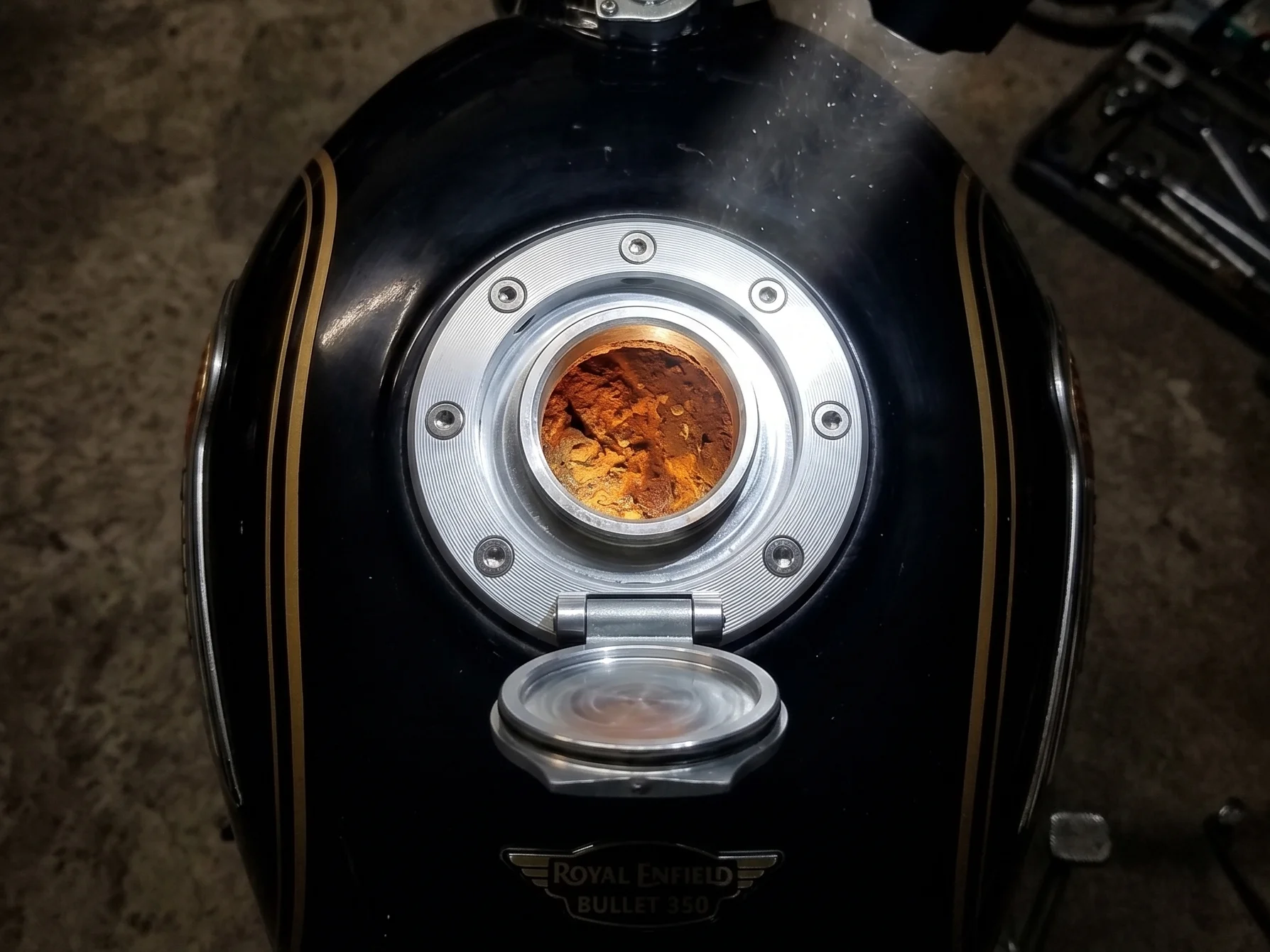
The inside of a motorcycle fuel tank is not visible during routine maintenance. Unlike a tyre or a brake pad, you cannot look at it and assess its condition. You only discover tank corrosion when rust particles have already travelled through the fuel system to clog the filter, block the carburettor jet, or, in the worst cases, allow a rust-contaminated fuel supply to reach the engine.
E20 petrol attacks steel fuel tanks through mechanisms that pure petrol or E10 petrol does not. The combination of ethanol’s hygroscopic nature, the acidity that develops in stored ethanol-petrol blends, and ethanol’s solvent action on protective coatings creates a corrosion environment inside older tanks that their designers never anticipated. This article explains each mechanism, describes the symptoms and diagnostic checks available without removing the tank, and gives the specific interventions that stop the process before it becomes a repair bill.
Table of Contents
- Why Older Motorcycle Tanks Are Specifically Vulnerable
- The Three Corrosion Mechanisms in E20
- How Fast Does Corrosion Progress
- The Components Most Damaged by Tank Corrosion
- How to Diagnose Tank Corrosion Without Removing the Tank
- Intervention Options, From Prevention to Repair
- Tank Liner Treatment, What It Is and Whether It Works
- When to Replace the Tank
- Sources
Why Older Motorcycle Tanks Are Specifically Vulnerable
Most Indian motorcycle fuel tanks manufactured before 2020 are made from stamped mild steel, welded along the centreline, and protected on the interior surface by either a thin phosphate treatment or a factory-applied coating. Neither protection was designed for sustained exposure to ethanol blends above E10.
The tank design compounds the problem in two ways. First, the seam weld along the tank’s centreline creates a metallurgical transition zone where the steel’s crystalline structure differs from the parent metal on either side. This transition zone is more susceptible to electrochemical corrosion than the bulk steel. Second, the typical tank geometry creates a sump area, the lowest point of the tank above the petcock, where water and ethanol-water mixtures from phase separation settle and remain in contact with the metal continuously.
Aluminium tanks, used on some premium models, are less susceptible to rust but are not immune. Research into aluminium alloy corrosion in ethanol-petrol blends has documented attack on the alloy’s surface when acetic acid and water are present, the Cu-containing precipitates in common aluminium alloys are particularly susceptible to galvanic micro-corrosion in this environment.
The Three Corrosion Mechanisms in E20
Mechanism 1, Acetic acid from microbial activity:
This is the least understood and most underreported mechanism. Ethanol does not exist in a sterile environment inside a fuel tank. Bacteria from the Acetobacter family, naturally present in fuel storage environments, feed on ethanol and convert it to acetic acid, the same organic acid that gives vinegar its characteristic smell and corrosive character.
These bacteria have been identified as the dominant microorganisms in contaminated fuel storage systems. They produce acetic acid in the air space above the fuel, the headspace, as well as in the fuel itself when conditions allow. Research has shown that acetic acid vapour in the headspace above an ethanol-petrol blend corrodes both steel and copper surfaces that may not even be submerged in the liquid fuel. The brass float valve inside a carburettor float bowl, for example, sits partly in the air space above the fuel and is exposed to acetic acid vapour continuously in a tank with bacterial contamination.
The acetic acid production is accelerated by warmth, which makes Indian conditions, particularly in summer and in tanks stored in warm garages, more conducive to this mechanism than temperate climates where most of the fuel compatibility research was originally conducted.
Mechanism 2, Water-ethanol phase separation at the tank bottom:
As covered in article 8 in this series, ethanol absorbs atmospheric moisture through the air space in a partially filled tank. When moisture absorption exceeds the phase separation threshold, approximately 0.3 to 0.5 percent water by volume, depending on temperature, the ethanol and water separate from the petrol and settle at the tank bottom as a dense, mildly acidic layer.
This layer remains in continuous contact with the lowest point of the steel tank interior. Unlike pure water, which would simply cause uniform rust, the ethanol-water mixture at phase separation conditions is both mildly acidic and a good electrolyte, it conducts the electrochemical current that drives metallic corrosion. The result is accelerated corrosion at the tank sump, concentrated in the area immediately above the petcock.
Mechanism 3, Solvent action on protective coatings:
Ethanol is a polar solvent. Many of the internal protective coatings applied to steel motorcycle tanks, particularly the phosphate treatments and alkyd-based factory coatings common in pre-2015 Indian manufacturing, were not formulated for sustained ethanol exposure. Ethanol gradually dissolves or delaminate these coatings, exposing bare steel to the fuel.
Once the coating is compromised, corrosion proceeds rapidly because the mechanism shifts from surface attack on a protected steel to direct attack on bare steel in an acidic, oxygenated environment. The coating delamination also produces particulates, flakes of old coating mixed with rust, that enter the fuel stream and clog downstream components.
How Fast Does Corrosion Progress
The rate of corrosion varies significantly by tank condition, usage pattern, and storage environment. The following is a general timeline based on documented patterns in older carburetted Indian motorcycles running on E20 from 2025 onwards.
Tanks in good pre-E20 condition, no existing rust, intact internal coating, ridden daily, show minimal visible change in the first six to twelve months of E20 exposure. The mechanisms are active but operating on intact surfaces.
Tanks with pre-existing minor corrosion, small rust spots, coating degradation from normal ageing, show accelerated progression on E20. Existing rust acts as a nucleation site for further corrosion and also traps moisture. These tanks may show significant rust deposits in the filter within twelve to eighteen months of E20 exposure.
Tanks stored for extended periods with partially filled E20 fuel, the highest-risk scenario, can show visible corrosion within weeks under Indian monsoon humidity conditions, particularly at the sump area where phase-separated water-ethanol settles.
The LocalCircles survey of October 2025 found that 52 percent of owners of pre-2022 vehicles were experiencing unusual wear and repair needs, double the figure from two months earlier. This rate of acceleration is consistent with progressive fuel system degradation in tanks where initial corrosion seeded further damage.
The Components Most Damaged by Tank Corrosion
Fuel filter: The filter is the first downstream component to show evidence of tank corrosion. Brown or reddish particles in a removed fuel filter, or premature filter clogging before the normal service interval, is the primary diagnostic indicator that corrosion is active in the tank. The filter is catching what the tank is producing.
Petcock and fuel tap: The petcock valve sits at the lowest point of the fuel delivery path. The brass or zinc alloy components of the petcock are susceptible to the same acetic acid environment described above. A petcock that has become stiff, difficult to operate, or that shows green or white deposits on its body is showing early corrosion effects.
Carburettor jets and needle valve: Rust particles and coating flakes that pass through a degraded or absent fuel filter reach the carburettor float bowl. They settle in the bowl, partially block the main jet orifice, or lodge under the float needle valve, preventing it from seating fully and causing fuel to overflow. A carburettor that floods repeatedly after cleaning, or that shows rust-coloured particles in the float bowl, indicates ongoing tank contamination.
Fuel pump (fuel-injected vehicles): In fuel-injected motorcycles, the in-tank fuel pump draws from the bottom of the tank. Rust particles in a corroded tank pass through the pump’s inlet strainer, wear the pump’s internal components, and may eventually cause pump failure. Fuel pump replacement is significantly more expensive than a tank treatment or filter replacement at the early-detection stage.
How to Diagnose Tank Corrosion Without Removing the Tank
The following checks are accessible at any service interval without tank removal.
Check the fuel filter: At every service, ask your mechanic to cut open the old fuel filter if it is an inline filter, or inspect the bowl filter if fitted. Brown or reddish particles indicate rust. An unusually thick brown residue on the filter paper indicates coating delamination particles alongside rust.
Inspect the petcock during oil changes: When the bike is on its side stand for an oil change, look at the petcock body for any white, green, or brown deposits. These are corrosion products from the petcock’s metallic components.
Check the carburettor float bowl: Request that the float bowl be drained and inspected at each carburettor service. A clean, translucent float bowl with clear petrol inside is normal. A bowl with visible rust particles, a rust-coloured bottom layer, or coating flakes indicates upstream tank corrosion.
Smell the fuel when filling: Fresh E20 petrol has a characteristic slightly sweet smell from the ethanol. A fuel sample from a tank with active microbial-induced acetic acid production may have a faintly vinegary or sour note, subtle, but distinguishable from fresh petrol. This is an unreliable diagnostic on its own but worth noting alongside other indicators.
Torch inspection through the filler neck: On a completely empty tank, a small torch angled through the filler neck can reveal the interior surface condition. Brown or orange discolouration on the visible interior surfaces, pitting, or visible flaking are indicators of active corrosion. This requires an empty tank and is best done at a planned service rather than casually.
Intervention Options, From Prevention to Repair
Prevention, active tank, good condition: For a tank in good condition with no corrosion evidence, the primary interventions are keeping the tank full during storage and using E0 petrol for extended storage periods. Both prevent the moisture accumulation that enables phase separation, the primary entry point for water-accelerated corrosion.
A corrosion-inhibitor fuel additive appropriate for ethanol-blended petrol adds a layer of electrochemical protection. These additives form a protective film on metal surfaces within the fuel system. They are not a substitute for physical tank condition but provide meaningful protection in tanks exposed to E20 continuously. Article 20 in this series covers specific products.
Early intervention, minor corrosion, no through-rust: If filter inspection reveals early rust particles but the tank surface has not developed through-rust or significant pitting, a tank flush followed by a tank liner treatment is the appropriate response. Flush the tank with clean petrol to remove loose particles and residue. Follow with a phosphoric acid-based tank cleaner to convert surface rust to iron phosphate, a stable, non-hygroscopic compound. Then apply a tank sealer/liner to create a fresh ethanol-resistant barrier over the treated surface.
Tank liner products available in India include POR-15 Tank Sealer, Caswell Tank Liner, and domestic equivalents available through automotive supply shops. These are two-part epoxy or polyurethane formulations that cure to an ethanol-resistant surface inside the tank. Application requires a completely clean, dry tank interior, follow the product instructions exactly for preparation.
Advanced corrosion, significant pitting or local through-rust: If inspection reveals through-rust, pin holes visible when the tank is held to light, or deep pitting that a liner treatment cannot bridge, the options narrow. A specialist tank repair involving welding the affected area followed by re-lining is one path. Tank replacement is the other. For common Indian models, replacement tanks are available from OEM and aftermarket suppliers at significantly lower cost than the engine damage that a failed tank eventually causes.
Tank Liner Treatment, What It Is and Whether It Works
Tank liner treatments are two-component coatings, typically epoxy or polyurethane resin systems, that cure to a hard, smooth, ethanol-resistant film on the interior of the treated tank. When applied correctly to a properly prepared surface, they are effective at:
Sealing surface rust and minor pitting against further moisture contact. Providing a stable, non-reactive barrier between the fuel and the base metal. Resisting ethanol-blended fuels including E20 and E85 when formulated specifically for fuel compatibility.
They do not work on heavily rusted tanks where the metal has lost structural integrity. They do not work on tanks that were not thoroughly cleaned and dried before application. They are not reversible, a liner applied incorrectly, or to an inadequately prepared surface, can delaminate inside the tank and create particles worse than the original rust.
The preparation sequence is critical: drain and clean with petrol, flush with tank cleaner, treat rust with phosphoric acid converter, rinse and dry completely, apply liner per manufacturer instructions. Cutting corners on any step produces a failed application. This is a job that takes a full day to do correctly, a morning for cleaning and rust treatment, an afternoon for liner application and curing initiation.
For tanks in early-stage corrosion where the metal is structurally sound, a correctly applied liner treatment is a cost-effective and long-lasting intervention. A quality liner applied to a well-prepared tank may outlast the vehicle’s remaining service life under E20 conditions.
When to Replace the Tank
Replace the tank when any of the following are true:
Through-rust has created pin holes or structural compromise that welding cannot practically address. The tank has been repaired previously and the repair has failed. The interior surface is so heavily pitted that a liner treatment cannot produce a smooth, bonded surface. The tank has suffered significant phase-separation-induced corrosion at the sump that extends through the metal in the area above the petcock.
For common Indian models, Bajaj Pulsar, Hero Splendor variants, Honda CB series, Royal Enfield UCE-era models, replacement tanks are available from OEM dealers and aftermarket suppliers. Prices range from Rs 1,500 to Rs 8,000 depending on model and source. This is a fraction of the cost of a carburettor rebuild from rust contamination or a fuel pump replacement on an injected model.
The correct time to address tank corrosion is at the filter inspection stage, when particles are appearing in the filter but no downstream damage has yet occurred. At that stage the intervention is a tank treatment costing Rs 800 to 2,500 in materials and a day of labour. Waiting until carburettor damage or fuel pump failure makes it a Rs 3,000 to 15,000 repair.
Sources
- ScienceInsights, How Does Ethanol Damage Engines: Corrosion to Clogs, March 2026
- ScienceDirect, Corrosion Behaviour of Aluminium Alloy in Bio-Ethanol Blended Gasoline, 2025
- Business Standard, E20 Fuel Hits Mileage of Older Petrol Vehicles, Survey October 2025
- CarToq, E20 Petrol Becomes Mandatory, April 2026
- Autocar India, How E20 Petrol Affects Your Bike and Scooter, September 2025
- Bureau of Indian Standards, IS 2796 E20 Petrol Specification
- Ministry of Petroleum and Natural Gas, Ethanol Blending Programme