Phase Separation Explained, Why Parking Your Bike in Monsoon Is Now Riskier Than Before
-
 Ajit Khandekar
 - 17 Jun, 2026
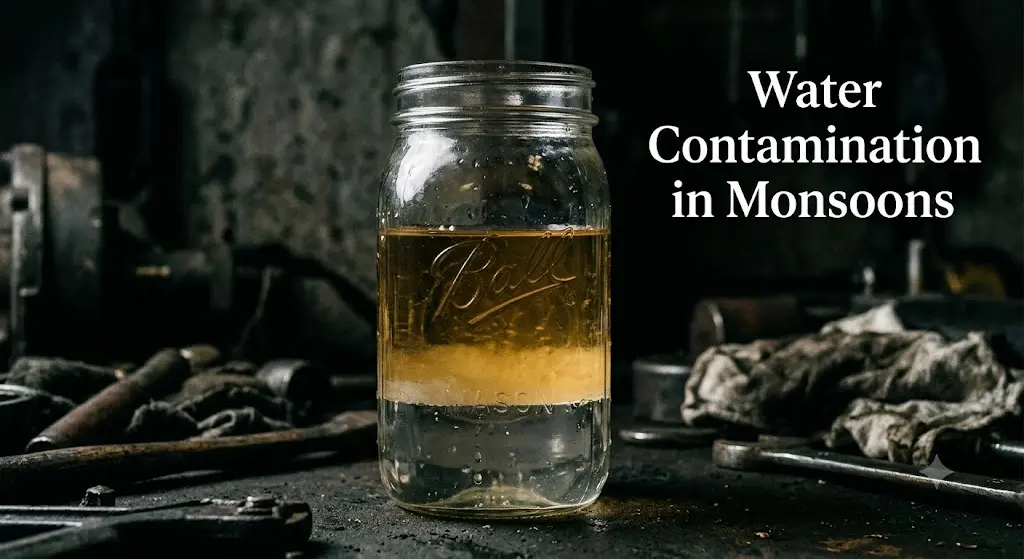
Before the E20 mandate, a motorcycle parked for two weeks during monsoon was mostly a battery and tyre concern. The petrol in the tank, pure or E10, absorbed very little atmospheric moisture, and whatever it absorbed stayed in solution without causing problems. E20 changes that calculation. The ethanol in E20 can absorb significantly more moisture than pure petrol, and once it absorbs enough, it does not stay in solution. It separates. The result is two distinct layers inside your fuel tank, one that is essentially low-octane petrol, and one that is an acidic ethanol-water mixture. Your engine does not run well on either layer. It runs badly on one and may not start on the other.
This is phase separation. It is not a theoretical risk. It has been documented in vehicle fuel tanks across India since the E20 rollout, and India’s monsoon season, June through September, is when the conditions for it are most favourable.
Table of Contents
- What Phase Separation Actually Is
- The Chemistry, Why E20 Is More Vulnerable Than E10
- Why Monsoon Makes It Worse
- What Happens to Your Engine When You Start on Phase-Separated Fuel
- Which Vehicles and Storage Situations Are at Highest Risk
- Four Steps That Prevent Phase Separation
- What to Do If You Suspect Phase Separation Has Already Occurred
- Sources
What Phase Separation Actually Is
Ethanol and water are chemically compatible, they mix readily and stay mixed. In an ethanol-petrol blend like E20, the ethanol acts as a bridge between the water molecules it absorbs from the air and the petrol in the blend. As long as the amount of water ethanol has absorbed stays below a certain threshold, everything remains in a single stable solution. The fuel in your tank looks and behaves like normal petrol.
When the water content exceeds that threshold, approximately 0.3 to 0.5 percent by volume depending on temperature and blend concentration, the ethanol can no longer hold the water in solution with the petrol. The ethanol and water separate out from the petrol as a distinct layer. This is phase separation.
The result inside your fuel tank is a visible layered structure. Pure petrol, now stripped of its ethanol content and lower in octane than when you filled the tank, floats on top. Below it sits a denser, milky-coloured mixture of ethanol and water. In tanks with very high water absorption, a third layer of nearly pure water may sit at the bottom.
The tank is still full, the total volume has not changed. But the fuel composition has changed dramatically, and the fuel that your pump draws from the bottom of the tank is the ethanol-water layer, not the petrol.
The Chemistry, Why E20 Is More Vulnerable Than E10
E20 is more vulnerable to phase separation than E10 for a straightforward reason: it contains more ethanol. More ethanol means greater capacity to absorb atmospheric moisture, which means phase separation requires more water ingress to trigger, but also that the fuel is actively pulling more moisture from the air over the same period of time.
Research from the US National Renewable Energy Laboratory found that E20 can absorb nearly 50 times more water than pure petrol before reaching its phase separation threshold. That sounds reassuring until you consider the other side: because ethanol in E20 is hygroscopic, it actively seeks out and retains moisture, it is continuously drawing water from any air space inside the tank.
The air space above the fuel in a partially full tank is the entry point. Every time the tank cools after riding, it contracts slightly, drawing in a small amount of fresh air. That air carries humidity. In an E10 or E0 fuel, the tiny amount of moisture in that air exchange is inconsequential. In an E20 fuel in a tank that is half-full and experiencing daily temperature cycles in monsoon conditions, the cumulative moisture absorption over two weeks can approach the phase separation threshold.
The phase separation threshold is also temperature-dependent. At warmer temperatures, ethanol-petrol blends can hold more water in solution. When temperature drops, overnight or in a cool garage, the threshold falls, and fuel that was stable at 35 degrees Celsius may begin to phase-separate at 22 degrees Celsius. This is why monsoon nights, which bring temperature drops after humid days, are particularly risky for stored vehicles.
Why Monsoon Makes It Worse
India’s monsoon season, running from June through September across most of the country, creates the conditions for phase separation more reliably than any other time of year.
High relative humidity: Monsoon air regularly reaches 80 to 95 percent relative humidity across coastal and inland regions. The moisture content of air drawn into a fuel tank during temperature cycling is at its maximum during monsoon months. More moisture per air exchange means faster moisture accumulation in the fuel.
Frequent temperature swings: Monsoon weather in India is characterised by warm humid days followed by cooler evenings after rainfall. These temperature swings increase the frequency and magnitude of the tank breathing cycle, expansion and contraction that pumps humid air in and out. Each cycle deposits a small amount of moisture. Over two weeks, the cumulative effect is significant.
Longer storage periods: Monsoon weather in India also coincides with a behaviour pattern of keeping vehicles parked for extended periods, heavy rain discourages riding, festivals and school holidays coincide with the season, and some owners put recreational or premium motorcycles into storage during the worst monsoon months. A bike with a half-full tank of E20 parked for three weeks in monsoon conditions in Mumbai, Pune, or Chennai is in the optimal environment for phase separation to occur.
The combination matters: Any one of these factors alone, high humidity, temperature swings, or extended storage, is manageable. All three together, sustained over two to three weeks, brings the risk from theoretical to real.
What Happens to Your Engine When You Start on Phase-Separated Fuel
The symptom pattern of starting a vehicle on phase-separated fuel is distinctive and worth knowing.
Difficult or failed cold start: The fuel pump draws from the bottom of the tank. If phase separation has produced an ethanol-water layer at the tank bottom, the first fuel the pump delivers to the carburettor or injectors is mostly ethanol and water. This mixture does not ignite reliably at cold start. The engine cranks, may fire partially, and either stalls immediately or runs very roughly.
Rough running and misfiring after start: Even if the engine starts, the ethanol-water mixture produces incomplete combustion. The engine runs lean, misfires under load, and may produce white or grey exhaust smoke as water vapour passes through the exhaust. In severe cases the engine stalls repeatedly.
Reduced octane in the petrol layer: When ethanol separates out from the petrol, it takes octane with it. The petrol layer left behind has a lower octane rating than the original E20 blend. For carburetted engines tuned for a specific octane range, this can cause knock or detonation under load.
Corrosion of tank and fuel system components: The ethanol-water layer that settles at the tank bottom is mildly acidic. If it sits in a steel tank for days or weeks, it accelerates corrosion of the tank interior, the fuel tap float, and any metal components in the lower fuel system. This is the damage pathway that leads to the significant repair bills documented in post-E20 survey data.
A vehicle that experiences phase separation once and is properly remediated typically suffers no permanent damage if caught early. A vehicle that is started repeatedly on phase-separated fuel, or left stored with the separated layer sitting in the tank for weeks, may require fuel system cleaning, carburettor service, and tank inspection.
Which Vehicles and Storage Situations Are at Highest Risk
Highest risk, older carburetted BS3 and BS4 motorcycles parked during monsoon: These vehicles have steel fuel tanks (more corrosion-vulnerable than aluminium), gravity-fed fuel systems without return lines, and no ECU compensation for fuel quality changes. Phase separation damage in these vehicles goes directly to the carburettor and tank.
High risk, any vehicle with a partially full tank stored for more than two weeks: The air space above the fuel is the moisture entry point. A half-full tank has twice the air space of a full tank and accumulates moisture proportionally faster. Vehicles stored with a quarter-tank or less are at highest risk.
Moderate risk, weekend-use motorcycles in coastal or high-humidity cities: Motorcycles ridden only on weekends and parked in garages the rest of the week accumulate six days of moisture absorption per week. In Mumbai, Chennai, Kochi, or Mangaluru, where monsoon humidity stays extreme for four months, this is sufficient for gradual moisture accumulation even without extended storage.
Lower risk, daily commuter bikes ridden every day: Regular use prevents moisture accumulation from reaching phase separation levels. The fuel turns over completely every few days and is replaced with fresh E20 before moisture build-up becomes critical. Daily riders in high-humidity cities should not be materially concerned about phase separation under normal use.
Four Steps That Prevent Phase Separation
These are ordered by effectiveness and ease. Do all four for full protection.
Step 1, Keep the tank as full as possible during storage: A full tank has minimal air space. Minimal air space means minimal moisture entry per temperature cycle. This is the single most effective and free intervention for any vehicle being stored during monsoon. Fill the tank completely before any storage period of more than three to four days. If the bike is being stored for a week or more, fill the tank to the brim immediately before parking.
Step 2, Use E0 petrol for the final fill before extended storage: XP100, Speed 100, or Power 100, the 100-octane, ethanol-free petrol grades available at select pumps, eliminate the hygroscopic component entirely. A tank filled with E0 petrol has no ethanol to absorb moisture and cannot phase-separate. For a seasonal storage period of two weeks or more, the Rs 50 to 60 per litre premium on a 10 to 15 litre fill, a one-time cost of Rs 500 to 900, is a small price to eliminate the phase separation risk entirely.
Step 3, Use a fuel stabiliser additive for storage periods of three weeks or more: Fuel stabiliser additives approved for ethanol-blended fuels work by inhibiting the oxidation and moisture absorption processes that lead to phase separation and fuel degradation. They do not reverse phase separation that has already occurred, they prevent it from occurring in the first place. Add the stabiliser to a full tank immediately before the storage period begins, run the engine for two to three minutes to circulate the treated fuel through the entire fuel system, then park. Dosage and specific products are covered in article 20 in this series.
Step 4, Store in a cool, dry environment with minimum temperature variation: A garage or covered parking that maintains a relatively stable temperature and low humidity reduces the tank breathing cycle frequency and the moisture content of any air drawn in. Not everyone has access to climate-controlled storage, but even a covered parking spot that prevents direct rain exposure and minimises temperature swings is meaningfully better than open outdoor parking for monsoon storage.
What to Do If You Suspect Phase Separation Has Already Occurred
If your vehicle has been stored for two or more weeks during monsoon and is now showing difficult starting, rough running, or misfiring that was not present before storage, phase separation is a reasonable first hypothesis.
Do not repeatedly attempt to start the engine on what may be phase-separated fuel. Each start attempt pumps the ethanol-water layer through the fuel system and deepens the contamination.
The correct response is to drain the fuel tank. For a carburetted motorcycle, open the petcock to the reserve position and drain into a clean container. Examine what comes out, if the fuel looks cloudy, milky, or shows visible layering, phase separation has occurred. Dispose of the contaminated fuel responsibly. Do not pour it into another vehicle.
After draining, flush the tank briefly with a small amount of fresh petrol to displace any residual ethanol-water mixture. Refill with fresh E20 and, if the vehicle sat for an extended period, have the carburettor cleaned before riding. The float bowl will have accumulated the contaminated fuel and may need to be drained and cleaned separately.
For fuel-injected vehicles, the fuel rail and injectors may require professional cleaning if they have been exposed to the ethanol-water mixture under pressure. Visit an authorised service centre and describe the storage duration and symptoms clearly.
Prevention is straightforward and inexpensive. Remediation after the fact is significantly more involved. The four steps above cost nothing beyond the optional E0 fill and additive, the discipline is free.
Sources
- CarToq, E20 Petrol Phase Separation: Why Keeping Your Fuel Tank Full Is Critical, 2025
- US National Renewable Energy Laboratory, Water Uptake and Weathering of Ethanol-Gasoline Blends in Humid Environments, 2016
- Autocar India, How E20 Petrol Affects Your Bike and Scooter, September 2025
- Bureau of Indian Standards, IS 2796 E20 Petrol Specification
- Ministry of Petroleum and Natural Gas, Ethanol Blending Programme
- CarzSpa, The Indian Car Owner’s Survival Guide to E20 Fuel, January 2026