E20 and Carburettor Lean Running, Why Your Old Bike Misfires and What Fixes It
-
 Ajit Khandekar
 - 18 Jun, 2026
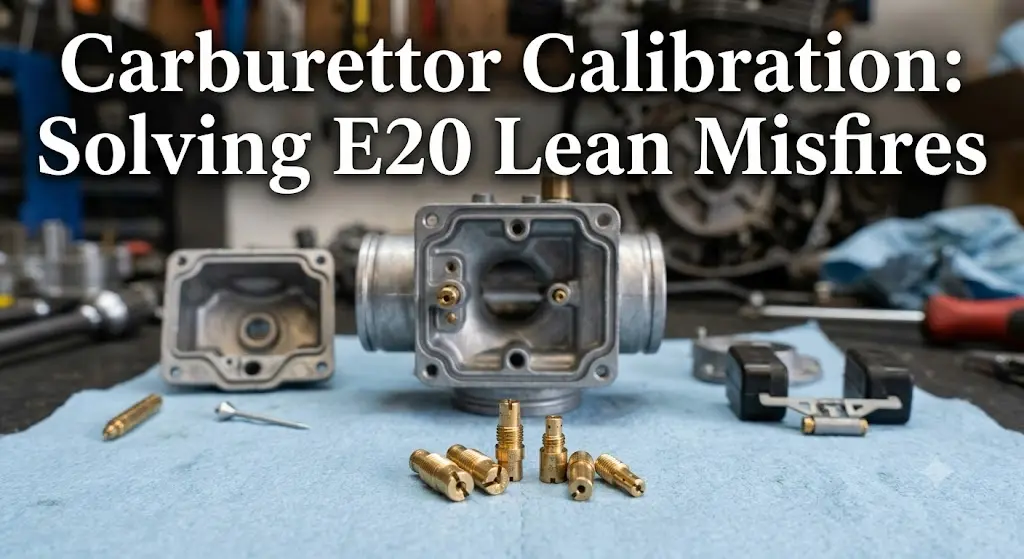
A fuel-injected motorcycle running on E20 measures the oxygen content in its exhaust through a lambda sensor, calculates that the mixture is slightly lean, and instructs the injector to deliver a small additional fuel pulse, all in a few milliseconds, dozens of times per second. The rider notices nothing except a marginal mileage reduction.
A carburetted motorcycle has no such capability. Its carburettor is a fixed mechanical device. It delivers an air-fuel mixture determined by the physical dimensions of its jets, needle, and air passages, dimensions calibrated for a specific fuel. When the fuel changes, the carburettor does not adapt. It continues delivering the same volume of fuel to a mixture that now requires more of it.
This is lean running. It is the defining problem for carburetted BS3 and BS4 motorcycles on E20 petrol, and it explains a significant portion of the misfiring, rough idle, hesitation, and performance degradation that owners of older bikes have been reporting since the E20 rollout.
Table of Contents
- Why E20 Makes a Carburettor Run Lean
- What Lean Running Feels Like, The Symptoms
- Which Throttle Positions Are Affected and Why
- What Lean Running Does to Your Engine Over Time
- What Rejetting Actually Is
- Which Carburettor Components Are Adjusted for E20
- What to Tell Your Mechanic
- Royal Enfield Retrofit Kits, What They Include
- What Rejetting Does Not Fix
- Sources
Why E20 Makes a Carburettor Run Lean
A carburettor meters fuel by drawing it through calibrated orifices, jets, using the vacuum created by intake airflow. The size of the main jet determines how much fuel is delivered at mid to full throttle. The pilot jet controls fuel delivery at idle and low throttle. The jet needle and needle jet manage the transition range between them.
These components are sized during factory calibration to deliver a specific air-fuel ratio, typically between 13.5:1 and 14.7:1 by mass for a four-stroke petrol engine, when the bike runs on the specified fuel. For carburetted Indian motorcycles manufactured before E20, that specified fuel was E0 or E10 petrol with a calorific value of approximately 44 to 46 MJ per kilogram.
E20 petrol has a lower calorific value, approximately 42 to 43 MJ per kilogram, because ethanol contains roughly 34 percent less energy per litre than pure petrol. Ethanol also contains oxygen within its molecular structure, approximately 35 percent by weight. This oxygen is already present in the fuel when it enters the carburettor.
The combined effect is that when E20 passes through a carburettor calibrated for E0 or E10, the mixture arriving at the combustion chamber has more oxygen relative to combustible hydrocarbons than the calibration intended. The mixture is lean, not dramatically, but consistently and measurably across the throttle range.
Autocar India confirmed this directly: older BS4 two-wheelers with carburettors end up running a lean air-fuel mixture due to the higher oxygen content in E20 fuel, leading to rising combustion temperatures and potential long-term engine harm.
What Lean Running Feels Like, The Symptoms
Not every carburetted bike may exhibit all of these symptoms on E20. The severity depends on how far the carburettor was from the lean edge of its calibration range on E10, the condition of the engine, and altitude. But these are the indicators to watch for.
Rough or unstable idle: The idle circuit, pilot jet and air screw, is the circuit most sensitive to small mixture changes. A carburettor running lean at idle will produce an irregular idle speed that hunts up and down, a tendency to stall at traffic lights when the throttle is released, and occasionally popping or spitting through the intake on overrun.
Hesitation or stumble at partial throttle: Lean running in the needle jet circuit, which governs the mixture from roughly one-quarter to three-quarter throttle, produces a characteristic stumble or hesitation when accelerating from low speed. The engine feels like it momentarily loses power before picking up again. In Indian riding conditions, frequent stop-start traffic, low-speed lane changes, constant partial-throttle use, this is one of the more noticeable E20 symptoms on older carburetted bikes.
Misfiring under load: At higher throttle openings, a lean main jet circuit causes misfiring under load, typically felt as an irregular firing pattern or slight surging when riding at a constant speed on an incline or at highway speeds. The engine does not feel smooth.
Overheating: Lean mixtures burn hotter than correct or slightly rich mixtures. The excess oxygen in the combustion chamber raises peak combustion temperature. In air-cooled engines, which rely entirely on airflow and engine oil to dissipate heat rather than a coolant circuit, this temperature increase is less well-managed than in liquid-cooled engines. Sustained lean running in an air-cooled carburetted engine raises cylinder head temperatures and accelerates wear on valve seats, guides, and piston crowns.
White or light grey spark plug colour: A spark plug removed from an engine running lean will show a white or very light grey electrode colour rather than the correct tan or light brown. This is a reliable diagnostic indicator. If your mechanic does a plug chop, removing the plug immediately after a sustained run and reading its colour, white indicates lean.
Which Throttle Positions Are Affected and Why
Understanding which carburettor circuit governs which throttle position helps you describe the problem to a mechanic precisely.
The pilot jet governs mixture from idle to approximately one-quarter throttle. Lean running here produces rough idle, stalling, and poor low-speed response.
The jet needle and needle jet govern mixture from one-quarter to three-quarter throttle, the range used in almost all Indian urban riding conditions. Lean running here produces the hesitation and stumble that most riders describe as their primary E20 symptom.
The main jet governs mixture from three-quarter to full throttle. Lean running here produces misfiring under hard acceleration and overheating under sustained high-speed riding.
E20’s lean effect is present across all three circuits because the oxygen content in the fuel affects the mixture throughout the throttle range. However, the symptoms are most noticeable in the pilot and needle jet circuits because those are the ranges most Indian riders spend most of their time in.
What Lean Running Does to Your Engine Over Time
This is the section most carburetted bike owners need to read carefully because the effects are gradual and initially invisible.
Valve seat recession: The valve seats in an air-cooled four-stroke engine act as both a sealing surface and a heat transfer path, the valve closes against the seat, transfers heat into the cylinder head, and opens again. In a correctly fuelled engine, this cycle maintains valve temperatures within design limits. In a chronically lean engine running at elevated combustion temperatures, exhaust valve seats in particular see higher peak temperatures on every combustion event. Over months and years of daily use, this accelerates wear of the valve seat, a condition called valve seat recession, leading to compression loss and eventually the need for a cylinder head rebuild.
Piston crown damage: Lean combustion raises the temperature of the combustion gases in contact with the piston crown. In an air-cooled engine without the thermal buffer of liquid cooling, sustained lean running can cause discolouration and eventually surface erosion of the piston crown. This is a long-term effect but one that shortens engine life measurably.
Detonation risk: Under load, climbing a gradient, carrying a pillion, accelerating onto a highway, a lean mixture in a carburetted engine raises the risk of detonation. Detonation is uncontrolled combustion that generates a sharp pressure spike rather than the smooth pressure rise of normal combustion. Individual detonation events are inaudible on most single-cylinder Indian motorcycles due to their mechanical noise level, but sustained detonation damages piston crowns and big-end bearings.
None of these effects destroy your engine in a week. They are the difference between an engine that runs well for 80,000 to 100,000 kilometres and one that needs significant work at 50,000 to 60,000 kilometres.
What Rejetting Actually Is
Rejetting is the process of replacing one or more of the carburettor’s metering components, jets, needle, or air screw adjustment, with different-sized equivalents to shift the air-fuel ratio toward the correct range for the new fuel.
For E20 compensation, rejetting typically means installing a slightly larger main jet and pilot jet, larger orifice means more fuel delivery at the same vacuum, compensating for the lower energy density of E20. The needle clip position may also be adjusted to lower the needle slightly, enriching the mid-throttle mixture. The air screw is adjusted to optimise idle mixture with the new pilot jet.
The result is a carburettor that delivers more fuel per unit of intake air, correcting the lean condition that E20’s oxygen content and lower energy density would otherwise produce. The engine runs at or near its correct air-fuel ratio, idle smooths out, hesitation reduces, and the elevated combustion temperatures from chronic lean running return to normal.
What rejetting does not do is recover the mileage loss from ethanol’s lower energy density. That loss is inherent to the fuel. A correctly rejetted carburettor running on E20 will deliver better power and smoother running than an unrejetted one, but it may still return lower mileage than the same engine on E0 petrol because E20 carries less energy per litre regardless of how well the carburettor is calibrated.
Which Carburettor Components Are Adjusted for E20
On a typical Indian 150cc to 350cc four-stroke carburetted motorcycle, covering most Bajaj, TVS, Hero, Honda, and Royal Enfield carburetted models, the E20 rejetting typically involves:
Main jet: Typically one to two sizes larger than the factory calibration. If the factory main jet is a 112, the rejetted equivalent for E20 may be a 115 or 118. The exact size depends on engine displacement, carburettor model, and current running condition. This is determined by plug chop or dyno, not by a generic table.
Pilot jet: One size larger in most cases, to correct the lean condition at idle and low throttle. Alternatively, the air screw may be adjusted outward by half a turn to one turn to richen the pilot circuit without replacing the jet, this is the easier first step and may be sufficient for mild lean symptoms.
Jet needle clip position: Moving the clip from the middle groove to one groove lower raises the needle, enriching the mid-throttle mixture. This is a no-cost adjustment that requires only removing the slide from the carburettor.
For Royal Enfield UCE 350 BS4 carburetted models, Classic 350, Bullet 350 in their pre-Reborn carb variants, Royal Enfield has released an OEM E20 carburettor upgrade kit designated KLT00004/A, priced at approximately Rs 1,700 to 4,000 depending on model and dealer. This kit includes a rejetted carburettor specification, OEM-grade seals, and an E20 fuel tank label. It is the most straightforward rejetting solution for eligible RE models.
What to Tell Your Mechanic
Most mechanics in India are familiar with carburettor rejetting in principle, it is standard practice for altitude compensation and performance modifications. However, not all mechanics have rejetted specifically for E20, and the correct jet sizes for E20 compensation vary by model.
At your next service, say: “My bike has a carburettor and it is running lean on E20. I want you to check the air-fuel ratio by reading the spark plug colour after a run, and if it is lean, rejet the pilot and main circuits for E20. The needle clip position should also be checked.”
If the mechanic is unfamiliar with the specific jet sizes for your model on E20, ask them to start with the air screw adjustment, turning it out by half a turn from the current setting, and assess whether idle and low-throttle response improves. This is a reversible, tool-free starting point that does not require jet replacement.
Do not accept an ECU remap recommendation for a carburetted motorcycle. Carburetted bikes do not have an ECU controlling fuelling. Any suggestion to remap the ECU of a carburetted bike indicates the mechanic is either confused about the engine type or recommending an irrelevant service. The only fuelling adjustment available on a carburetted engine is mechanical, jets, needle position, and air screw.
Royal Enfield Retrofit Kits, What They Include
For owners of Royal Enfield Classic 350, Bullet 350, and equivalent UCE 350 carburetted models manufactured before the BS6 transition, Royal Enfield has produced an OEM retrofit kit specifically addressing E20 compatibility.
The kit includes a carburettor jet specification adjusted for E20, new jet needle and jets for the correct air-fuel ratio on E20 fuel, along with OEM-grade rubber seals and gaskets that address the parallel concern of nitrile rubber degradation on ethanol. A fuel tank E20 label is included to mark the vehicle as having undergone the retrofit.
The kit is designed for workshop installation during a carburettor service or overhaul. It does not require any special tools beyond standard carburettor service equipment. Royal Enfield recommends installation at an authorised dealer, though any experienced mechanic familiar with the UCE engine can perform the work.
The kit is not compatible with fuel-injected models including the Classic 350 Reborn (J-series engine), Meteor 350, Hunter 350, and Himalayan 452, these vehicles are BS6 Phase 2 compliant and do not require carburettor modification for E20.
What Rejetting Does Not Fix
Rejetting addresses lean running. It does not address the other E20-related concerns that affect carburetted bikes.
It does not protect rubber fuel hoses and carburettor gaskets from ethanol-related degradation, that requires material replacement, covered in article 7 in this series.
It does not prevent phase separation in stored fuel, that requires keeping the tank full and using E0 petrol for storage, covered in article 8.
It does not prevent corrosion of a steel fuel tank interior, that requires tank inspection and, where corrosion is present, tank treatment or lining.
Rejetting is one component of an E20 adaptation strategy for carburetted bikes, not a complete solution by itself. The full checklist, including hose inspection, gasket replacement, and storage precautions, is covered in article 19 in this series.
Sources
- Autocar India, How E20 Petrol Affects Your Bike and Scooter, September 2025
- Autocar India, BS6 Phase 2 Emissions Regulations Explained, April 2023
- Riders Junction, Royal Enfield E20 Carburettor Upgrade Kit KLT00004/A
- CarToq, E20 Petrol Becomes Mandatory, April 2026
- Bureau of Indian Standards, IS 2796 E20 Petrol Specification
- Ministry of Petroleum and Natural Gas, Ethanol Blending Programme