Showing Posts From
Maintenance
- 19 Jun, 2026
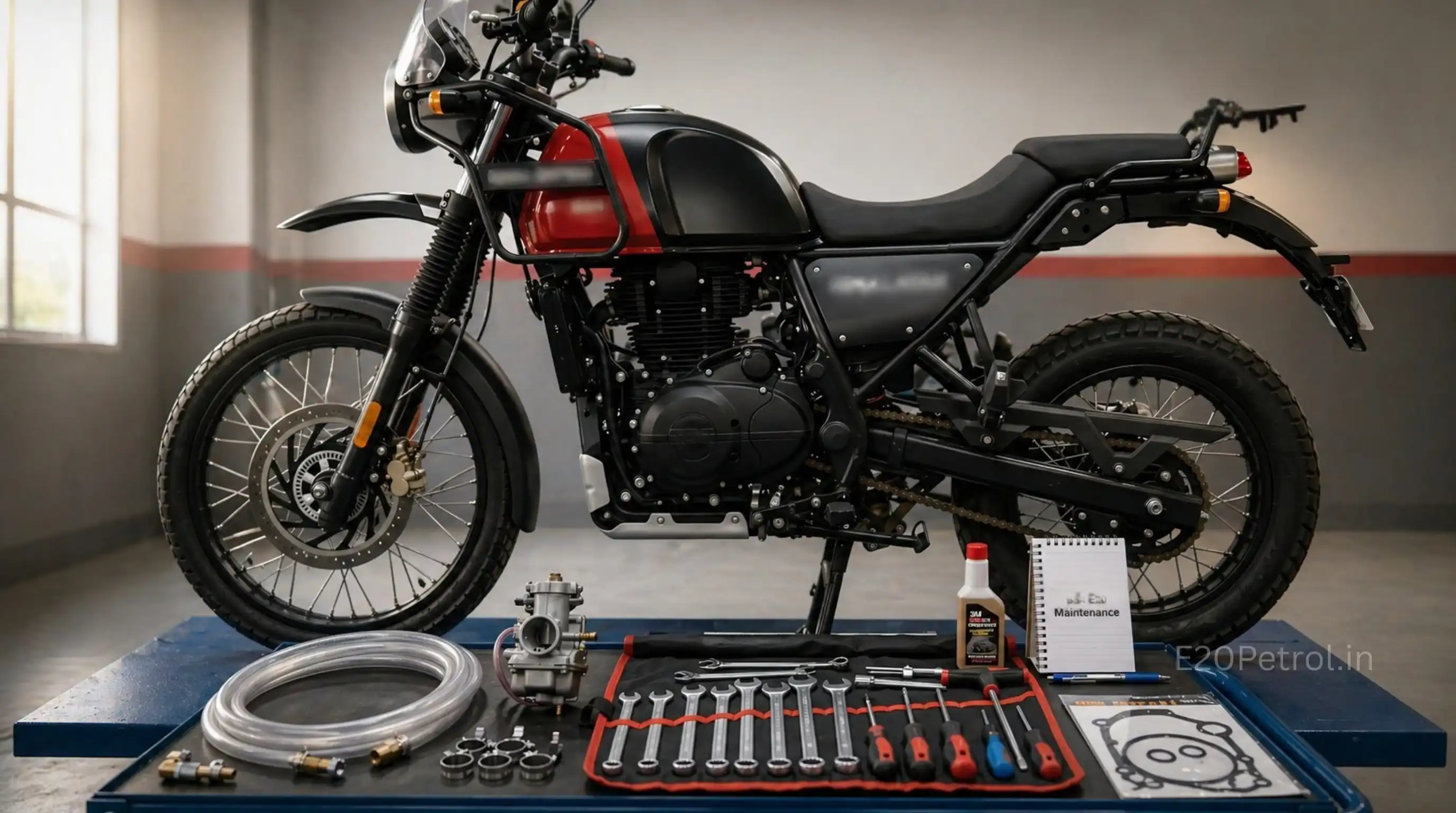
E20 Petrol and Fuel Tank Corrosion, What Is Happening Inside Your Tank Right Now
The inside of a motorcycle fuel tank is not visible during routine maintenance. Unlike a tyre or a brake pad, you cannot look at it and assess its condition. You only discover tank corrosion when rust particles have already travelled through the fuel system to clog the filter, block the carburettor jet, or, in the worst cases, allow a rust-contaminated fuel supply to reach the engine. E20 petrol attacks steel fuel tanks through mechanisms that pure petrol or E10 petrol does not. The combination of ethanol's hygroscopic nature, the acidity that develops in stored ethanol-petrol blends, and ethanol's solvent action on protective coatings creates a corrosion environment inside older tanks that their designers never anticipated. This article explains each mechanism, describes the symptoms and diagnostic checks available without removing the tank, and gives the specific interventions that stop the process before it becomes a repair bill. Table of ContentsWhy Older Motorcycle Tanks Are Specifically Vulnerable The Three Corrosion Mechanisms in E20 How Fast Does Corrosion Progress The Components Most Damaged by Tank Corrosion How to Diagnose Tank Corrosion Without Removing the Tank Intervention Options, From Prevention to Repair Tank Liner Treatment, What It Is and Whether It Works When to Replace the Tank SourcesWhy Older Motorcycle Tanks Are Specifically Vulnerable Most Indian motorcycle fuel tanks manufactured before 2020 are made from stamped mild steel, welded along the centreline, and protected on the interior surface by either a thin phosphate treatment or a factory-applied coating. Neither protection was designed for sustained exposure to ethanol blends above E10. The tank design compounds the problem in two ways. First, the seam weld along the tank's centreline creates a metallurgical transition zone where the steel's crystalline structure differs from the parent metal on either side. This transition zone is more susceptible to electrochemical corrosion than the bulk steel. Second, the typical tank geometry creates a sump area, the lowest point of the tank above the petcock, where water and ethanol-water mixtures from phase separation settle and remain in contact with the metal continuously. Aluminium tanks, used on some premium models, are less susceptible to rust but are not immune. Research into aluminium alloy corrosion in ethanol-petrol blends has documented attack on the alloy's surface when acetic acid and water are present, the Cu-containing precipitates in common aluminium alloys are particularly susceptible to galvanic micro-corrosion in this environment. The Three Corrosion Mechanisms in E20 Mechanism 1, Acetic acid from microbial activity: This is the least understood and most underreported mechanism. Ethanol does not exist in a sterile environment inside a fuel tank. Bacteria from the Acetobacter family, naturally present in fuel storage environments, feed on ethanol and convert it to acetic acid, the same organic acid that gives vinegar its characteristic smell and corrosive character. These bacteria have been identified as the dominant microorganisms in contaminated fuel storage systems. They produce acetic acid in the air space above the fuel, the headspace, as well as in the fuel itself when conditions allow. Research has shown that acetic acid vapour in the headspace above an ethanol-petrol blend corrodes both steel and copper surfaces that may not even be submerged in the liquid fuel. The brass float valve inside a carburettor float bowl, for example, sits partly in the air space above the fuel and is exposed to acetic acid vapour continuously in a tank with bacterial contamination. The acetic acid production is accelerated by warmth, which makes Indian conditions, particularly in summer and in tanks stored in warm garages, more conducive to this mechanism than temperate climates where most of the fuel compatibility research was originally conducted. Mechanism 2, Water-ethanol phase separation at the tank bottom: As covered in article 8 in this series, ethanol absorbs atmospheric moisture through the air space in a partially filled tank. When moisture absorption exceeds the phase separation threshold, approximately 0.3 to 0.5 percent water by volume, depending on temperature, the ethanol and water separate from the petrol and settle at the tank bottom as a dense, mildly acidic layer. This layer remains in continuous contact with the lowest point of the steel tank interior. Unlike pure water, which would simply cause uniform rust, the ethanol-water mixture at phase separation conditions is both mildly acidic and a good electrolyte, it conducts the electrochemical current that drives metallic corrosion. The result is accelerated corrosion at the tank sump, concentrated in the area immediately above the petcock. Mechanism 3, Solvent action on protective coatings: Ethanol is a polar solvent. Many of the internal protective coatings applied to steel motorcycle tanks, particularly the phosphate treatments and alkyd-based factory coatings common in pre-2015 Indian manufacturing, were not formulated for sustained ethanol exposure. Ethanol gradually dissolves or delaminate these coatings, exposing bare steel to the fuel. Once the coating is compromised, corrosion proceeds rapidly because the mechanism shifts from surface attack on a protected steel to direct attack on bare steel in an acidic, oxygenated environment. The coating delamination also produces particulates, flakes of old coating mixed with rust, that enter the fuel stream and clog downstream components. How Fast Does Corrosion Progress The rate of corrosion varies significantly by tank condition, usage pattern, and storage environment. The following is a general timeline based on documented patterns in older carburetted Indian motorcycles running on E20 from 2025 onwards. Tanks in good pre-E20 condition, no existing rust, intact internal coating, ridden daily, show minimal visible change in the first six to twelve months of E20 exposure. The mechanisms are active but operating on intact surfaces. Tanks with pre-existing minor corrosion, small rust spots, coating degradation from normal ageing, show accelerated progression on E20. Existing rust acts as a nucleation site for further corrosion and also traps moisture. These tanks may show significant rust deposits in the filter within twelve to eighteen months of E20 exposure. Tanks stored for extended periods with partially filled E20 fuel, the highest-risk scenario, can show visible corrosion within weeks under Indian monsoon humidity conditions, particularly at the sump area where phase-separated water-ethanol settles. The LocalCircles survey of October 2025 found that 52 percent of owners of pre-2022 vehicles were experiencing unusual wear and repair needs, double the figure from two months earlier. This rate of acceleration is consistent with progressive fuel system degradation in tanks where initial corrosion seeded further damage. The Components Most Damaged by Tank Corrosion Fuel filter: The filter is the first downstream component to show evidence of tank corrosion. Brown or reddish particles in a removed fuel filter, or premature filter clogging before the normal service interval, is the primary diagnostic indicator that corrosion is active in the tank. The filter is catching what the tank is producing. Petcock and fuel tap: The petcock valve sits at the lowest point of the fuel delivery path. The brass or zinc alloy components of the petcock are susceptible to the same acetic acid environment described above. A petcock that has become stiff, difficult to operate, or that shows green or white deposits on its body is showing early corrosion effects. Carburettor jets and needle valve: Rust particles and coating flakes that pass through a degraded or absent fuel filter reach the carburettor float bowl. They settle in the bowl, partially block the main jet orifice, or lodge under the float needle valve, preventing it from seating fully and causing fuel to overflow. A carburettor that floods repeatedly after cleaning, or that shows rust-coloured particles in the float bowl, indicates ongoing tank contamination. Fuel pump (fuel-injected vehicles): In fuel-injected motorcycles, the in-tank fuel pump draws from the bottom of the tank. Rust particles in a corroded tank pass through the pump's inlet strainer, wear the pump's internal components, and may eventually cause pump failure. Fuel pump replacement is significantly more expensive than a tank treatment or filter replacement at the early-detection stage. How to Diagnose Tank Corrosion Without Removing the Tank The following checks are accessible at any service interval without tank removal. Check the fuel filter: At every service, ask your mechanic to cut open the old fuel filter if it is an inline filter, or inspect the bowl filter if fitted. Brown or reddish particles indicate rust. An unusually thick brown residue on the filter paper indicates coating delamination particles alongside rust. Inspect the petcock during oil changes: When the bike is on its side stand for an oil change, look at the petcock body for any white, green, or brown deposits. These are corrosion products from the petcock's metallic components. Check the carburettor float bowl: Request that the float bowl be drained and inspected at each carburettor service. A clean, translucent float bowl with clear petrol inside is normal. A bowl with visible rust particles, a rust-coloured bottom layer, or coating flakes indicates upstream tank corrosion. Smell the fuel when filling: Fresh E20 petrol has a characteristic slightly sweet smell from the ethanol. A fuel sample from a tank with active microbial-induced acetic acid production may have a faintly vinegary or sour note, subtle, but distinguishable from fresh petrol. This is an unreliable diagnostic on its own but worth noting alongside other indicators. Torch inspection through the filler neck: On a completely empty tank, a small torch angled through the filler neck can reveal the interior surface condition. Brown or orange discolouration on the visible interior surfaces, pitting, or visible flaking are indicators of active corrosion. This requires an empty tank and is best done at a planned service rather than casually. Intervention Options, From Prevention to Repair Prevention, active tank, good condition: For a tank in good condition with no corrosion evidence, the primary interventions are keeping the tank full during storage and using E0 petrol for extended storage periods. Both prevent the moisture accumulation that enables phase separation, the primary entry point for water-accelerated corrosion. A corrosion-inhibitor fuel additive appropriate for ethanol-blended petrol adds a layer of electrochemical protection. These additives form a protective film on metal surfaces within the fuel system. They are not a substitute for physical tank condition but provide meaningful protection in tanks exposed to E20 continuously. Article 20 in this series covers specific products. Early intervention, minor corrosion, no through-rust: If filter inspection reveals early rust particles but the tank surface has not developed through-rust or significant pitting, a tank flush followed by a tank liner treatment is the appropriate response. Flush the tank with clean petrol to remove loose particles and residue. Follow with a phosphoric acid-based tank cleaner to convert surface rust to iron phosphate, a stable, non-hygroscopic compound. Then apply a tank sealer/liner to create a fresh ethanol-resistant barrier over the treated surface. Tank liner products available in India include POR-15 Tank Sealer, Caswell Tank Liner, and domestic equivalents available through automotive supply shops. These are two-part epoxy or polyurethane formulations that cure to an ethanol-resistant surface inside the tank. Application requires a completely clean, dry tank interior, follow the product instructions exactly for preparation. Advanced corrosion, significant pitting or local through-rust: If inspection reveals through-rust, pin holes visible when the tank is held to light, or deep pitting that a liner treatment cannot bridge, the options narrow. A specialist tank repair involving welding the affected area followed by re-lining is one path. Tank replacement is the other. For common Indian models, replacement tanks are available from OEM and aftermarket suppliers at significantly lower cost than the engine damage that a failed tank eventually causes. Tank Liner Treatment, What It Is and Whether It Works Tank liner treatments are two-component coatings, typically epoxy or polyurethane resin systems, that cure to a hard, smooth, ethanol-resistant film on the interior of the treated tank. When applied correctly to a properly prepared surface, they are effective at: Sealing surface rust and minor pitting against further moisture contact. Providing a stable, non-reactive barrier between the fuel and the base metal. Resisting ethanol-blended fuels including E20 and E85 when formulated specifically for fuel compatibility. They do not work on heavily rusted tanks where the metal has lost structural integrity. They do not work on tanks that were not thoroughly cleaned and dried before application. They are not reversible, a liner applied incorrectly, or to an inadequately prepared surface, can delaminate inside the tank and create particles worse than the original rust. The preparation sequence is critical: drain and clean with petrol, flush with tank cleaner, treat rust with phosphoric acid converter, rinse and dry completely, apply liner per manufacturer instructions. Cutting corners on any step produces a failed application. This is a job that takes a full day to do correctly, a morning for cleaning and rust treatment, an afternoon for liner application and curing initiation. For tanks in early-stage corrosion where the metal is structurally sound, a correctly applied liner treatment is a cost-effective and long-lasting intervention. A quality liner applied to a well-prepared tank may outlast the vehicle's remaining service life under E20 conditions. When to Replace the Tank Replace the tank when any of the following are true: Through-rust has created pin holes or structural compromise that welding cannot practically address. The tank has been repaired previously and the repair has failed. The interior surface is so heavily pitted that a liner treatment cannot produce a smooth, bonded surface. The tank has suffered significant phase-separation-induced corrosion at the sump that extends through the metal in the area above the petcock. For common Indian models, Bajaj Pulsar, Hero Splendor variants, Honda CB series, Royal Enfield UCE-era models, replacement tanks are available from OEM dealers and aftermarket suppliers. Prices range from Rs 1,500 to Rs 8,000 depending on model and source. This is a fraction of the cost of a carburettor rebuild from rust contamination or a fuel pump replacement on an injected model. The correct time to address tank corrosion is at the filter inspection stage, when particles are appearing in the filter but no downstream damage has yet occurred. At that stage the intervention is a tank treatment costing Rs 800 to 2,500 in materials and a day of labour. Waiting until carburettor damage or fuel pump failure makes it a Rs 3,000 to 15,000 repair. SourcesScienceInsights, How Does Ethanol Damage Engines: Corrosion to Clogs, March 2026 ScienceDirect, Corrosion Behaviour of Aluminium Alloy in Bio-Ethanol Blended Gasoline, 2025 Business Standard, E20 Fuel Hits Mileage of Older Petrol Vehicles, Survey October 2025 CarToq, E20 Petrol Becomes Mandatory, April 2026 Autocar India, How E20 Petrol Affects Your Bike and Scooter, September 2025 Bureau of Indian Standards, IS 2796 E20 Petrol Specification Ministry of Petroleum and Natural Gas, Ethanol Blending Programme
- 18 Jun, 2026
E20 and Carburettor Lean Running, Why Your Old Bike Misfires and What Fixes It
A fuel-injected motorcycle running on E20 measures the oxygen content in its exhaust through a lambda sensor, calculates that the mixture is slightly lean, and instructs the injector to deliver a small additional fuel pulse, all in a few milliseconds, dozens of times per second. The rider notices nothing except a marginal mileage reduction. A carburetted motorcycle has no such capability. Its carburettor is a fixed mechanical device. It delivers an air-fuel mixture determined by the physical dimensions of its jets, needle, and air passages, dimensions calibrated for a specific fuel. When the fuel changes, the carburettor does not adapt. It continues delivering the same volume of fuel to a mixture that now requires more of it. This is lean running. It is the defining problem for carburetted BS3 and BS4 motorcycles on E20 petrol, and it explains a significant portion of the misfiring, rough idle, hesitation, and performance degradation that owners of older bikes have been reporting since the E20 rollout. Table of ContentsWhy E20 Makes a Carburettor Run Lean What Lean Running Feels Like, The Symptoms Which Throttle Positions Are Affected and Why What Lean Running Does to Your Engine Over Time What Rejetting Actually Is Which Carburettor Components Are Adjusted for E20 What to Tell Your Mechanic Royal Enfield Retrofit Kits, What They Include What Rejetting Does Not Fix SourcesWhy E20 Makes a Carburettor Run Lean A carburettor meters fuel by drawing it through calibrated orifices, jets, using the vacuum created by intake airflow. The size of the main jet determines how much fuel is delivered at mid to full throttle. The pilot jet controls fuel delivery at idle and low throttle. The jet needle and needle jet manage the transition range between them. These components are sized during factory calibration to deliver a specific air-fuel ratio, typically between 13.5:1 and 14.7:1 by mass for a four-stroke petrol engine, when the bike runs on the specified fuel. For carburetted Indian motorcycles manufactured before E20, that specified fuel was E0 or E10 petrol with a calorific value of approximately 44 to 46 MJ per kilogram. E20 petrol has a lower calorific value, approximately 42 to 43 MJ per kilogram, because ethanol contains roughly 34 percent less energy per litre than pure petrol. Ethanol also contains oxygen within its molecular structure, approximately 35 percent by weight. This oxygen is already present in the fuel when it enters the carburettor. The combined effect is that when E20 passes through a carburettor calibrated for E0 or E10, the mixture arriving at the combustion chamber has more oxygen relative to combustible hydrocarbons than the calibration intended. The mixture is lean, not dramatically, but consistently and measurably across the throttle range. Autocar India confirmed this directly: older BS4 two-wheelers with carburettors end up running a lean air-fuel mixture due to the higher oxygen content in E20 fuel, leading to rising combustion temperatures and potential long-term engine harm. What Lean Running Feels Like, The Symptoms Not every carburetted bike may exhibit all of these symptoms on E20. The severity depends on how far the carburettor was from the lean edge of its calibration range on E10, the condition of the engine, and altitude. But these are the indicators to watch for. Rough or unstable idle: The idle circuit, pilot jet and air screw, is the circuit most sensitive to small mixture changes. A carburettor running lean at idle will produce an irregular idle speed that hunts up and down, a tendency to stall at traffic lights when the throttle is released, and occasionally popping or spitting through the intake on overrun. Hesitation or stumble at partial throttle: Lean running in the needle jet circuit, which governs the mixture from roughly one-quarter to three-quarter throttle, produces a characteristic stumble or hesitation when accelerating from low speed. The engine feels like it momentarily loses power before picking up again. In Indian riding conditions, frequent stop-start traffic, low-speed lane changes, constant partial-throttle use, this is one of the more noticeable E20 symptoms on older carburetted bikes. Misfiring under load: At higher throttle openings, a lean main jet circuit causes misfiring under load, typically felt as an irregular firing pattern or slight surging when riding at a constant speed on an incline or at highway speeds. The engine does not feel smooth. Overheating: Lean mixtures burn hotter than correct or slightly rich mixtures. The excess oxygen in the combustion chamber raises peak combustion temperature. In air-cooled engines, which rely entirely on airflow and engine oil to dissipate heat rather than a coolant circuit, this temperature increase is less well-managed than in liquid-cooled engines. Sustained lean running in an air-cooled carburetted engine raises cylinder head temperatures and accelerates wear on valve seats, guides, and piston crowns. White or light grey spark plug colour: A spark plug removed from an engine running lean will show a white or very light grey electrode colour rather than the correct tan or light brown. This is a reliable diagnostic indicator. If your mechanic does a plug chop, removing the plug immediately after a sustained run and reading its colour, white indicates lean. Which Throttle Positions Are Affected and Why Understanding which carburettor circuit governs which throttle position helps you describe the problem to a mechanic precisely. The pilot jet governs mixture from idle to approximately one-quarter throttle. Lean running here produces rough idle, stalling, and poor low-speed response. The jet needle and needle jet govern mixture from one-quarter to three-quarter throttle, the range used in almost all Indian urban riding conditions. Lean running here produces the hesitation and stumble that most riders describe as their primary E20 symptom. The main jet governs mixture from three-quarter to full throttle. Lean running here produces misfiring under hard acceleration and overheating under sustained high-speed riding. E20's lean effect is present across all three circuits because the oxygen content in the fuel affects the mixture throughout the throttle range. However, the symptoms are most noticeable in the pilot and needle jet circuits because those are the ranges most Indian riders spend most of their time in. What Lean Running Does to Your Engine Over Time This is the section most carburetted bike owners need to read carefully because the effects are gradual and initially invisible. Valve seat recession: The valve seats in an air-cooled four-stroke engine act as both a sealing surface and a heat transfer path, the valve closes against the seat, transfers heat into the cylinder head, and opens again. In a correctly fuelled engine, this cycle maintains valve temperatures within design limits. In a chronically lean engine running at elevated combustion temperatures, exhaust valve seats in particular see higher peak temperatures on every combustion event. Over months and years of daily use, this accelerates wear of the valve seat, a condition called valve seat recession, leading to compression loss and eventually the need for a cylinder head rebuild. Piston crown damage: Lean combustion raises the temperature of the combustion gases in contact with the piston crown. In an air-cooled engine without the thermal buffer of liquid cooling, sustained lean running can cause discolouration and eventually surface erosion of the piston crown. This is a long-term effect but one that shortens engine life measurably. Detonation risk: Under load, climbing a gradient, carrying a pillion, accelerating onto a highway, a lean mixture in a carburetted engine raises the risk of detonation. Detonation is uncontrolled combustion that generates a sharp pressure spike rather than the smooth pressure rise of normal combustion. Individual detonation events are inaudible on most single-cylinder Indian motorcycles due to their mechanical noise level, but sustained detonation damages piston crowns and big-end bearings. None of these effects destroy your engine in a week. They are the difference between an engine that runs well for 80,000 to 100,000 kilometres and one that needs significant work at 50,000 to 60,000 kilometres. What Rejetting Actually Is Rejetting is the process of replacing one or more of the carburettor's metering components, jets, needle, or air screw adjustment, with different-sized equivalents to shift the air-fuel ratio toward the correct range for the new fuel. For E20 compensation, rejetting typically means installing a slightly larger main jet and pilot jet, larger orifice means more fuel delivery at the same vacuum, compensating for the lower energy density of E20. The needle clip position may also be adjusted to lower the needle slightly, enriching the mid-throttle mixture. The air screw is adjusted to optimise idle mixture with the new pilot jet. The result is a carburettor that delivers more fuel per unit of intake air, correcting the lean condition that E20's oxygen content and lower energy density would otherwise produce. The engine runs at or near its correct air-fuel ratio, idle smooths out, hesitation reduces, and the elevated combustion temperatures from chronic lean running return to normal. What rejetting does not do is recover the mileage loss from ethanol's lower energy density. That loss is inherent to the fuel. A correctly rejetted carburettor running on E20 will deliver better power and smoother running than an unrejetted one, but it may still return lower mileage than the same engine on E0 petrol because E20 carries less energy per litre regardless of how well the carburettor is calibrated. Which Carburettor Components Are Adjusted for E20 On a typical Indian 150cc to 350cc four-stroke carburetted motorcycle, covering most Bajaj, TVS, Hero, Honda, and Royal Enfield carburetted models, the E20 rejetting typically involves: Main jet: Typically one to two sizes larger than the factory calibration. If the factory main jet is a 112, the rejetted equivalent for E20 may be a 115 or 118. The exact size depends on engine displacement, carburettor model, and current running condition. This is determined by plug chop or dyno, not by a generic table. Pilot jet: One size larger in most cases, to correct the lean condition at idle and low throttle. Alternatively, the air screw may be adjusted outward by half a turn to one turn to richen the pilot circuit without replacing the jet, this is the easier first step and may be sufficient for mild lean symptoms. Jet needle clip position: Moving the clip from the middle groove to one groove lower raises the needle, enriching the mid-throttle mixture. This is a no-cost adjustment that requires only removing the slide from the carburettor. For Royal Enfield UCE 350 BS4 carburetted models, Classic 350, Bullet 350 in their pre-Reborn carb variants, Royal Enfield has released an OEM E20 carburettor upgrade kit designated KLT00004/A, priced at approximately Rs 1,700 to 4,000 depending on model and dealer. This kit includes a rejetted carburettor specification, OEM-grade seals, and an E20 fuel tank label. It is the most straightforward rejetting solution for eligible RE models. What to Tell Your Mechanic Most mechanics in India are familiar with carburettor rejetting in principle, it is standard practice for altitude compensation and performance modifications. However, not all mechanics have rejetted specifically for E20, and the correct jet sizes for E20 compensation vary by model. At your next service, say: "My bike has a carburettor and it is running lean on E20. I want you to check the air-fuel ratio by reading the spark plug colour after a run, and if it is lean, rejet the pilot and main circuits for E20. The needle clip position should also be checked." If the mechanic is unfamiliar with the specific jet sizes for your model on E20, ask them to start with the air screw adjustment, turning it out by half a turn from the current setting, and assess whether idle and low-throttle response improves. This is a reversible, tool-free starting point that does not require jet replacement. Do not accept an ECU remap recommendation for a carburetted motorcycle. Carburetted bikes do not have an ECU controlling fuelling. Any suggestion to remap the ECU of a carburetted bike indicates the mechanic is either confused about the engine type or recommending an irrelevant service. The only fuelling adjustment available on a carburetted engine is mechanical, jets, needle position, and air screw. Royal Enfield Retrofit Kits, What They Include For owners of Royal Enfield Classic 350, Bullet 350, and equivalent UCE 350 carburetted models manufactured before the BS6 transition, Royal Enfield has produced an OEM retrofit kit specifically addressing E20 compatibility. The kit includes a carburettor jet specification adjusted for E20, new jet needle and jets for the correct air-fuel ratio on E20 fuel, along with OEM-grade rubber seals and gaskets that address the parallel concern of nitrile rubber degradation on ethanol. A fuel tank E20 label is included to mark the vehicle as having undergone the retrofit. The kit is designed for workshop installation during a carburettor service or overhaul. It does not require any special tools beyond standard carburettor service equipment. Royal Enfield recommends installation at an authorised dealer, though any experienced mechanic familiar with the UCE engine can perform the work. The kit is not compatible with fuel-injected models including the Classic 350 Reborn (J-series engine), Meteor 350, Hunter 350, and Himalayan 452, these vehicles are BS6 Phase 2 compliant and do not require carburettor modification for E20. What Rejetting Does Not Fix Rejetting addresses lean running. It does not address the other E20-related concerns that affect carburetted bikes. It does not protect rubber fuel hoses and carburettor gaskets from ethanol-related degradation, that requires material replacement, covered in article 7 in this series. It does not prevent phase separation in stored fuel, that requires keeping the tank full and using E0 petrol for storage, covered in article 8. It does not prevent corrosion of a steel fuel tank interior, that requires tank inspection and, where corrosion is present, tank treatment or lining. Rejetting is one component of an E20 adaptation strategy for carburetted bikes, not a complete solution by itself. The full checklist, including hose inspection, gasket replacement, and storage precautions, is covered in article 19 in this series. SourcesAutocar India, How E20 Petrol Affects Your Bike and Scooter, September 2025 Autocar India, BS6 Phase 2 Emissions Regulations Explained, April 2023 Riders Junction, Royal Enfield E20 Carburettor Upgrade Kit KLT00004/A CarToq, E20 Petrol Becomes Mandatory, April 2026 Bureau of Indian Standards, IS 2796 E20 Petrol Specification Ministry of Petroleum and Natural Gas, Ethanol Blending Programme
- 17 Jun, 2026
Phase Separation Explained, Why Parking Your Bike in Monsoon Is Now Riskier Than Before
Before the E20 mandate, a motorcycle parked for two weeks during monsoon was mostly a battery and tyre concern. The petrol in the tank, pure or E10, absorbed very little atmospheric moisture, and whatever it absorbed stayed in solution without causing problems. E20 changes that calculation. The ethanol in E20 can absorb significantly more moisture than pure petrol, and once it absorbs enough, it does not stay in solution. It separates. The result is two distinct layers inside your fuel tank, one that is essentially low-octane petrol, and one that is an acidic ethanol-water mixture. Your engine does not run well on either layer. It runs badly on one and may not start on the other. This is phase separation. It is not a theoretical risk. It has been documented in vehicle fuel tanks across India since the E20 rollout, and India's monsoon season, June through September, is when the conditions for it are most favourable. Table of ContentsWhat Phase Separation Actually Is The Chemistry, Why E20 Is More Vulnerable Than E10 Why Monsoon Makes It Worse What Happens to Your Engine When You Start on Phase-Separated Fuel Which Vehicles and Storage Situations Are at Highest Risk Four Steps That Prevent Phase Separation What to Do If You Suspect Phase Separation Has Already Occurred SourcesWhat Phase Separation Actually Is Ethanol and water are chemically compatible, they mix readily and stay mixed. In an ethanol-petrol blend like E20, the ethanol acts as a bridge between the water molecules it absorbs from the air and the petrol in the blend. As long as the amount of water ethanol has absorbed stays below a certain threshold, everything remains in a single stable solution. The fuel in your tank looks and behaves like normal petrol. When the water content exceeds that threshold, approximately 0.3 to 0.5 percent by volume depending on temperature and blend concentration, the ethanol can no longer hold the water in solution with the petrol. The ethanol and water separate out from the petrol as a distinct layer. This is phase separation. The result inside your fuel tank is a visible layered structure. Pure petrol, now stripped of its ethanol content and lower in octane than when you filled the tank, floats on top. Below it sits a denser, milky-coloured mixture of ethanol and water. In tanks with very high water absorption, a third layer of nearly pure water may sit at the bottom. The tank is still full, the total volume has not changed. But the fuel composition has changed dramatically, and the fuel that your pump draws from the bottom of the tank is the ethanol-water layer, not the petrol. The Chemistry, Why E20 Is More Vulnerable Than E10 E20 is more vulnerable to phase separation than E10 for a straightforward reason: it contains more ethanol. More ethanol means greater capacity to absorb atmospheric moisture, which means phase separation requires more water ingress to trigger, but also that the fuel is actively pulling more moisture from the air over the same period of time. Research from the US National Renewable Energy Laboratory found that E20 can absorb nearly 50 times more water than pure petrol before reaching its phase separation threshold. That sounds reassuring until you consider the other side: because ethanol in E20 is hygroscopic, it actively seeks out and retains moisture, it is continuously drawing water from any air space inside the tank. The air space above the fuel in a partially full tank is the entry point. Every time the tank cools after riding, it contracts slightly, drawing in a small amount of fresh air. That air carries humidity. In an E10 or E0 fuel, the tiny amount of moisture in that air exchange is inconsequential. In an E20 fuel in a tank that is half-full and experiencing daily temperature cycles in monsoon conditions, the cumulative moisture absorption over two weeks can approach the phase separation threshold. The phase separation threshold is also temperature-dependent. At warmer temperatures, ethanol-petrol blends can hold more water in solution. When temperature drops, overnight or in a cool garage, the threshold falls, and fuel that was stable at 35 degrees Celsius may begin to phase-separate at 22 degrees Celsius. This is why monsoon nights, which bring temperature drops after humid days, are particularly risky for stored vehicles. Why Monsoon Makes It Worse India's monsoon season, running from June through September across most of the country, creates the conditions for phase separation more reliably than any other time of year. High relative humidity: Monsoon air regularly reaches 80 to 95 percent relative humidity across coastal and inland regions. The moisture content of air drawn into a fuel tank during temperature cycling is at its maximum during monsoon months. More moisture per air exchange means faster moisture accumulation in the fuel. Frequent temperature swings: Monsoon weather in India is characterised by warm humid days followed by cooler evenings after rainfall. These temperature swings increase the frequency and magnitude of the tank breathing cycle, expansion and contraction that pumps humid air in and out. Each cycle deposits a small amount of moisture. Over two weeks, the cumulative effect is significant. Longer storage periods: Monsoon weather in India also coincides with a behaviour pattern of keeping vehicles parked for extended periods, heavy rain discourages riding, festivals and school holidays coincide with the season, and some owners put recreational or premium motorcycles into storage during the worst monsoon months. A bike with a half-full tank of E20 parked for three weeks in monsoon conditions in Mumbai, Pune, or Chennai is in the optimal environment for phase separation to occur. The combination matters: Any one of these factors alone, high humidity, temperature swings, or extended storage, is manageable. All three together, sustained over two to three weeks, brings the risk from theoretical to real. What Happens to Your Engine When You Start on Phase-Separated Fuel The symptom pattern of starting a vehicle on phase-separated fuel is distinctive and worth knowing. Difficult or failed cold start: The fuel pump draws from the bottom of the tank. If phase separation has produced an ethanol-water layer at the tank bottom, the first fuel the pump delivers to the carburettor or injectors is mostly ethanol and water. This mixture does not ignite reliably at cold start. The engine cranks, may fire partially, and either stalls immediately or runs very roughly. Rough running and misfiring after start: Even if the engine starts, the ethanol-water mixture produces incomplete combustion. The engine runs lean, misfires under load, and may produce white or grey exhaust smoke as water vapour passes through the exhaust. In severe cases the engine stalls repeatedly. Reduced octane in the petrol layer: When ethanol separates out from the petrol, it takes octane with it. The petrol layer left behind has a lower octane rating than the original E20 blend. For carburetted engines tuned for a specific octane range, this can cause knock or detonation under load. Corrosion of tank and fuel system components: The ethanol-water layer that settles at the tank bottom is mildly acidic. If it sits in a steel tank for days or weeks, it accelerates corrosion of the tank interior, the fuel tap float, and any metal components in the lower fuel system. This is the damage pathway that leads to the significant repair bills documented in post-E20 survey data. A vehicle that experiences phase separation once and is properly remediated typically suffers no permanent damage if caught early. A vehicle that is started repeatedly on phase-separated fuel, or left stored with the separated layer sitting in the tank for weeks, may require fuel system cleaning, carburettor service, and tank inspection. Which Vehicles and Storage Situations Are at Highest Risk Highest risk, older carburetted BS3 and BS4 motorcycles parked during monsoon: These vehicles have steel fuel tanks (more corrosion-vulnerable than aluminium), gravity-fed fuel systems without return lines, and no ECU compensation for fuel quality changes. Phase separation damage in these vehicles goes directly to the carburettor and tank. High risk, any vehicle with a partially full tank stored for more than two weeks: The air space above the fuel is the moisture entry point. A half-full tank has twice the air space of a full tank and accumulates moisture proportionally faster. Vehicles stored with a quarter-tank or less are at highest risk. Moderate risk, weekend-use motorcycles in coastal or high-humidity cities: Motorcycles ridden only on weekends and parked in garages the rest of the week accumulate six days of moisture absorption per week. In Mumbai, Chennai, Kochi, or Mangaluru, where monsoon humidity stays extreme for four months, this is sufficient for gradual moisture accumulation even without extended storage. Lower risk, daily commuter bikes ridden every day: Regular use prevents moisture accumulation from reaching phase separation levels. The fuel turns over completely every few days and is replaced with fresh E20 before moisture build-up becomes critical. Daily riders in high-humidity cities should not be materially concerned about phase separation under normal use. Four Steps That Prevent Phase Separation These are ordered by effectiveness and ease. Do all four for full protection. Step 1, Keep the tank as full as possible during storage: A full tank has minimal air space. Minimal air space means minimal moisture entry per temperature cycle. This is the single most effective and free intervention for any vehicle being stored during monsoon. Fill the tank completely before any storage period of more than three to four days. If the bike is being stored for a week or more, fill the tank to the brim immediately before parking. Step 2, Use E0 petrol for the final fill before extended storage: XP100, Speed 100, or Power 100, the 100-octane, ethanol-free petrol grades available at select pumps, eliminate the hygroscopic component entirely. A tank filled with E0 petrol has no ethanol to absorb moisture and cannot phase-separate. For a seasonal storage period of two weeks or more, the Rs 50 to 60 per litre premium on a 10 to 15 litre fill, a one-time cost of Rs 500 to 900, is a small price to eliminate the phase separation risk entirely. Step 3, Use a fuel stabiliser additive for storage periods of three weeks or more: Fuel stabiliser additives approved for ethanol-blended fuels work by inhibiting the oxidation and moisture absorption processes that lead to phase separation and fuel degradation. They do not reverse phase separation that has already occurred, they prevent it from occurring in the first place. Add the stabiliser to a full tank immediately before the storage period begins, run the engine for two to three minutes to circulate the treated fuel through the entire fuel system, then park. Dosage and specific products are covered in article 20 in this series. Step 4, Store in a cool, dry environment with minimum temperature variation: A garage or covered parking that maintains a relatively stable temperature and low humidity reduces the tank breathing cycle frequency and the moisture content of any air drawn in. Not everyone has access to climate-controlled storage, but even a covered parking spot that prevents direct rain exposure and minimises temperature swings is meaningfully better than open outdoor parking for monsoon storage. What to Do If You Suspect Phase Separation Has Already Occurred If your vehicle has been stored for two or more weeks during monsoon and is now showing difficult starting, rough running, or misfiring that was not present before storage, phase separation is a reasonable first hypothesis. Do not repeatedly attempt to start the engine on what may be phase-separated fuel. Each start attempt pumps the ethanol-water layer through the fuel system and deepens the contamination. The correct response is to drain the fuel tank. For a carburetted motorcycle, open the petcock to the reserve position and drain into a clean container. Examine what comes out, if the fuel looks cloudy, milky, or shows visible layering, phase separation has occurred. Dispose of the contaminated fuel responsibly. Do not pour it into another vehicle. After draining, flush the tank briefly with a small amount of fresh petrol to displace any residual ethanol-water mixture. Refill with fresh E20 and, if the vehicle sat for an extended period, have the carburettor cleaned before riding. The float bowl will have accumulated the contaminated fuel and may need to be drained and cleaned separately. For fuel-injected vehicles, the fuel rail and injectors may require professional cleaning if they have been exposed to the ethanol-water mixture under pressure. Visit an authorised service centre and describe the storage duration and symptoms clearly. Prevention is straightforward and inexpensive. Remediation after the fact is significantly more involved. The four steps above cost nothing beyond the optional E0 fill and additive, the discipline is free. SourcesCarToq, E20 Petrol Phase Separation: Why Keeping Your Fuel Tank Full Is Critical, 2025 US National Renewable Energy Laboratory, Water Uptake and Weathering of Ethanol-Gasoline Blends in Humid Environments, 2016 Autocar India, How E20 Petrol Affects Your Bike and Scooter, September 2025 Bureau of Indian Standards, IS 2796 E20 Petrol Specification Ministry of Petroleum and Natural Gas, Ethanol Blending Programme CarzSpa, The Indian Car Owner's Survival Guide to E20 Fuel, January 2026
- 16 Jun, 2026
How E20 Damages Rubber Fuel Lines, And Which Material Actually Holds Up
The fuel hoses on your bike or car are not a single piece of rubber. They are a layered assembly, an inner tube that contacts the fuel, a reinforcing braid for pressure, and an outer cover for protection. The inner tube material is what determines whether your fuel system holds up or deteriorates on E20 petrol. In most pre-BS6 Phase 2 vehicles, that inner tube is made from nitrile rubber. Nitrile rubber and ethanol have a problem. This article explains exactly what that problem is, how to identify early degradation before it becomes a failure, and what the correct replacement material is and where to source it in India. Table of ContentsWhat Nitrile Rubber Is and Why It Was Used What Ethanol Does to Nitrile Rubber Which Hoses Are at Risk in Your Vehicle How to Identify Nitrile Rubber Degradation Early Viton FKM, What It Is and Why It Holds Up Other Materials, What Works and What Does Not Sourcing Viton Fuel Hose in India What to Tell Your Mechanic How Much Does Replacement Cost SourcesWhat Nitrile Rubber Is and Why It Was Used Nitrile rubber, technically acrylonitrile-butadiene rubber, abbreviated NBR, became the dominant fuel hose material in the Indian automotive industry because it performs well in the application it was designed for: carrying petroleum-based fuel at low to moderate temperatures and pressures. Nitrile's properties match the original fuel system requirements precisely. It is resistant to mineral oils, petrol, and diesel. It is flexible across the temperature range that Indian motorcycles and cars operate in. It is inexpensive to manufacture at scale. It meets the SAE J30 specifications that most OEM fuel system suppliers were designing to when India's current vehicle fleet was built. The acrylonitrile content in nitrile rubber, typically between 28 and 45 percent, determines how oil-resistant the compound is. Higher acrylonitrile content improves petroleum resistance. Most automotive-grade nitrile runs at 33 to 40 percent acrylonitrile, which gives excellent performance in petroleum fuels. The problem is that nitrile's petroleum resistance does not extend to ethanol. Ethanol is an alcohol, not a petroleum derivative. Its molecular behaviour in contact with nitrile rubber is fundamentally different from petrol's behaviour, and the result is chemical degradation of the rubber matrix rather than mere surface contact. What Ethanol Does to Nitrile Rubber Ethanol is a polar solvent. Nitrile rubber, despite its resistance to non-polar solvents like petroleum, is susceptible to polar solvents. When ethanol in E20 fuel contacts nitrile rubber continuously over weeks and months, three things happen in sequence. Swelling: Ethanol molecules penetrate the rubber matrix and displace the cross-linked polymer chains. The rubber absorbs ethanol and expands. A nitrile hose that was a tight fit on a carburettor nipple may swell enough to restrict fuel flow or, paradoxically, to loosen if the expansion causes it to deform outward rather than inward. Internal diameter restriction reduces fuel delivery. Loss of grip on nipple fittings creates leak risk. Softening: As ethanol displaces the cross-links in the rubber matrix, the material loses its mechanical integrity. A hose that was firm and resilient becomes soft and pliable, not in the way that new rubber is pliable, but in the way that overcooked food is pliable. It has lost structural strength. At this stage the hose may feel normal on the outside but may fail under the pulsing fuel pressure that a running engine generates. Permeation and cracking: In the later stages of degradation, ethanol physically permeates through the hose wall. You may notice a faint petrol smell around the fuel system even when there is no visible leak. This is ethanol vapour passing through softened nitrile rubber. Eventually the outer surface cracks, and a hairline crack in a softened hose under fuel pressure is a fuel leak waiting to happen. The timeline for this progression on E20 depends on the original nitrile compound quality, hose age, and operating temperature. High-acrylonitrile nitrile compounds (above 40 percent) have somewhat better ethanol resistance and may progress more slowly. Standard automotive-grade nitrile at 33 to 36 percent acrylonitrile content, which is what most Indian OEM fuel hoses use, begins showing measurable swelling within six months of continuous E20 exposure in testing conditions. Which Hoses Are at Risk in Your Vehicle Not all rubber in your fuel system is the same material, and not all of it is at equal risk. Main fuel delivery hose (tank to carburettor or fuel pump): This is the primary risk component. It carries fuel continuously whenever the engine is running. It is typically 6mm to 8mm inner diameter on Indian 150cc to 350cc motorcycles. If this hose is nitrile, it is degrading on E20. Carburettor overflow and vent hoses: Smaller diameter, typically 4mm to 6mm, and carry fuel intermittently. Lower pressure than the main delivery hose, but still in continuous contact with E20 when the fuel system is full. Also at risk. Carburettor bowl gasket: Not a hose, but the same material concern. The carburettor bowl gasket is typically nitrile rubber in BS3 and BS4 carburetted vehicles. It seals the float bowl against the carburettor body. A swollen or softened gasket leaks, and a petrol leak at the carburettor bowl is a fire risk in addition to a performance issue. Fuel injector O-rings (fuel-injected vehicles): In BS6 Phase 1 and some BS4 fuel-injected vehicles, the O-rings sealing the fuel injectors to the rail and intake manifold are rubber compounds. These are typically higher-specification materials than standard nitrile in modern FI systems, but older BS4 FI vehicles may have more vulnerable O-ring compounds. A leaking injector O-ring presents as a rough idle and fuel smell under the fuel tank. Return hose (fuel-injected vehicles): Fuel injection systems have a return line from the fuel rail back to the tank. This hose carries returned fuel, still E20, and is subject to the same degradation as the delivery hose. Tank-to-tap hose and petcock seal: On carburetted motorcycles with a petcock fuel tap, the rubber seal inside the petcock and the short hose between the tank and the tap are also nitrile in most cases. These are small components but frequently overlooked in service. How to Identify Nitrile Rubber Degradation Early Early detection is the difference between a planned Rs 300 to 500 hose replacement and an unplanned fuel leak on the road. The squeeze test: With the engine off and the fuel system unpressurised, grip the main fuel delivery hose between your thumb and forefinger and squeeze gently. New or undegraded nitrile should feel firm and resilient, it springs back immediately when you release. Degraded nitrile that has been softened by ethanol exposure feels noticeably softer, does not spring back as crisply, and may feel slightly tacky on the surface. Ask your mechanic to do this test specifically at each service. Check for visible swelling: Where the hose fits over carburettor nipples or fuel tap connections, look at whether the hose still sits flush and tight or whether there is a slight bulge at the connection point. Ethanol-swollen nitrile may sometimes show a visible bulge just behind the clamp or hose clip. If a hose clip has been re-tightened recently by a mechanic without investigation, this is a sign that swelling has been noticed. The smell test: A faint but persistent petrol smell around the fuel system that is not explained by a visible wet leak is often ethanol permeating through degraded nitrile rubber. This is the hose warning you before it fails. Do not ignore a fuel smell that appears between services. Discolouration: Nitrile rubber that has absorbed ethanol may show surface discolouration, slight whitening or cloudiness, compared to the uniform black of a healthy hose. This is more visible on hoses that have not been exposed to road grime. Service history marker: If your BS4 bike has been running on E20 for more than 12 to 18 months and has not had its fuel hoses replaced or inspected, treat it as overdue. The degradation window on standard nitrile at E20 exposure puts meaningful deterioration in the 12 to 24-month range for Indian riding conditions. Viton FKM, What It Is and Why It Holds Up Viton is the trade name for fluoroelastomer rubber, generically designated FKM. It was developed in the 1950s by DuPont (now Chemours) specifically to address the limitations of standard elastomers in aggressive chemical environments. The chemistry behind Viton's resistance is the fluorine content. FKM compounds contain 65 to 70 percent fluorine by weight, bonded directly to the carbon backbone of the polymer chain. Fluorine-carbon bonds are among the strongest in organic chemistry. They do not break down in contact with alcohols, aromatic hydrocarbons, oxygenated solvents, or most automotive fuels, including ethanol blends up to E100. In direct contrast to nitrile, Viton FKM does not swell measurably in contact with ethanol. Independent testing shows near-zero volume change for FKM compounds in E85 and E100 immersion tests, conditions far more aggressive than E20. For E20, Viton FKM is essentially inert. It does not absorb the ethanol, does not soften, does not permeate, and does not crack. The trade-off is cost. FKM material costs significantly more than nitrile rubber. A Viton fuel hose for an Indian motorcycle, typically 500mm to 800mm of 6mm ID hose, costs approximately Rs 200 to 600 depending on source and quality, compared to Rs 50 to 150 for a nitrile replacement. For a one-time replacement that eliminates the primary E20 failure risk in your fuel system, this is not a significant cost. Other Materials, What Works and What Does Not PTFE (polytetrafluoroethylene): Fully ethanol-resistant, zero permeation. Used in high-performance fuel systems and braided stainless racing hoses. Excellent for E85 and E100 applications. For a standard Indian motorcycle on E20, PTFE lined hose is the premium option but more expensive than needed. EPDM (ethylene propylene diene monomer): Sometimes proposed as an alternative. EPDM has reasonable ethanol resistance but poor resistance to petroleum fuels. It is not suitable as a petrol or E20 fuel hose. Do not use EPDM as a fuel hose replacement. Silicone rubber: Good temperature resistance but poor resistance to petrol and ethanol. Not suitable for fuel hose applications. Silicone hoses are correct for coolant and intake air; wrong for fuel delivery. High-acrylonitrile nitrile (above 40 percent ACN content): Marginally better than standard nitrile on E20 but not fully resistant. If the only option available is a quality nitrile replacement, high-ACN content is preferable to standard-ACN. However, if Viton FKM is available, it is the correct choice. Sourcing Viton Fuel Hose in India Viton FKM fuel hose availability in India has improved significantly since the E20 rollout began. Several sourcing channels are currently reliable. Amazon.in: Search for "Viton fuel hose 6mm" or "FKM fuel hose 6mm", available from multiple sellers, typically in 1-metre lengths. Prices range from Rs 200 to 500 per metre. Verify the listing explicitly states Viton or FKM inner liner. Generic descriptions of "high-quality rubber hose" are not sufficient, the inner liner material must be specified. Automotive rubber suppliers: Shore Auto Rubber (TVS Mobility Group), based in Pune, manufactures FKM fuel hoses for automotive applications commercially. Their products are available through industrial rubber distributors in most major cities. This is the correct channel if you need hose in specific lengths or non-standard internal diameters. OEM retrofit kits: Royal Enfield's E20 retrofit kit for BS3 and BS4 Classic 350 and Bullet 350 models (priced at Rs 1,700 to 4,000) includes fuel system components validated for E20. If your vehicle is an eligible RE model, the OEM kit is the most straightforward option. Local automotive hose suppliers (industrial areas): In Pune, Bengaluru, Chennai, Mumbai, Delhi, and other manufacturing hubs, industrial rubber suppliers stock Viton hose for local manufacturing needs. These suppliers can often cut to length and are competitively priced compared to online options. When purchasing, confirm: inner diameter matches your existing hose, the inner liner is explicitly Viton or FKM fluoroelastomer, and the pressure rating is suitable for a gravity-fed or low-pressure carburetted fuel system (very low pressure, under 1 bar) or a fuel-injected system (3 to 5 bar depending on the system). What to Tell Your Mechanic At your next service, use this specific language: "I want you to replace the main fuel delivery hose, the carburettor overflow hoses, and the carburettor bowl gasket with Viton or FKM-rated components. The current hoses are nitrile rubber and I want to upgrade them for E20 resistance." If the mechanic says Viton hose is not available, ask them to use high-acrylonitrile nitrile as an interim and note that you want Viton at the next opportunity. If they are not familiar with the material distinction, show them the internal diameter of the existing hose and ask them to source a Viton-compatible replacement of the same dimension. Do not accept a replacement with generic nitrile hose if Viton is available. The cost difference is small. The service life difference is significant. How Much Does Replacement Cost For a typical Indian 150cc to 350cc motorcycle: The main fuel delivery hose and carburettor overflow hoses combined use approximately 500mm to 1,000mm of hose material. At Rs 300 to 500 per metre for Viton FKM hose, the material cost is Rs 150 to 500. Labour at a standard service centre for hose replacement is typically Rs 200 to 400 depending on the workshop and city. Carburettor bowl gasket replacement adds Rs 50 to 150 for the part and is often included in a carburettor service charge. Total cost for a complete fuel hose and gasket upgrade: approximately Rs 400 to 1,000 at a standard service centre, depending on model, city, and whether the mechanic charges separately for each component. This is a one-time investment. Viton FKM hose, once installed, does not need to be replaced on an E20 schedule, it may outlast the vehicle's remaining service life in this application. SourcesDelta Rubber, Nitrile vs Viton Rubber: Which Seal Material Should You Specify, April 2026 Autocar India, How E20 Petrol Affects Your Bike and Scooter, September 2025 Shore Auto Rubber (TVS Mobility Group) — FKM Fuel Hoses for Automotive Applications, Pune Business Standard — E20 Fuel Hits Mileage of Older Petrol Vehicles, Survey October 2025 Ministry of Petroleum and Natural Gas — Ethanol Blending Programme Bureau of Indian Standards — IS 2796 E20 Petrol Specification
- 15 Jun, 2026
Your Owner Manual Says E10, Here Is What to Do Now That E10 No Longer Exists
Open the owner manual for any Indian motorcycle or car manufactured before April 2023 and look at the fuel specification section. In most cases, it recommends petrol with up to 10 percent ethanol, E10, as the maximum permissible blend. Some older manuals specify E5 or pure petrol. A handful say nothing about ethanol at all. None of that matters at the pump anymore. E10 has not been available at any Indian retail fuel station since the nationwide E20 rollout was completed in 2025. The only petrol at every pump in India, standard or premium, IOCL, BPCL, HPCL, Shell, or Nayara, is E20. Your manual says E10. Your tank is getting E20. The gap between those two facts is what this article addresses. Table of ContentsHow Many Vehicles Are Affected What the Manual Recommendation Actually Means Did OEMs Communicate This Change? What Happens When You Run E20 in an E10-Spec Vehicle The Practical Maintenance Response, By Vehicle Type What to Tell Your Mechanic Warranty, Insurance, and Legal Position SourcesHow Many Vehicles Are Affected The scale of this conflict is significant. India has approximately 240 million two-wheelers and 40 million cars on the road. Of these, every vehicle manufactured before April 2023 was designed and tested with E10 as the maximum ethanol blend. Vehicles manufactured between April 2020 and March 2023, the BS6 Phase 1 period, are fuel-injected and partially tolerant, but were not factory-validated for E20. The most affected segment is the largest: BS4 vehicles manufactured between April 2017 and March 2020, and all BS3 and older vehicles. These were designed for E10 at most, have fuel system components, hoses, gaskets, carburettor parts, specified for E10 tolerance, and are now running E20 with no official retrofit guidance from most manufacturers. There is no government mechanism requiring OEMs to notify existing owners when the fuel specification changes. The burden falls entirely on the vehicle owner. What the Manual Recommendation Actually Means Owner manual fuel specifications are not arbitrary suggestions. They represent the maximum ethanol concentration the manufacturer has validated against every fuel system component, rubber hoses, float bowl gaskets, carburettor jets, injector seals, fuel pump membranes, and fuel tank coatings. When a manual specifies E10, it means the manufacturer tested the vehicle on E10 and confirmed that no component degrades beyond acceptable limits over the vehicle's expected service life at that blend. It does not mean the vehicle will fail immediately on E20. It means degradation beyond the validated threshold was not tested, and the manufacturer makes no representation about performance or durability above that blend level. Running E20 in an E10-spec vehicle is not a catastrophic event on day one. It is a progressive degradation event that accelerates over months and years. The components most vulnerable, nitrile rubber hoses and gaskets, begin absorbing ethanol and swelling at a rate proportional to ethanol concentration. On E10, this rate was within acceptable tolerance. On E20, for components not specified for higher ethanol exposure, the rate is outside the validated range. Did OEMs Communicate This Change? For most vehicle owners, the answer is no. Honda India issued guidance on its website confirming that Honda cars sold since January 2009 are E20 material-compatible, and that all Honda two-wheelers from April 2023 onwards are E20-ready. For pre-April 2023 Honda two-wheelers, Honda's position is that owners should use E10 or below, a recommendation that is now impossible to follow. Bajaj Auto has acknowledged E20's arrival and referenced fuel additives as a mitigation measure for older vehicles. Royal Enfield developed retrofit kits for BS3 and BS4 Classic 350 and Bullet 350 models, priced at approximately Rs 1,700 to 4,000, covering carburettor rejetting specifically for E20. Most other manufacturers have not issued active owner communications about the E10-to-E20 transition. If you have not received a letter, SMS, or email from your manufacturer advising you on E20 compatibility, you are in the majority. The practical consequence is that millions of vehicle owners are making fuelling decisions with no guidance, leading to a pattern documented by the LocalCircles survey of October 2025: 80 percent of owners of pre-2022 vehicles reported mileage drops, and 52 percent reported unusual wear and repair needs, double the figure from two months earlier as E20 exposure continued. What Happens When You Run E20 in an E10-Spec Vehicle The failure modes operate on different timescales, which is part of why the damage is difficult to attribute directly. Immediate effects (within first few tankfuls): Mileage reduction, typically 7 to 15 percent in carburetted BS4 vehicles. Possible rough idle or slight hesitation under load in carburetted engines as the air-fuel mixture runs lean. No mechanical damage at this stage, just performance changes. Short-term effects (one to six months): Nitrile rubber hoses begin to swell slightly as ethanol permeates the material. This reduces internal diameter and can restrict fuel flow. Carburettor bowl gaskets show early signs of swelling. Fuel filter may clog earlier than the usual service interval if it is trapping ethanol-degraded particulates from hose or gasket breakdown. None of these are visible without inspection. Medium-term effects (six months to two years): Fuel hose degradation accelerates. A hose that was firm and crack-free may become soft and porous. In some cases owners notice a faint petrol smell near the fuel system, this is ethanol permeating through softened nitrile rubber, a precursor to a fuel leak. Carburettor jets may show deposits from ethanol's solvent action loosening old varnish and carbon from the fuel system. Fuel pump diaphragm in carburetted vehicles may show deterioration. Long-term effects (two years or more): In high-humidity environments or vehicles that sit unused for extended periods, phase separation can cause the ethanol-water mixture to settle at the tank bottom, creating an acidic layer that corrodes steel tank interiors and brass float valves. Seal failures, fuel leaks, and injector fouling become more likely. A LocalCircles survey found that a luxury car owner in Chennai spent nearly Rs 4 lakh on repairs after water contamination from E20 caused engine damage. The timeline varies significantly by vehicle age, kilometres on the odometer, how often it is ridden, and local climate. Monsoon humidity accelerates moisture absorption. The Practical Maintenance Response, By Vehicle Type This is the section that translates the problem into action. Carburetted BS3 and older vehicles: These vehicles face the highest risk and have the least factory protection. The priority actions in order of urgency: First, inspect rubber fuel hoses at the next service. Ask the mechanic to physically flex the hoses and check for softness, swelling, or any surface cracking. Nitrile rubber that has been exposed to E20 for an extended period will feel noticeably softer than new. If hoses show any degradation, replace them with Viton FKM rubber hoses. Viton is ethanol-resistant and is the correct replacement material for E20 conditions. Second, inspect and replace the carburettor bowl gasket. This is an inexpensive part, typically under Rs 100, and accessible at any service centre. If it shows swelling or deformation, replace it. Do this proactively at every second service interval going forward. Third, if you are experiencing misfiring, rough idle, or hesitation at partial throttle, have the carburettor rejetted for E20. Rejetting adjusts the air-fuel mixture to compensate for ethanol's lower energy content. This is a mechanic task. It does not involve the ECU and is straightforward for any experienced two-wheeler mechanic. Fourth, if the vehicle is parked for more than two weeks at a time, consider using E0 petrol, XP100, Speed 100, or Power 100, for the last fill before storage. This eliminates the phase separation risk during the storage period. Carburetted BS4 vehicles: Same priority actions as BS3, but the fuel system materials are generally more tolerant and degradation will be slower. The carburettor bowl gasket inspection is still the most cost-effective preventive step. Rejetting is worth considering if you have noticed misfiring, do not wait for the problem to worsen. Fuel-injected BS4 vehicles: Lean running is not a concern, the lambda sensor and closed-loop fuel injection system adapt to E20 automatically. Corrosion and seal degradation remain relevant. Inspect fuel lines at service. The fuel filter is the most likely first point of evidence of ethanol-related degradation, a clogged or discoloured filter before its expected service interval is a signal worth investigating. BS6 Phase 1 vehicles (April 2020 to March 2023): These vehicles are fuel-injected with more modern materials than BS4. E20 is within the adaptive range of their fuel injection systems. However, their fuel system materials were specified to E10 tolerances, not E20. Practical experience over the first year of E20 exposure will determine how quickly any degradation becomes visible. Monitor fuel system components at scheduled service intervals and flag any fuel smell or starting difficulty promptly. What to Tell Your Mechanic Many service centre mechanics have not been formally briefed on E20-related fuel system issues by OEMs. Some are aware through their own research or customer complaints. Many are not proactively looking for ethanol-related degradation unless instructed. At your next service, say this specifically: "My bike was manufactured before 2023. My owner manual says E10. The pump now has E20. I want you to check the rubber fuel hoses, the carburettor bowl gasket, and the fuel filter for any signs of ethanol-related swelling or degradation." This framing gives the mechanic a specific task with a known cause. It is more likely to produce a useful inspection than a general "check the fuel system" instruction. If the mechanic says there is no issue with E20 in older vehicles, ask them to show you the condition of the hose material specifically. The physical condition of the nitrile rubber is the evidence. Keep a record of the inspection findings and any parts replaced. If a pattern of fuel system degradation becomes apparent over multiple services, this documentation is useful context for any warranty or insurance discussion. Warranty, Insurance, and Legal Position The warranty position for most pre-April 2023 vehicles is straightforward: the vehicle is out of its standard warranty period for any mechanical components, so manufacturer warranty is not a primary concern for most owners in this category. For vehicles still within warranty, typically BS6 Phase 1 vehicles registered between 2020 and 2023 that may have remaining warranty coverage, the situation is less clear. The Ministry of Petroleum clarified publicly that E20 fuel has no impact on vehicle insurance validity. Insurance companies confirmed this through official statements in 2025. A misinterpreted social media post in 2025 suggested E20 damage would void insurance; the Ministry dismissed this as baseless. However, the warranty question, whether an OEM will cover fuel system component failure in a vehicle whose manual specifies E10 when the owner has been running E20 because no alternative is available, has not been definitively tested. The government mandated E20 at all pumps without a parallel mandate requiring OEMs to extend warranty coverage or issue compatibility bulletins. This is a gap in the policy framework. The practical advice: document your fuel system inspections, replace degrading components proactively, and if a significant repair arises that you believe is directly attributable to E20 exposure in a vehicle specified for E10, raise it with your OEM's customer service before authorising the repair. The response will vary by manufacturer, but creating a paper trail is more useful than having none. SourcesAutocar India, How E20 Petrol Affects Your Bike and Scooter, September 2025 Business Standard, E20 Fuel Hits Mileage of Older Petrol Vehicles, Survey, October 2025 CarToq, E20 Petrol Becomes Mandatory, April 2026 Honda India, E20 Compatibility by Model Ministry of Petroleum and Natural Gas, E20 Insurance Clarification, 2025 Bureau of Indian Standards, IS 2796 E20 Petrol Specification 91Wheels, How to Save Your Car or Bike If Not E20 Compliant, September 2025