Showing Posts From
Myth buster
-
 Editorial Team
 - 14 Jul, 2026
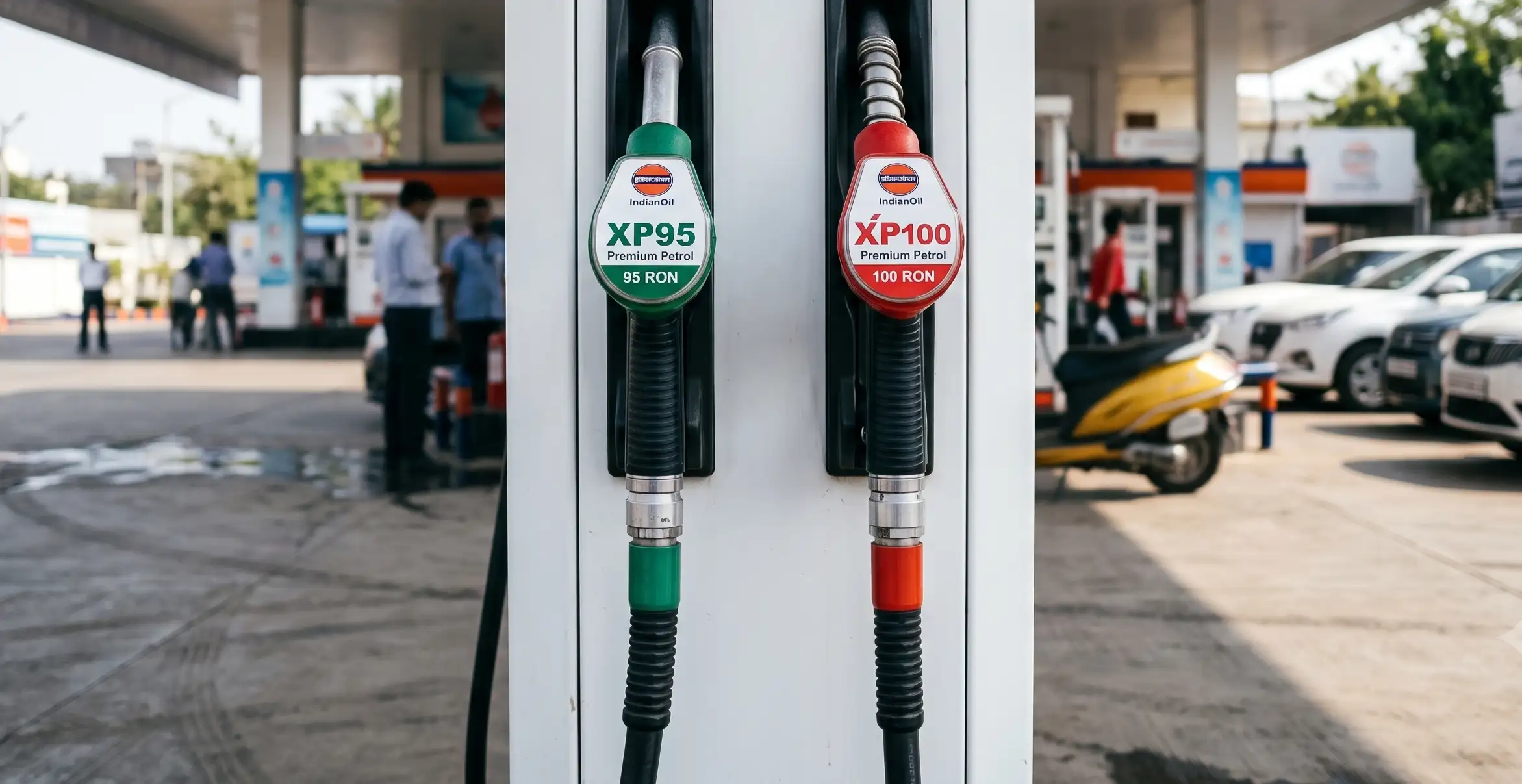
XP95 vs XP100, Which Petrol Is Right for Your Vehicle?
The most common question we see from Indian vehicle owners right now is a variation of this: "I heard XP95 is better than regular petrol. And is XP100 the one without ethanol? Should I be using that instead?" Both questions are understandable. Both usually get incomplete answers. XP95 and XP100 are sold side by side at IndianOil pumps, both carry the word "premium," both cost more than regular petrol, and both have been mentioned in the same breath as E20 confusion. But they are chemically different products built on different refining technologies, priced for different markets, and designed for engines that have almost nothing in common. This article separates the facts from the marketing. By the end, you will know exactly what is in each fuel, which engine types benefit from each, what you are actually paying for, and the one scenario where XP100 matters to riders and drivers who have never considered it before. Table of ContentsWhat XP95 Actually Is, and What It Is Not What XP100 Actually Is, the Ethanol-Free Fuel How RON Works and Why It Matters for Your Engine Which Vehicles Benefit from XP95 Which Vehicles Benefit from XP100 The Price Reality, What You Are Actually Paying For Where to Find XP100, and Why It Is Hard to Find SourcesWhat XP95 Actually Is, and What It Is Not XP95 is IndianOil's standard premium petrol grade. It carries a minimum Research Octane Number of 95 RON and is blended with approximately 20% anhydrous ethanol by volume. It is, in precise chemical terms, an E20 fuel, identical in ethanol concentration to regular petrol at the pump. This is not a speculation or an inference. An IndianOil RTI response confirmed it. Independent gas chromatography testing of IOCL's XP95, conducted per the ASTM D4815 standard and reported by Autocar India, found an ethanol content of 19.88% by volume. The regular petrol tested in the same batch showed 20.86%. The ethanol concentration in both fuels is effectively identical. What XP95 has that regular petrol does not is a proprietary additive package. The additives include advanced friction modifiers, corrosion inhibitors, and detergent compounds that IOCL claims deliver a 3.95% improvement in fuel economy, a 4% increase in power output, and a 20.15% improvement in acceleration compared to unadditised 91 RON fuel. These are IOCL's own figures from their official XP95 product page. The higher RON is achieved through the ethanol content itself, ethanol has a naturally high octane rating of approximately 108.5 RON, and at a 20% blend concentration it raises the overall anti-knock index of the fuel. What XP95 is not: it is not ethanol-reduced, it is not a protection fuel for BS4 or older vehicles, and it is not safer than regular petrol for fuel systems that are incompatible with ethanol. XP95 and regular E20 petrol carry the same ethanol load. The difference is in additives and octane, not in ethanol content. What XP100 Actually Is, the Ethanol-Free Fuel XP100 is a fundamentally different product. It is India's only commercially available 100 RON petrol and the only ethanol-free (E0) fuel available at standard retail pumps. Independent testing of IOCL's XP100 found an ethanol content of less than 0.2% by volume, effectively zero. Instead of ethanol, XP100 uses Methyl Tertiary-Butyl Ether (MTBE) as its primary oxygenate, at approximately 12.38% by volume. MTBE is a synthetic ether manufactured from methanol and isobutylene. Its pure RON ranges between 115 and 135, which is why even at a 12.38% blend concentration it can elevate the finished fuel to 100 RON. Unlike ethanol, MTBE does not absorb atmospheric moisture. It has low water solubility (approximately 4.2% by weight at saturation), does not form the ethanol-water azeotrope that triggers phase separation, and does not cause the elastomer degradation that makes ethanol problematic in older fuel systems. The production of XP100 depends on IOCL's proprietary Octamax technology, a refining process developed entirely by IndianOil's R&D Centre and commissioned at the Mathura Refinery in January 2018. The Octamax process converts C4 hydrocarbon streams (butanes and butylenes, byproducts of Fluid Catalytic Cracking units) into an ultra-high-octane gasoline blending component with a blending RON above 120. The first samples from the Mathura unit yielded a blending octane of 118, above the guaranteed 108 baseline. IOCL's R&D team won the National Technology Award in 2022 for this process under the category "Successful Commercialization of Indigenous Technology." The practical consequence of MTBE over ethanol for the vehicle owner: XP100 does not degrade in underground storage tanks at low-turnover stations the way ethanol-blended fuel does. It does not corrode nitrile rubber seals. It does not trigger phase separation during monsoon humidity spikes. And it carries more energy per litre than E20 blends, because it does not dilute the hydrocarbon base with the lower-caloric-value ethanol. How RON Works and Why It Matters for Your Engine RON, Research Octane Number, measures a fuel's resistance to auto-ignition under compression. In an internal combustion engine, the air-fuel mixture is compressed before the spark plug fires. A fuel that ignites prematurely from heat and pressure alone, before the spark, creates opposing pressure waves inside the cylinder. This is engine knock, or detonation. Prolonged detonation damages pistons, connecting rods, and valves. Modern engines, particularly turbocharged ones, are managed by ECUs that listen for knock via acoustic sensors. The moment knock is detected, the ECU retards ignition timing, firing the spark plug later in the compression stroke to prevent the fuel from auto-igniting. Retarded timing protects the engine but sacrifices efficiency: the combustion gases push on the piston at a less optimal angle, delivering less energy to the crankshaft. The engine produces less power and consumes more fuel to compensate. This is why RON matters. A higher-RON fuel gives the ECU more headroom before knock occurs. The ECU can maintain, or even advance, ignition timing, extracting more work from each combustion cycle. For engines specifically calibrated to use this headroom (high-compression, turbocharged engines with aggressive ECU maps), the difference between 91 RON, 95 RON, and 100 RON is a tangible performance and efficiency variable. For engines that are not calibrated to use the headroom, naturally aspirated, low-compression engines in commuter bikes and entry-level cars, using a higher RON fuel provides no measurable benefit. The ECU simply does not advance timing further than its calibrated limit, regardless of how much knock resistance the fuel offers. Standard petrol in India moved from 91 RON to a minimum of 95 RON with the E20 mandate from April 2026. Every fuel at the pump, including regular petrol, is now at least 95 RON. XP95 is 95 RON. XP100 is 100 RON. Which Vehicles Benefit from XP95 XP95 is the right fuel for the majority of modern Indian vehicles, with one important clarification. It delivers measurable value specifically to turbocharged petrol engines manufactured after April 2020 (BS6 Phase 1 and Phase 2). These engines have ECUs calibrated to use 95 RON fuel and will advance ignition timing optimally. The additives in XP95 provide genuine injector cleaning benefit for GDI engines, which accumulate carbon deposits faster than port-injection engines because fuel does not wash the intake valves. Team-BHP long-term testing of XP95 in a Skoda Slavia 1.5L DSG showed average urban fuel returns of 7.5 to 8.5 km/l, a measurable improvement over equivalent figures on standard 91 RON fuel in pre-E20 testing. Users of the Hyundai Creta 1.4 T-GDI, Tata Nexon 1.2 Turbo, and VW Taigun 1.0 TSI report similar patterns: smoother idle, reduced vibration under hard acceleration, and slightly better highway mileage compared to standard petrol. For motorcycles, XP95 is appropriate for BS6 Phase 2 bikes and high-compression single-cylinder performance bikes (KTM Duke 390, Bajaj Dominar 400, Royal Enfield 650 Twins, Suzuki Gixxer SF 250). These engines have ECUs that can use 95 RON effectively. XP95's detergent package also helps slow injector fouling on performance bikes that see high-RPM use. What XP95 does not do: it does not protect older fuel system components from ethanol degradation. A BS4 bike or a pre-2023 car running on XP95 is running on 20% ethanol, the same as regular petrol. The additive package does not neutralise ethanol's solvent effect on nitrile rubber, nor does it prevent phase separation. If your motivation for switching to XP95 is to reduce ethanol exposure, XP95 does not solve that problem. Which Vehicles Benefit from XP100 XP100's legitimate use cases are narrower and more specific than its pricing suggests. The first and most commercially significant case is high-compression performance vehicles. Cars like the Porsche 718 Cayman, BMW M-series, Audi RS models, and Volkswagen's EA888 Evo4-equipped models (Skoda Kodiaq, Octavia RS) frequently specify a minimum of 98 RON in the owner manual. Running these on E20 95 RON fuel forces the ECU into a double penalty: timing retardation from insufficient knock resistance, plus lower energy density from the ethanol content. XP100's 100 RON removes the first penalty and its E0 composition removes the second. Team-BHP testing in a Skoda Kodiaq reported efficiency figures jumping from 8.5 km/l on XP95 to over 10.2 km/l, and up to 13.9 km/l in light traffic, on XP100. These gains reflect the ECU recovering thermal energy that was previously being wasted through retarded timing. The second case is vintage and classic motorcycles and cars. Vehicles manufactured before approximately 2000, Royal Enfield Bullets of the iron-barrel era, Yezdi, Rajdoot, classic Ambassadors, imported classics, have fuel system components that predate any ethanol compatibility requirement. Nitrile rubber seals, untreated steel fuel tanks with original coatings, carburettor float bowls with zinc or magnesium alloys, and brass jets are all vulnerable to continuous E20 exposure. XP100 is the only commercially available pump fuel that provides E0 operation. For owners of these vehicles who cannot access E0 petrol through any other legitimate retail channel, XP100 is not a luxury, it is a preservation tool. The third case is long-term vehicle storage. Phase separation is the specific risk when a vehicle sits with an E20 tank for weeks or months. Ethanol absorbs moisture from the headspace, the concentration crosses the phase separation threshold, and a water-ethanol layer accumulates at the tank bottom. On recommissioning, this layer enters the fuel system with predictable damage. Filling a tank with XP100 before extended storage eliminates this risk because MTBE does not absorb atmospheric moisture the way ethanol does. One pattern documented in automotive forums is the "3:1 method": three refuels on regular E20 or XP95, one on XP100. This seeks to periodically flush accumulated ethanol residue from injectors and dilute the overall ethanol concentration across the fuel system without bearing the full cost of XP100 for every tank. It is not an OEM recommendation, but the chemistry of periodic flushing has a rational basis. What XP100 does not do: it provides no measurable benefit to naturally aspirated low-compression engines in commuter bikes (Hero Splendor, Honda Activa, Bajaj Pulsar 150) or standard sedans (Maruti Swift K12N, Hyundai Grand i10 1.2). These engines cannot advance timing further than their ECU's calibration ceiling, regardless of RON. Filling a Splendor with XP100 at Rs 160 per litre accomplishes nothing that regular petrol at Rs 105 does not, except drain your wallet. The Price Reality, What You Are Actually Paying For Fuel pricing in Pune in mid-2026 illustrates the economic gap clearly. Standard 91 RON petrol trades between Rs 103.82 and Rs 112.04 per litre. XP95 carries a Rs 3 to Rs 5 premium over standard petrol, placing it at approximately Rs 111.85 to Rs 115.66 per litre. XP100, unprotected by government price controls and burdened by Octamax process costs and imported MTBE, rose to Rs 160 to Rs 167.35 per litre following an Rs 11 single-day price hike triggered by global crude market volatility in early 2026. Check petrolprice.in for your city's current prices, these figures change with global crude and state VAT. For XP95, the cost-benefit is straightforward for turbocharged engines. The Rs 3 to Rs 5 premium per litre is partially or fully offset by the documented 3% to 4% mileage improvement in calibrated engines, and the long-term injector cleaning benefit reduces service costs. For naturally aspirated commuter engines, the premium buys nothing performance-related, though the additive package still provides some cleaning value. For XP100, the premium is 50% to 60% above standard petrol. For a high-performance car requiring 98+ RON, the calculation includes not just pump price but the mileage penalty of running the wrong fuel, an engine retarding timing and burning more E20 fuel may cost more per kilometre than XP100 at optimised timing. For a commuter bike or standard sedan, there is no legitimate cost justification. For a vintage vehicle owner using XP100 as a preservation measure, the cost is weighed against the cost of replacing corroded fuel system components, and corrosion typically costs more. One alternative that some enthusiasts attempt is aftermarket octane boosters, chemicals like Ferrocene, NMA (N-Methyl Aniline), or MMT added to XP95 to reach 100 RON equivalent. These do elevate the octane number but introduce metallic ash deposits on spark plugs, oxygen sensors, and catalytic converters. These deposits eventually trigger check-engine lights and require expensive sensor or catalyst replacement. Refinery-blended XP100 using ashless MTBE remains the only genuinely safe route to ultra-high octane at the pump. Where to Find XP100, and Why It Is Hard to Find XP100 is distributed exclusively through Company-Owned and Company-Operated (COCO) retail outlets, stations operated directly by IOCL rather than franchise dealers. This vertical integration allows IOCL to maintain quality control over a niche, high-value product and prevent adulteration. The trade-off is availability. In a country with over 100,000 fuel stations, XP100 is stocked at only a few hundred vetted locations. The practical implication is that finding XP100 requires planning. The most reliable official source is the Indian Oil One mobile application, which has a filter for XP100-stocked stations. In Pune, locations that the automotive community has mapped as consistent XP100 suppliers include Sure Petroleum in Erandwane and Sukhwani Petroleum in Wakad. Similar community-verified station lists exist on Reddit's r/pune and r/CarsIndia threads for other cities. Because XP100 is a low-turnover product at most stations, freshness is a genuine concern, not because MTBE degrades like ethanol does, but because any fuel sitting in a storage tank for months in adverse conditions can pick up trace contamination from the tank itself. Sticking to COCO pumps, which IOCL manages directly and which see higher accountability than franchise locations, is the practical mitigation. The Ethanol Fuel Finder on this site maps verified XP100 and HPCL Power 100 stations across India. HPCL's Power 100 is the direct equivalent of XP100 from a different OMC, 100 RON, E0, MTBE-based. BPCL's Speed 100 occupies the same category. If XP100 is unavailable near you, Power 100 or Speed 100 at an HPCL or BPCL COCO outlet is chemically equivalent. SourcesIOCL XP95, Official Product Page, IndianOil IOCL XP100 and Motorists Page, IndianOil How Much Ethanol Is in Your Petrol? Gas Chromatography Testing, Autocar India Even Premium XP95 Petrol Has 20% Ethanol, IOCL RTI Response, Cartoq Octamax Technology, IOCL R&D Leaflet, Mathura Refinery Commissioning IndianOil Commissions Octamax Unit at Mathura, Europétrole Experiencing 100 RON Fuel in My Skoda Kodiaq, Team-BHP Tried XP100 Petrol on My Slavia 1.5L DSG, Team-BHP High-Octane Petrol Prices Hiked, JM Financial Services, March 2026 E20 Petrol Row, What Is XP100, Is It Really Ethanol-Free?, LiveMint
- Editorial Team
- 13 Jul, 2026
Is XP100 Worth Using in a Standard Commuter Bike or Car?
When E20 confusion peaked after April 2026, XP100 went from being a niche product for supercar owners to a fuel that every BS4 bike owner started asking about. The reasoning was understandable: if regular petrol now has 20% ethanol and XP100 has none, should I be using XP100 to protect my older bike? The short answer is: it depends entirely on what engine you have, and for the majority of Indian riders and drivers, XP100 at Rs 160 per litre provides no measurable advantage over regular E20 at Rs 105. This article explains the engineering reason why, and the specific, narrow set of cases where XP100 does actually make sense. Table of ContentsWhy RON Only Helps If Your Engine Can Use It What Happens When You Put XP100 in a Splendor or Activa What About the Ethanol-Free Benefit for Commuter Bikes? Which Vehicles Are in the No-Benefit Zone The Cases Where XP100 Actually Makes Sense The Honest Cost Calculation SourcesWhy RON Only Helps If Your Engine Can Use It Every petrol engine has an ECU timing map, a set of instructions that tells the spark plug when to fire relative to the piston's position. This timing map is calibrated at the factory for a specific fuel grade. For most Indian commuter engines, that calibration is set conservatively, at or around 91 RON, because that was the standard fuel grade for decades. The ECU's job includes monitoring for engine knock via acoustic sensors. When knock occurs, the ECU retards timing as a protective measure. When the fuel's RON is high enough that knock does not occur at the engine's calibrated timing, the ECU simply holds at that calibrated timing, it does not advance further just because the fuel offers more knock resistance. This is the critical point. ECU timing advance is bounded at the top by the engine's mechanical design, not just by the fuel. A low-compression, naturally aspirated engine has a mechanical ceiling on useful ignition advance that the factory calibration already sits near. Providing 95 RON or 100 RON fuel to this engine does not push the ECU past that ceiling. The ECU sees that knock is not occurring, holds its calibrated timing, and nothing changes. The same power, the same mileage, the same combustion cycle, just a different fuel cost. What Happens When You Put XP100 in a Splendor or Activa Nothing measurable happens, in terms of performance or efficiency. A Hero Splendor 100cc engine has a compression ratio of approximately 9.5:1 and uses a simple carburettor. It was designed for 91 RON fuel and its carburettor jet sizing, needle position, and float level are calibrated for that fuel composition. There is no knock sensor, no ECU timing map, and no adaptive feedback mechanism. The engine will run on XP100. It will not knock on XP100. But it also will not produce more power, deliver better mileage, or clean its carburettor jets any better than it does on regular E20 petrol. The 100 RON anti-knock capability of XP100 is simply unused, the engine never approaches the conditions where additional knock resistance would matter. The Rs 55 per litre premium you pay for XP100 over regular petrol returns nothing. A Honda Activa 125 is a step up, fuel injected, BS6 Phase 2, slightly higher compression. But the ECU calibration for a 125cc scooter engine is still conservative. The factory timing map does not have aggressive advance that needs protecting. XP100 in an Activa returns the same result as in a Splendor: the engine runs fine, nothing improves. A Maruti Swift with the 1.2-litre K12N naturally aspirated engine is the four-wheeler equivalent. Compression ratio of 12.0:1, port fuel injection, no turbocharger. The K12N benefits from quality fuel and benefits from E20's 95 RON minimum, but it does not have the ECU headroom or the mechanical design to extract any additional value from 100 RON over 95 RON. IOCL's own framing of XP100 as a product for high-compression performance engines is implicitly an acknowledgement of this: the product page does not claim commuter car or bike benefits. What About the Ethanol-Free Benefit for Commuter Bikes? This is where the question becomes more nuanced. The RON argument is clear, no benefit for commuter engines. But XP100 is also E0, and E0 does protect fuel system components from ethanol degradation. Does that change the calculation for a BS4 Splendor owner who is worried about their nitrile rubber fuel hoses? The protection benefit is real in principle but the cost equation does not work for daily commuter use. A BS4 Splendor covering 40 km per day will use roughly 1.5 to 2 litres of petrol. At the Rs 55 per litre premium of XP100 over regular petrol, that is an additional Rs 82 to Rs 110 per day, or approximately Rs 2,500 to Rs 3,300 per month, purely to avoid ethanol exposure. For that same Rs 2,500 to Rs 3,300, you can replace all the nitrile rubber fuel hoses on a Splendor with Viton FKM equivalents, which are chemically resistant to E20 at any ethanol concentration, and have the job done for the next 20,000 km or more. The one-time material fix costs the same as one month of XP100 commuting and provides permanent protection. XP100 as a daily fuel for a commuter bike is the most expensive possible way to manage ethanol exposure, and not the most effective one. Viton hose replacement, fuel additives with corrosion inhibitors, and keeping the tank above 75% during monsoon months achieves more durable protection at a fraction of the ongoing cost. Which Vehicles Are in the No-Benefit Zone The no-benefit zone covers any vehicle where the engine's compression ratio and ECU calibration do not require more than 95 RON to maintain optimal timing. In practice this means: All carburetted engines, BS3, BS4, and any older vehicle. No knock sensor, no adaptive ECU, no timing advance to exploit. Naturally aspirated, low-compression petrol engines, the Maruti K10C and K12N, Hyundai 1.2 Kappa VTVT, Honda 1.2 i-VTEC in non-VTEC operation, Tata 1.2 Revotron naturally aspirated. These engines are calibrated for 91 RON and operate comfortably within 95 RON. Entry-level and mid-range motorcycles below 200cc, Hero Splendor, Honda Activa, TVS Jupiter, Bajaj Pulsar 150, TVS Apache RTR 160. Compression ratios and ECU calibrations do not require 100 RON. Standard commuter cars in the Rs 6 to Rs 12 lakh segment, Maruti Swift, Hyundai Grand i10 Nios, Tata Tiago, Honda Amaze. These are designed for cost-efficiency, not thermodynamic optimisation, and their engines reflect that priority. The Cases Where XP100 Actually Makes Sense There are four legitimate use cases for XP100, and they are all specific. High-compression performance vehicles that specify 98 RON or above in the owner manual. Porsche 718, BMW M-series, Audi RS models, Mercedes-AMG variants, Lamborghini, Ferrari. For these engines, running E20 95 RON causes measurable ECU timing retardation and a compound efficiency penalty, lower timing plus lower energy density from ethanol. XP100 removes both penalties. The cost premium is a fraction of the operating cost of these vehicles. Volkswagen Group EA888 Evo4 engines in India, the Skoda Kodiaq 2.0 TSI, Octavia RS, and similar. These engines use the Budack cycle and have aggressive ECU maps that can genuinely exploit 100 RON headroom. Team-BHP testing documented fuel economy jumping from 8.5 km/l on XP95 to over 10.2 km/l on XP100 in real-world driving, a gain that partially offsets the price premium. Vintage and classic vehicles with fuel systems that predate any ethanol compatibility standard. Carburetted Royal Enfields of the iron-barrel era, Yezdi, Rajdoot, Ambassador, imported classics. For these vehicles, XP100 is not a performance fuel, it is a preservation fuel. The E0 composition prevents ethanol-induced corrosion of period-correct rubber seals, brass carburettor components, and untreated steel tanks where the original coating has degraded. Long-term storage preparation. Any vehicle being stored for more than three to four weeks should have a full tank of XP100 before storage if ethanol exposure risk is a concern. MTBE in XP100 does not absorb atmospheric moisture the way ethanol does, eliminating the phase separation risk that E20 creates in a partially filled tank during extended parking. The Honest Cost Calculation At Rs 160 per litre for XP100 versus Rs 105 for regular E20 petrol, the premium is approximately 52%. That premium is only recovered through demonstrable gains, either performance gains from timing advance in a capable engine, or avoided repair costs from ethanol damage in a vulnerable fuel system. For a naturally aspirated commuter engine producing no timing advance gains, the premium is a pure loss. For a high-compression turbocharged engine recovering meaningful efficiency through optimal ECU timing, the gap in cost-per-kilometre narrows significantly and may justify the pump price difference. For a vintage vehicle where a single fuel system corrosion event could cost Rs 5,000 to Rs 15,000 in parts and labour, the premium buys genuine protection. The question to ask before filling with XP100 is not "is premium fuel always better?" It is "does my engine have a mechanism to use the additional RON, or does my fuel system have a specific vulnerability that E0 addresses?" If the answer to both is no, regular E20 petrol, or XP95 for its detergent additive benefit in GDI engines, is the right choice. SourcesIOCL XP100, Official Product Page IOCL XP95, Official Product Page and Performance Claims How Much Ethanol Is in Your Petrol?, Autocar India Should You Switch to XP100 Petrol Over Ethanol-Blended Fuel?, CRECKK Experiencing 100 RON Fuel in My Skoda Kodiaq, Team-BHP Used Full Tank of XP100 in My XUV700 Petrol, Team-BHP E20 Petrol Row, What Is XP100, Is It Really Ethanol-Free?, LiveMint High-Octane Petrol Prices Hiked, JM Financial Services, March 2026

-
 Ajit Khandekar
 - 13 Jun, 2026
Is XP95 Ethanol Free? The Myth Every BS4 Owner Needs to Stop Believing
XP95 is not ethanol free. It contains 20 percent ethanol, the same as standard petrol. This has been confirmed by an RTI filed with Indian Oil Corporation, independently verified by a laboratory gas chromatography test conducted by Autocar India, and corroborated by multiple Right to Information replies across cities. If you have been paying the XP95 premium believing it protects your BS4 or older vehicle from ethanol-related damage, you have been paying for additives while receiving identical ethanol exposure. This article presents the evidence, explains why the myth persists, and tells you what actually works. Table of ContentsIs XP95 Ethanol Free? The Evidence, RTI Replies and a Lab Test Why the Myth Persists What XP95 Actually Is What About Speed 95, Power 95, and Shell V-Power? What Should BS4 Owners Do Instead? The Only Ethanol-Free Option at Indian Pumps SourcesIs XP95 Ethanol Free? No. XP95 is E20 petrol. It contains 20 percent ethanol by volume, the same as standard petrol at every other pump in India. There is no reduced-ethanol or ethanol-free option available in the XP95 grade or any other sub-100-octane premium grade at Indian retail pumps. This is not ambiguous. It is not a matter of interpretation or regional variation. It is confirmed by the oil company itself through an official government transparency mechanism. The Evidence, RTI Replies and a Lab Test RTI Reply, IOCL, July 2025: A Right to Information application filed with Indian Oil Corporation in June 2025 asked two direct questions: what is the ethanol percentage in XP95 petrol sold in Kolkata, and what is the ethanol percentage in standard Motor Spirit sold in Kolkata. The reply, issued by IOCL's Public Information Officer on 3 July 2025, gave the same answer to both questions: 20 percent. XP95 and standard petrol contain identical ethanol content. A separate RTI filed earlier confirmed the same finding across Delhi outlets. IOCL's pan-India response has been consistent: XP95 is blended with up to 20 percent ethanol across India, depending on availability of ethanol at supply locations. The upper limit is 20 percent. There is no minimum-ethanol or ethanol-free XP95 variant. Gas Chromatography Lab Test, Autocar India, September 2025: Autocar India obtained fuel samples of standard petrol and XP95 from retail pumps and sent them for independent gas chromatography testing, the only scientifically reliable method for measuring ethanol content in fuel. The results were unambiguous. Standard petrol tested at 20.86 percent ethanol, slightly above the stated 20 percent, within blending tolerances. XP95 tested at 19.88 percent ethanol. Both grades are E20 fuels by any reasonable definition. Autocar India also tested XP100 and Power 100 from the 100-octane segment. Both returned zero percent ethanol, confirming that E0 status is genuine and exclusive to the 100-octane grades. The chromatography test is important because it eliminates the ambiguity created by water separation tests, a popular DIY method used by enthusiasts to detect ethanol in fuel. Water separation tests are unreliable. Fuel additives including MTBE can produce false positives, suggesting ethanol-free fuel when ethanol is present, or vice versa. The GC test is definitive. Why the Myth Persists Several factors reinforce the XP95-is-ethanol-free belief, none of them accurate. The price premium signals quality: XP95 costs more than standard petrol. Consumers reasonably infer that a premium price means a purer or higher-quality product. In terms of performance additives, that is partially true, XP95 contains a detergent and deposit-control additive package that standard petrol does not. But those additives have no bearing on ethanol content. The price premium reflects additive cost, not ethanol reduction. The name "XP95" sounds performance-oriented: "XP" implies extra performance. "95" appears to reference the octane rating. Neither part of the name says anything about ethanol content, but the branding positions the fuel as a cut above standard, leading buyers to assume it is better in every dimension. Oil companies initially gave contradictory answers: When vehicle owners contacted IOCL, BPCL, and HPCL on social media in 2025 asking about ethanol content in premium grades, some responses incorrectly stated that premium fuels contained E10 or E15. Those responses were inaccurate. The RTI mechanism and independent testing have since provided authoritative confirmation that all sub-100-octane grades are E20. Water separation tests produced confusing results: Home ethanol testing using the water separation method became popular on forums and YouTube in 2025. These tests frequently produced inconsistent results, sometimes suggesting low or zero ethanol in XP95, sometimes suggesting high ethanol. The inconsistency led some owners to conclude that XP95 had variable or lower ethanol content. The GC test confirmed this interpretation was wrong. The water separation method is not reliable for these fuels. What XP95 Actually Is XP95 is standard E20 petrol with a performance additive package. The additives serve real purposes: Detergent additives help prevent carbon deposits on fuel injectors and intake valves, particularly relevant for fuel-injected engines that accumulate deposits over time. Deposit-control chemistry helps maintain fuel system cleanliness in engines that see varied fuel quality or extended service intervals. The 95 RON octane rating is not meaningfully higher than standard E20 petrol. Before the E20 mandate, standard petrol in India had a RON of approximately 91. Blending 20 percent ethanol raises the octane rating to approximately 95 RON. Standard E20 petrol now meets the 95 RON minimum under BIS IS 2796. XP95 and standard petrol are both 95 RON fuels. The octane gap that once existed between them has been eliminated by the ethanol mandate itself. In practical terms: XP95 offers cleaner injectors and intake valves compared to standard petrol in fuel-injected engines. It offers no ethanol reduction, no corrosion protection from ethanol, and no mileage improvement beyond the small cleaning benefit for deposit-laden injectors. What About Speed 95, Power 95, and Shell V-Power? The same answer applies to all of them. Bharat Petroleum's Speed 97 contains 20 percent ethanol. BPCL confirmed this directly. Hindustan Petroleum's Power 95 contains 20 percent ethanol. Shell V-Power, sold at select Shell outlets in India, contains 20 percent ethanol. All premium petrol grades below 100 octane in India are E20. CarDekho independently confirmed this through oil company responses: there is no intermediate blending in India's retail fuel market. The choice is binary, standard E20 petrol, premium E20 petrol with additives, or 100-octane E0 petrol. There is no reduced-ethanol middle ground at any price point. What Should BS4 Owners Do Instead? The underlying concern driving XP95 purchases among older vehicle owners is legitimate: ethanol damages fuel system components in BS3 and BS4 vehicles not designed for it. That concern is real and well-founded. The solution, however, is not premium petrol. It is targeted maintenance. Replace nitrile rubber fuel hoses with Viton FKM equivalents. Nitrile rubber degrades under sustained ethanol exposure. Viton, also called FKM fluoroelastomer, is ethanol-resistant and is the appropriate replacement material. This is a one-time intervention that eliminates the primary mechanical risk. The relevant article on this site covers the replacement process in detail. Inspect and replace carburettor bowl gaskets at service intervals. The carburettor bowl gasket in a carburetted BS4 bike is typically nitrile rubber. It is inexpensive and accessible. At your next service, ask the mechanic to check its condition and replace it if there is any sign of swelling or degradation. Rejett the carburettor if misfiring. Carburetted engines running lean on E20, because ethanol has lower energy density than petrol, may exhibit rough idle, misfiring under load, or hesitation at partial throttle. Rejetting the carburettor corrects the air-fuel ratio for E20. This is a mechanic task, not DIY. It does not involve the ECU and applies only to carburetted engines. Establish a mileage baseline. Measure your kmpl over three full tanks using a consistent method. Knowing your actual mileage gives you a reference point. A drop of more than 10 to 15 percent from your pre-E20 baseline suggests a fuel system issue worth investigating, not simply the expected mileage reduction from ethanol. None of these steps involve premium petrol. The additive package in XP95 does not prevent ethanol-related seal degradation, does not reduce moisture absorption, and does not compensate for lean running in carburettors. The Only Ethanol-Free Option at Indian Pumps If you genuinely need ethanol-free petrol, for a vintage motorcycle, for long-term vehicle storage, or for a superbike with a 100-RON engine requirement, the options are XP100 from IOCL, Speed 100 from BPCL, and Power 100 from HPCL. All three are 100-octane, E0 fuel, confirmed ethanol-free by independent testing and RTI. They are available at select pumps in major cities and priced at approximately {{price_range_100}}. They are not practical for daily commuting on cost grounds. For daily use in a BS4 bike, targeted maintenance is the answer. For long-term storage or a vehicle that genuinely requires ethanol-free fuel, XP100 and its equivalents are the correct choice. XP95 is neither. It is E20 with additives. Use it for cleaner injectors if that matters to you. Do not use it as a substitute for ethanol-free petrol, because it is not one. SourcesIOCL RTI Reply, XP95 Ethanol Content 20%, July 2025, via Trak.in CarToq, IOCL Premium Fuel XP95 Confirmed 20% Ethanol, August 2025 Autocar India, How Much Ethanol Is in Your Petrol? GC Lab Test, September 2025 CarDekho, E20 Petrol Blending Explained: Which Grades Contain Ethanol Bureau of Indian Standards, IS 2796 E20 Petrol Specification, RON 95 Minimum CarToq, IOCL RTI XP100 Confirmed No Ethanol, September 2025
- Ajit Khandekar
- 12 Jun, 2026
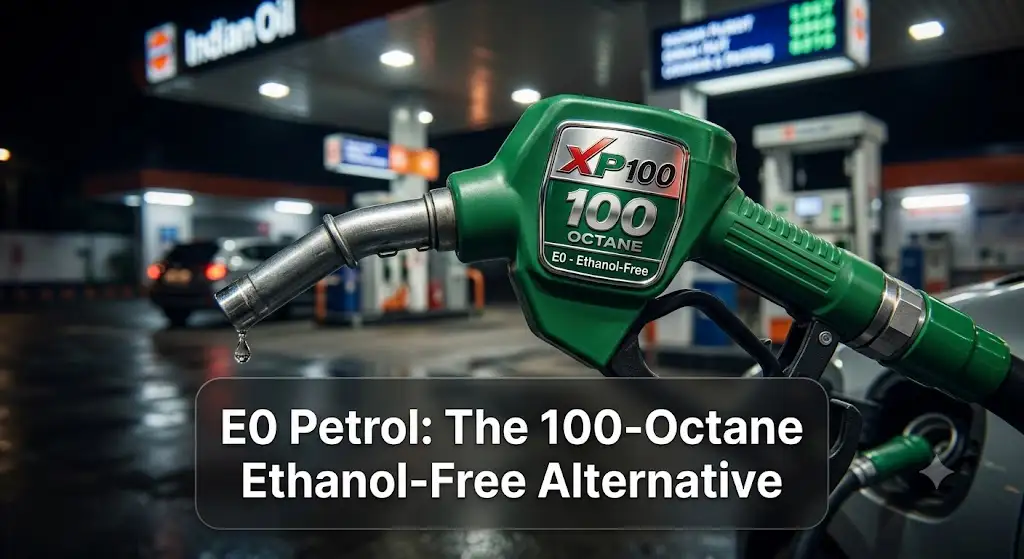
What Is E0 Petrol in India, XP100, Speed 100 and Power 100 Explained
Every standard petrol grade at every pump in India is now E20, blended with 20 percent ethanol. XP95, Speed 95, Shell V-Power, Power 95, Speed 97, all of them contain ethanol. There is no ethanol-free option in the standard or premium segments. But there is one category that remains E0: 100-octane petrol. XP100 from Indian Oil, Speed 100 from Bharat Petroleum, and Power 100 from Hindustan Petroleum are the only grades of petrol available at Indian retail pumps that contain zero percent ethanol. This article explains exactly what they are, where to find them, what they cost, and, critically, who actually needs them and who does not. Table of ContentsWhat E0 Petrol Actually Means The Three E0 Options in India Why Only 100-Octane Petrol Remains Ethanol-Free Where to Find E0 Petrol and What It Costs Who Should Use E0 Petrol Who Should Not Use E0 Petrol The XP95 Myth, and Why It Keeps Spreading SourcesWhat E0 Petrol Actually Means E0 is simply petrol with zero percent ethanol content. Pure petrol, refined from crude oil, with no alcohol blended in. Before India's ethanol blending programme began in earnest, all petrol was effectively E0. Today, E0 at a retail pump is the exception, not the rule, and it comes at a significant price premium. The E in E0, E10, E20, E85 refers to the percentage of ethanol in the fuel blend by volume. E0 is 100 percent petrol. E20 is 80 percent petrol and 20 percent ethanol. The number is not an octane rating, it is an ethanol content label. This distinction matters because many vehicle owners conflate ethanol content with fuel quality, assuming that premium-grade petrol must have less ethanol. That assumption is wrong, and it has led to a widespread misconception that is actively causing problems for older vehicle owners. E0 petrol has a higher energy content per litre than any ethanol blend. Ethanol contains roughly 34 percent less energy per litre than pure petrol. A litre of E0 delivers more potential energy to your engine than a litre of E20. This is why mileage on E0 is always higher than mileage on E20 in the same vehicle, regardless of the octane rating. The Three E0 Options in India XP100, Indian Oil Corporation (IOCL): Launched in December 2020, XP100 was India's first commercially available 100-octane petrol. It carries a Research Octane Number of 100 and contains zero percent ethanol. IOCL confirmed via a Right to Information reply that XP100 does not have ethanol blending, making it the most authoritatively documented E0 option currently available. XP100 is available at select IOCL pumps across major cities. Current pricing is approximately {{price_xp100}} depending on city and state taxes. Speed 100, Bharat Petroleum (BPCL): BPCL's 100-octane offering, available at select pumps across eight cities as of early 2026. Zero percent ethanol, 100 RON. Priced at approximately {{price_speed100}}. The fuel has been independently tested and confirmed ethanol-free. BPCL's own response on social media confirmed that Speed 97 contains E20, while Speed 100 remains E0, the distinction between the two grades is not just octane, it is ethanol content. Power 100, Hindustan Petroleum (HPCL): HPCL's 100-octane, ethanol-free grade. Available at select HPCL outlets. Pricing is approximately {{price_power100}}. Same fuel specification as the other two, 100 RON, E0. All three are functionally equivalent in their ethanol-free status. The minor differences in formulation, detergent additives, lubricity improvers, may vary by brand but the core specification is identical: 100 RON, zero ethanol. Why Only 100-Octane Petrol Remains Ethanol-Free This is the question most vehicle owners do not think to ask, and the answer explains the entire landscape. Ethanol blending raises the octane rating of petrol. Pure petrol without additives typically has a Research Octane Number of around 88 to 91. Blending in 20 percent ethanol raises that to approximately 95 RON, which is why all standard E20 petrol in India now meets the minimum 95 RON specification under BIS IS 2796. For premium grades like XP95, Speed 95, Speed 97, and Shell V-Power, the octane boost from ethanol actually helps meet their octane targets without additional refining costs. There is no technical barrier to blending ethanol into these grades, and no commercial incentive for the oil marketing companies to keep them ethanol-free. For 100-octane petrol, the situation is different. Achieving a genuine 100 RON requires either high-quality base refining, specific performance additives, or both. Blending ethanol at E20 levels into a 100-octane base would raise the RON further, creating a fuel above 100, not a problem in itself, but it would change the product specification and require re-testing and re-certification. More practically, the target market for 100-octane petrol is high-performance vehicles and superbikes whose owners have heightened sensitivity to fuel quality. Introducing ethanol into this grade may likely reduce demand. The oil marketing companies have chosen to keep 100-octane as E0. This is not a regulatory requirement. There is no BIS standard mandating that 100-octane petrol must be ethanol-free. It is a commercial and technical decision by IOCL, BPCL, and HPCL. In theory, E0 100-octane fuel could be withdrawn or reformulated at any point. Where to Find E0 Petrol and What It Costs E0 petrol is available in major cities only. It is not at every pump, it is at select high-traffic outlets and those near premium vehicle dealerships and motorsport venues. For XP100, IOCL has outlets in Delhi, Gurugram, Noida, Agra, Jaipur, Chandigarh, Ludhiana, Mumbai, Pune, Ahmedabad, Chennai, Bengaluru, Hyderabad, Kolkata, and Bhubaneswar among others. To find the nearest XP100 pump, search the IOCL fuel station locator on the IndianOil website and filter by fuel type. For Speed 100, BPCL outlets are currently in eight cities. For Power 100, check the HPCL pump locator. On cost: at approximately {{price_range_100}} versus Rs 100 to 110 for standard E20 petrol in most cities, E0 petrol carries a significant premium. On a 15-litre tank fill, that is Rs 600 to 900 extra per tankful. For daily commuting on a 150cc to 250cc bike doing 40 to 50 kmpl, that translates to approximately Rs 2,500 to 4,000 extra per month in fuel costs. For a 350cc to 500cc bike covering 25 to 35 kmpl, the monthly premium is Rs 1,500 to 2,500. The E0 Fuel Finder tool on this site is being developed to show verified E0 pump locations near you, initially covering Maharashtra with expansion planned. Who Should Use E0 Petrol E0 petrol is appropriate and practically justified for three categories of vehicle and use case. Long-term vehicle storage: This is the most unambiguous use case for E0. When a vehicle is stored for more than two weeks, during an extended trip, monsoon storage for a vintage bike, or simply a vehicle used only on weekends, E0 petrol eliminates the risk of phase separation. Ethanol in E20 absorbs atmospheric moisture during storage. If enough moisture accumulates, the ethanol-water mixture can separate from the petrol and settle at the bottom of the tank as a layer of dilute alcohol. This layer does not combust cleanly and can cause starting difficulty, rough running, and accelerated corrosion of the fuel tank interior. Filling with E0 before long-term storage prevents this entirely. Vintage and classic motorcycles with no retrofit available: Pre-BS3 bikes, Royal Enfield bullets from the 1980s and 1990s, Yezdi, Rajdoot, older Jawas, have fuel systems that were designed for pure petrol. Viton hose upgrades may not be available for all models, and carburettor rejetting alone does not address corrosion risk. For these vehicles, E0 petrol on a full-time basis is the most conservative approach to fuel system preservation. The price premium is justified by the cost and difficulty of replacing irreplaceable parts. High-performance superbikes with 100-RON engine requirements: Some superbikes, primarily imported litre-class motorcycles, have ECUs and compression ratios tuned for 100 RON fuel. Using lower-octane petrol in these engines can cause knock under high loads. XP100, Speed 100, and Power 100 are the correct fuel grade for these vehicles. The ethanol-free aspect is a secondary benefit; the primary reason to use them is the octane requirement. Who Should Not Use E0 Petrol This is the section that most people need to read most carefully. BS4 and BS6 commuter bikes and standard motorcycles: A standard BS4 Bajaj Pulsar, TVS Apache, or Yamaha FZ running on E0 petrol may not experience any performance improvement. These engines are not tuned for 100 RON, their compression ratios and ignition timing are calibrated for 91 to 95 RON fuel. Running 100 RON in a 91-RON engine does not produce more power, better mileage, or reduced wear. The only guaranteed outcome is a significantly higher fuel bill. The mileage improvement from E0 versus E20 in a standard bike is real, approximately 5 to 8 percent in a BS4 model, because E0 has higher energy density. But at Rs 50 to 60 extra per litre, that mileage recovery costs far more than the mileage lost. The arithmetic does not work for daily use. BS4 owners seeking to protect their fuel system from ethanol damage: This is the most important misconception to address. Some BS4 owners have concluded that filling with XP100 on every tankful will protect their fuel system from ethanol damage. This logic is correct in its premise, E0 eliminates ethanol exposure. But the solution is disproportionate to the problem. The correct response to ethanol-related fuel system concerns in a BS4 bike is targeted maintenance: replacing nitrile rubber hoses with Viton FKM equivalents, inspecting and replacing carburettor gaskets, and cleaning the fuel system at appropriate intervals. These interventions cost a fraction of the ongoing E0 fuel premium and address the actual failure modes directly. BS6 Phase 2 vehicles: These are factory E20-compliant. There is no fuel system risk from E20 in a BS6 Phase 2 vehicle. Using E0 petrol provides no benefit beyond the marginal energy density improvement, at a cost that makes no financial sense for daily use. The XP95 Myth, and Why It Keeps Spreading A separate article on this site addresses the XP95 misconception in full detail. The short version: XP95 contains 20 percent ethanol. It is E20. It is not ethanol-free, it is not lower-ethanol than standard petrol, and filling with XP95 instead of standard petrol provides no protection against ethanol-related fuel system damage in older vehicles. The misconception persists because the name "XP95" sounds premium, because it costs more than standard petrol, and because people reasonably assume that a more expensive fuel must be better in every dimension, including ethanol content. None of these assumptions are correct. IOCL confirmed via Right to Information that XP95 is blended with up to 20 percent ethanol pan India, the same as standard petrol. The only meaningful difference between XP95 and standard E20 petrol is the additive package, detergent and deposit-control additives that may help keep fuel injectors and intake valves cleaner. On ethanol content, they are identical. If you have been filling your BS4 or older vehicle with XP95 believing it to be ethanol-free, you have been paying a premium for additives while getting the same ethanol exposure as standard petrol. Switch to XP100 if you need genuine E0 petrol for storage or a vintage vehicle. If you are using a standard commuter or mid-range motorcycle daily, the maintenance approach is more cost-effective than any fuel premium. SourcesIOCL Right to Information Reply, XP100 Ethanol Content Confirmed, September 2025 Bureau of Indian Standards, IS 2796 E20 Petrol Specification, RON 95 Minimum CarDekho, E20 Petrol Blending Explained: Which Grades Contain Ethanol CarToq, Bharat Petroleum Speed 100 Ethanol Fuel Test, March 2026 IndianOil Corporation, XP100 Product Page Bharat Petroleum, Speed Fuels Official Page Ministry of Petroleum and Natural Gas, Ethanol Blending Programme